Repository navigation
Conversation




The Hotspot tile only switched the hotspot on and off; its long-press
opened the Wi-Fi picker, which says nothing about the hotspot itself. The
tile now has a chevron, like Wi-Fi and Bluetooth, and behind it a page
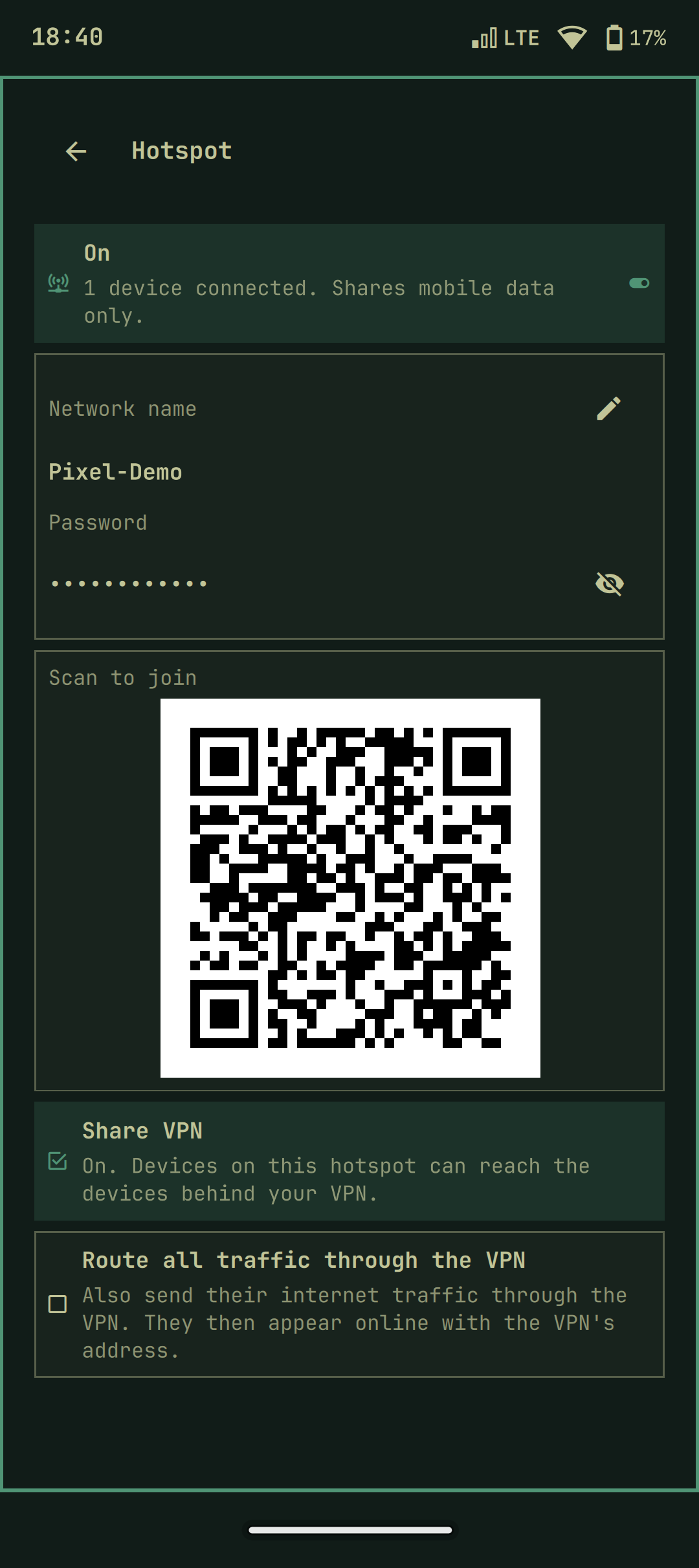
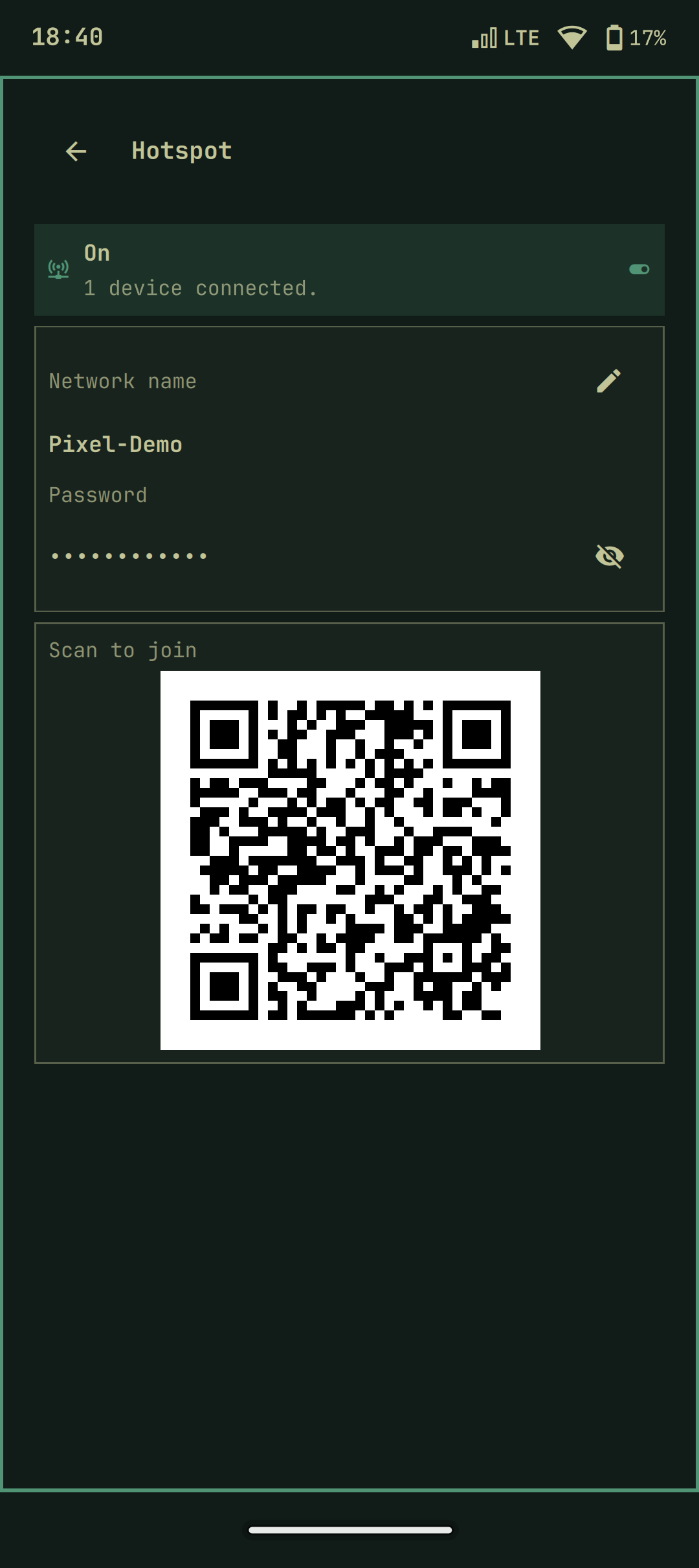
(HotspotPanel.qml): the switch with the number of connected devices, the
network name and the password (hidden, an eye shows it), a QR code that
joins another phone (the usual WIFI: string, drawn with qrencode, now a
dependency), and a pencil that makes name and password editable; a running
hotspot restarts with the new values.

Data and actions go through hotspot-panel.sh next to the page, as the
tiles' tile-state.sh and tile-action.sh. It reads NetworkManager's
"Hotspot" connection (the one tile-action.sh makes) and changes it with
`nmcli connection modify`. Two more boxes, "Share VPN" (devices on the
hotspot reach what the phone's VPN reaches) and "Route all traffic
through the VPN", are drawn only when the backend reports them:
NetworkManager's shared mode has no such switch, so they stay hidden
there. A device that brings its own hotspot (hostapd, its own firewall)
can answer the page's verbs from an executable at
/etc/omamobile/hotspot-backend (or ~/.config/omamobile/hotspot-backend)
and gets the boxes; the script still adds the QR code for it. This is
what the Pixel 9a runs today (its hotspot is hostapd on ap0, derekross#523), so
the whole page, boxes included, was used there; the NetworkManager path
is covered by the test.

The page is a layer-shell window of its own, like the Wi-Fi picker, with
the same back glyph, and `omarchy-shell shell summon
omamobile.quicksettings '{"page":"hotspot"}'` opens it.

Tests: test/hotspot-panel.sh (the NetworkManager state line, the QR code
drawn once and dropped after a change, name and password checks, a change
on a running and on a stopped hotspot, the VPN boxes refused there, no
qrencode, a device's own backend), and test/all checks that the tile's
chevron opens the page, that the page runs the script next to it and that
the password field is masked.

Co-Authored-By: Claude Fable 5.1 <noreply@anthropic.com>
Claude-Session: https://claude.ai/code/session_01176vSgL9PRmxFqbaB3D9vk


|
Thanks for this. It's a nice page, and the script is careful: the QR code drawn only when the string changes and kept private in the runtime directory, the name and password checked before any backend sees them, and a test that covers both a running and a stopped hotspot and a device's own backend. I checked that the default path needs no password prompt: NetworkManager's polkit rule lets local A few things before it can go in:
Smaller ones: Versions: main shipped 0.2.107 with #420 after you branched, and git merges your identical 0.2.106 → 0.2.107 line without a conflict, so I'll renumber at merge (likely 0.2.111, after #553, #557 and #542). If #553 lands first, this page should also get its swipe up from the bottom edge, so the three pages close the same way. |

- shareAvailable starts false and only a backend's share_available: true
  shows the VPN boxes, so they no longer flash on open or stay when the
  state line can't be parsed.
- "Shares mobile data only." is no longer shown for every backend: a
  backend that knows says where its devices' traffic goes in a new
  optional uplink_note; NetworkManager's gives none (its devices follow
  the phone's default route, a full-tunnel VPN included), and the
  stopped hotspot reads "Shares the phone's internet connection over
  Wi-Fi."
- qrencode gets the WIFI: string on stdin, keeping the password out of
  /proc/*/cmdline; the unused qr_escape() is gone.
- README: a Hotspot page section on hotspot-panel.sh and where a
  device's hotspot-backend comes from.

Co-Authored-By: Claude Opus 5.5 <noreply@anthropic.com>
|
Thanks for the careful read, and for checking the polkit side.
Smaller ones: Screenshots of the updated page, both with demo values from a stand-in backend: left a device's own backend (the boxes and its "Shares mobile data only."), right what the NetworkManager backend's state line gives (no boxes, no sentence after the device count):
Renumbering at merge and the swipe-up once #553 is in: both fine with me. |

|
Thank you for turning these around so quickly. Every point is answered, and well. The VPN boxes now wait for the backend to claim them. The One small thing in the test, not blocking: the fake What's left is on my side: the NetworkManager run on my 7 Pro. I'll open the page from the chevron and from a long-press, change the name and password with the hotspot off and on, and join a second phone from the QR code. I'll post the result here. Main has moved to 0.2.108 since your last push, so the version file now conflicts. No need to rebase for that: I'll set the next free number at merge (most likely 0.2.111, after #553 and #557), and if #553 lands first, I'll make sure this page gets the same swipe up to close. |
The owner asked that the full-screen pages behind quick settings' tiles
close the same way. The Wi-Fi and Bluetooth pages get a swipe-up strip
at their bottom edge in derekross#553; the Hotspot page now has the same one:
max(28, Style.space(36)) high, a swipe up past 24 px closes it, and the
page's body ends above the strip, so nothing on the page lies under it.

test/all on a PC: 304 ok.

Co-Authored-By: Claude Opus 5.5 <noreply@anthropic.com>
|
7b0b7a7 adds a swipe-up strip at the page's bottom edge, the same one the Wi-Fi and Bluetooth pages get in #553. That way all the full-screen pages behind the tiles close the same way, which is what I (the owner) asked for. The page's body ends above the strip. |
|
Thanks for adding the swipe up here too. I read it against #553's final Two things before this can go in, one for you and one for me:
One small thing for the merge, nothing for you to do: your first commit I'd like #553 to land first, so the three pages get the same strip in one |
…de fake tells arguments from stdin

Review of derekross#539. tests/grep-q-pipes (derekross#587) refuses a pipe into grep -q in a
script that sets pipefail: grep -q exits at the first match, the writer can
get SIGPIPE, and pipefail then fails the pipeline at random.
test/hotspot-panel.sh had eleven; they now use grep -c ... >/dev/null,
which reads all its input.

The fake qrencode logged its arguments and its stdin on one line, so the
check that the WIFI: string goes to qrencode on stdin passed either way. It
now writes "qrencode args:" and "qrencode stdin:" lines, and the test checks
that the string arrives on stdin, that the arguments are only the options,
and that the string is never an argument (it would show in
/proc/*/cmdline). With the script changed to pass the string as an
argument, the old test still passed and the new one fails.

Co-Authored-By: Claude Opus 5.5 <noreply@anthropic.com>
main is at omamobile-shell 0.2.115; this branch takes 0.2.116 so the
version file no longer conflicts and CI runs again. The final number is
set at merge.

Co-Authored-By: Claude Opus 5.5 <noreply@anthropic.com>
|
Thanks. Both points are in:
One thing I noticed while running it on the 9a: Fine with #553 going in first. |
|
Thanks, both points are in and I checked them: Main moved under you again this evening, in a way that matters for this
Two small things while you're there:
The NetworkManager run on my 7 Pro is still mine and still not done; I'll do |


What and why
The Hotspot tile only switched the hotspot on and off, and its long-press opened the Wi-Fi picker, which says nothing about the hotspot itself. This gives the tile a chevron, like Wi-Fi and Bluetooth, and a page behind it (
HotspotPanel.qml):WIFI:string, drawn withqrencode, a new dependency of omamobile-shell);Data and actions go through
hotspot-panel.shnext to the page, as the tiles go throughtile-state.shandtile-action.sh. By default it reads NetworkManager'sHotspotconnection (the onetile-action.shmakes) and changes it withnmcli connection modify. NetworkManager's shared mode has no switch for sharing a VPN, so the two boxes stay hidden there. A device that brings its own hotspot (hostapd, its own firewall) can answer the page's verbs from an executable at/etc/omamobile/hotspot-backend(or~/.config/omamobile/hotspot-backend) and gets the boxes, plus an optionaluplink_note(the sentence under the switch on where its devices' traffic goes; NetworkManager's backend gives none); the script still adds the QR code for it. The script's header documents the verbs and the state line.Why the boxes at all: on the 9a the hotspot is hostapd on
ap0(#523, #525), and sharing a VPN with the hotspot's devices turned out to be something you want to decide visibly, per device, not have as a side effect of the forwarding rules. The page is where that decision belongs, so the hook for it is here, without any device's own service in the shell.Follows the Wi-Fi and Bluetooth pages' pattern (its own layer-shell window, the same back glyph).
omarchy-shell shell summon omamobile.quicksettings '{"page":"hotspot"}'opens it, likewifiandbluetooth.(The network name and the password in the QR code are demo values set for these screenshots; the Wi-Fi tile's network is masked.)
Device and build
uname -r): 7.3.0-rc6-omamobile-push1-g7423da0736b1 (the test kernel from docs: add a roadmap for the Pixel 8 Pro (husky) #213's review, with the merged lens driver)Checks (no phone needed)
tools/pr-check origin/mainpassestests/allpasses (488 ok)tests/packagespasses (or the packages I touched: omamobile-shelltest/all, with the newtest/hotspot-panel.sh)versionbumped, and the new version is in the commit subjectCo-Authored-By:orAssisted-by:trailer, never aSigned-off-by:On the phone
ap0): open from the chevron and fromsummon, back to the sheet, the switch, the eye, the pencil with a name change and a password change (the hotspot restarted, a joined phone reconnected, the QR code followed the change), both boxes on and off. The NetworkManager path is covered bytest/hotspot-panel.sh(state, name and password change on a running and a stopped hotspot, the boxes refused, noqrencode, a device's own backend).test/quicksettings-render) for the new page, which I couldn't run here (no OWL container on this laptop).userdata, weakens the storage guard, or reads registers from userspace (AGENTS.md §1)The two
not okrows in the report are known on this phone and not from this change: the cpif lines come with the modem's start at boot, andomamobile-bt-addr@hci0is #512's neighbour (the bootloader address isn't where the unit looks).tools/phone-smokereportphone-smoke: tegu
Kernel
7.3.0-rc6-omamobile-push1-g7423da0736b1, tools at0e32235, 2026-11-08T22:03Z.Packages: hyprland 0.57.0-3.1, libcamera 0.7.2-4.22, mesa 1:26.2.4-1.4, omacam 0.3.3-1, omamessages 0.2.2-1, omamobile-apps 0.2.2-1, omamobile-audio 0.5.15-1, omamobile-device-tegu 0.2.9-1, omamobile-firstboot 0.1.3-1, omamobile-gnss 0.2.7-1, omamobile-keyring 20261026-1, omamobile-mirror 0.1.1-1, omamobile-mmd 0.1.2-1, omamobile-modem 0.1.16-1, omamobile-modem-sit 0.3.31-1, omamobile-omarchy 0.1.32-1, omamobile-owl-widgets 0.1.2-1, omamobile-sensors 0.2.1-1, omamobile-shell 0.2.100-1, omamobile-voice 0.1.0-1, omaphone 0.2.3-1, omarchy 4.0.6-1, omatel-agent 0.2.4-2, quickshell 0.3.2.r7.g2b4501a-1
🤖 Generated with Claude Code