


A C++ operating systems and hardware architecture simulator that models the complete Memory Management Unit (MMU) virtual-to-physical address translation pipeline, including Translation Lookaside Buffer (TLB) caching, page table walks, dirty-page disk write-backs, and interactive Raylib visualization. It executes FIFO, LRU, and Optimal (Bélády's) page replacement algorithms side-by-side on the same address trace to compare page fault rates and Effective Access Time (EAT).
- Live API & Class Documentation: Doxygen Documentation
- Overview & Architecture
- Page Replacement Algorithms
- Repository File Structure
- Prerequisites & Build / Run Instructions
- Reproducible Configuration & Input Trace
- Performance Metrics & GUI Output
- License
This project simulates the complete virtual-to-physical memory translation hierarchy:
| Component | Source Files | Function |
|---|---|---|
| TLB (Translation Lookaside Buffer) |
TLB_table.h, TLB_table.cpp
|
Fast associative cache for recent Virtual Page Number (VPN) |
| Page Table & Frame Manager |
Page_frame.h, Page_frame.cpp
|
Full VPN valid and dirty bit tracking ( |
| Physical RAM Simulation |
Ram_memory.h, Ram_memory.cpp
|
Byte-addressable physical memory array storing active page frames. |
| Backing Store (Hard Disk) |
HardDisk.txt (generated/read at runtime) |
Persistent backing store for page-fault loads and dirty-page eviction write-backs ( |
| Interactive GUI Visualizer |
mem_visualization.h/.cpp, Drawer.h/.cpp
|
Raylib graphical dashboard comparing FIFO, LRU, and Optimal hit/fault metrics and step-by-step frame allocations. |
┌─────────────────────────────────────────────────────────┐
│                     Virtual Address                     │
│              ┌──────────────┬──────────┐                │
│              │     VPN      │  Offset  │                │
│              └──────┬───────┴─────┬────┘                │
│                     │             │                     │
│              ┌──────▼──────┐      │                     │
│              │     TLB     │      │                     │
│              │  (Cache)    │      │                     │
│              └──┬───────┬──┘      │                     │
│            Hit  │       │ Miss    │                     │
│              ┌──▼───────▼──┐      │                     │
│              │ Page Table  │      │                     │
│              │ (FIFO/LRU/  │      │                     │
│              │    OPT)     │      │                     │
│              └──────┬──────┘      │                     │
│                     │ Frame #     │                     │
│              ┌──────▼─────────────▼───┐                 │
│              │         RAM            │                 │
│              │  memory[frame][offset] │                 │
│              └──────────┬─────────────┘                 │
│                         │ Dirty eviction                │
│              ┌──────────▼─────────────┐                 │
│              │     HardDisk.txt       │                 │
│              │    (Backing Store)     │                 │
│              └────────────────────────┘                 │
└─────────────────────────────────────────────────────────┘
The simulator executes three replacement strategies independently on the same address stream:
-
FIFO (First-In, First-Out)
-
Policy: Evicts the oldest resident page frame in physical memory using a queue (
std::list). -
Audit Log: Writes step-by-step frame transitions to
FIFO_logging.txt.
-
Policy: Evicts the oldest resident page frame in physical memory using a queue (
-
LRU (Least Recently Used)
-
Policy: Evicts the page frame whose last reference is furthest in the past using an
$O(1)$ hash map (std::unordered_map) coupled with a doubly linked list. -
Audit Log: Writes eviction traces to
log.txt.
-
Policy: Evicts the page frame whose last reference is furthest in the past using an
-
OPT (Optimal / Bélády's Algorithm)
- Policy: Pre-scans the future address trace buffer and evicts the page frame whose next reference is furthest in the future (establishing the theoretical lower bound on page faults).
-
Audit Log: Writes eviction traces to
OPT_logging.
Memory-Simulator-System/
├── OS_project.cpp                 # Main entry point; runs FIFO, LRU, and OPT and launches GUI
├── Virtual_Memory_manager.h/.cpp  # Orchestration logic for the three simulation modes
├── TLB_table.h/.cpp               # TLB cache lookup, replacement, and hit/miss counters
├── Page_frame.h/.cpp              # Page table translation, dirty-bit tracking, and disk I/O
├── Ram_memory.h/.cpp              # Physical memory frame array and Page_frame_node structs
├── FileConfiguration.h/.cpp       # JSON config parser and hexadecimal address stream reader
├── ADRESS_POP.h/.cpp              # Address stream preprocessing utilities
├── mem_visualization.h/.cpp       # Raylib GUI window and comparative chart controller
├── Drawer.h/.cpp                  # Frame table and metric rendering primitives
├── Parameters.json                # Simulation configuration parameters (frames, TLB size, latency)
├── OS_project.slnx / .vcxproj     # Visual Studio 2022 solution and project files
├── docs/                          # Generated Doxygen HTML/LaTeX documentation
└── LICENSE                        # MIT License
The project includes a Visual Studio 2022 solution (OS_project.slnx / OS_project.vcxproj) configured with NuGet (packages.config) for raylib.5.5.0:
- Clone the repository:
git clone https://github.com/usman-irshad1/Memory-Simulator-System.git
cd Memory-Simulator-System
- Open
OS_project.slnx(orOS_project.vcxproj) in Visual Studio 2022. - Right-click the solution in Solution Explorer and select Restore NuGet Packages.
- Ensure
Parameters.jsonand an input trace file (addresses.txt) are present in the working directory, then pressCtrl + F5to build and launch.
g++ -std=c++17 -O2 OS_project.cpp Virtual_Memory_manager.cpp TLB_table.cpp Page_frame.cpp Ram_memory.cpp FileConfiguration.cpp ADRESS_POP.cpp mem_visualization.cpp Drawer.cpp -o MemorySimulator -lraylib -lopengl32 -lgdi32 -lwinmm
./MemorySimulator1. Checked-In Configuration (Parameters.json)
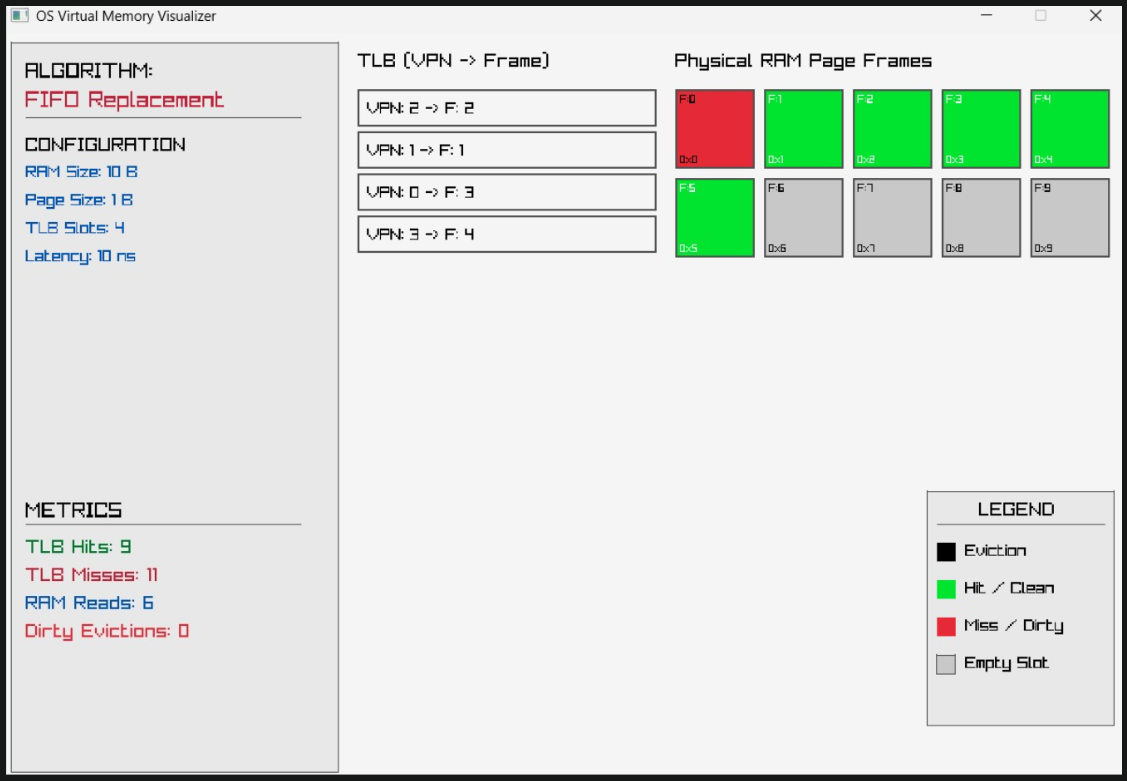
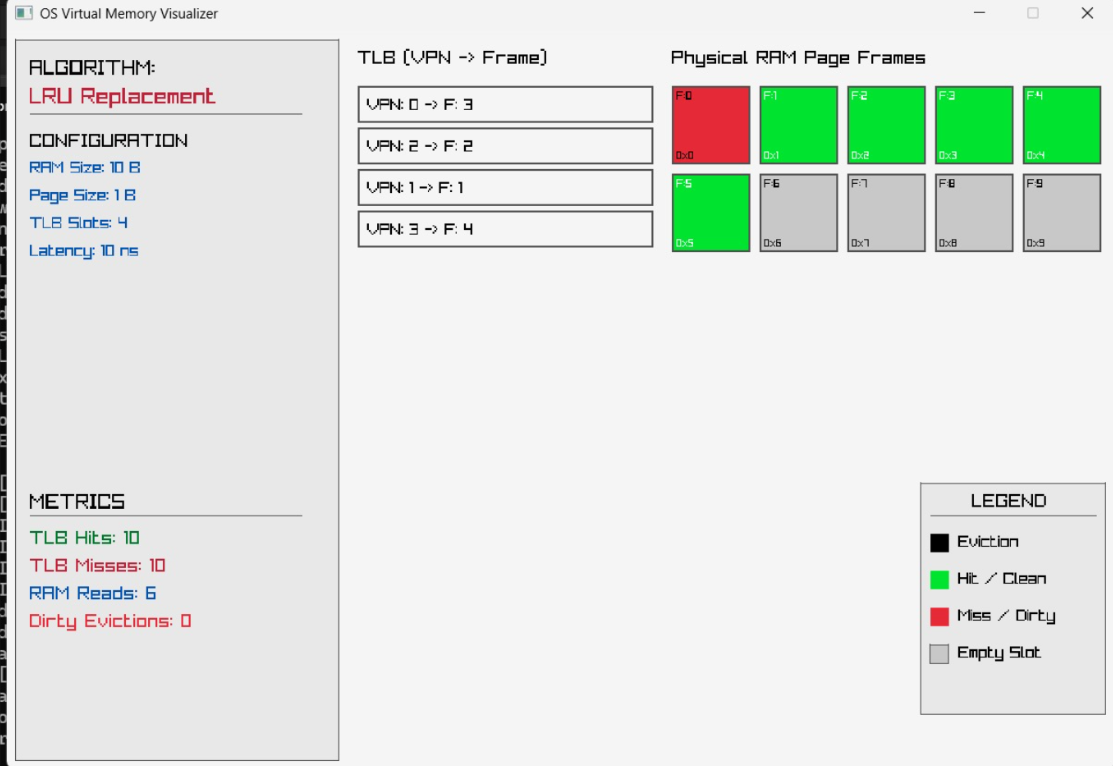
To reproduce the 4-page-frame GUI comparison screenshots shown below, Parameters.json is configured with 4 physical frames (physical_size: 4, page_size: 1) and a 4-entry TLB:
{
    "physical_size": 4,
    "page_size": 1,
    "TLB_size": 4,
    "virtual_size": 18446744073709551615,
    "latency": 10
}
(You can also scale physical_size to 40960 and page_size to 4096 to simulate 4 KB pages across 40 KB of RAM).
Create or edit addresses.txt in the project root with one hexadecimal virtual address and access mode (R for Read, W for Write) per line:
0x0001 R
0x0002 W
0x0003 R
0x0004 R
0x0001 R
0x0005 W
0x0002 R
0x0006 R
0x0003 W
0x0004 R
The simulator computes Effective Access Time (EAT) across all requests:

- FIFO Replacement Trace:
- LRU Replacement Trace:
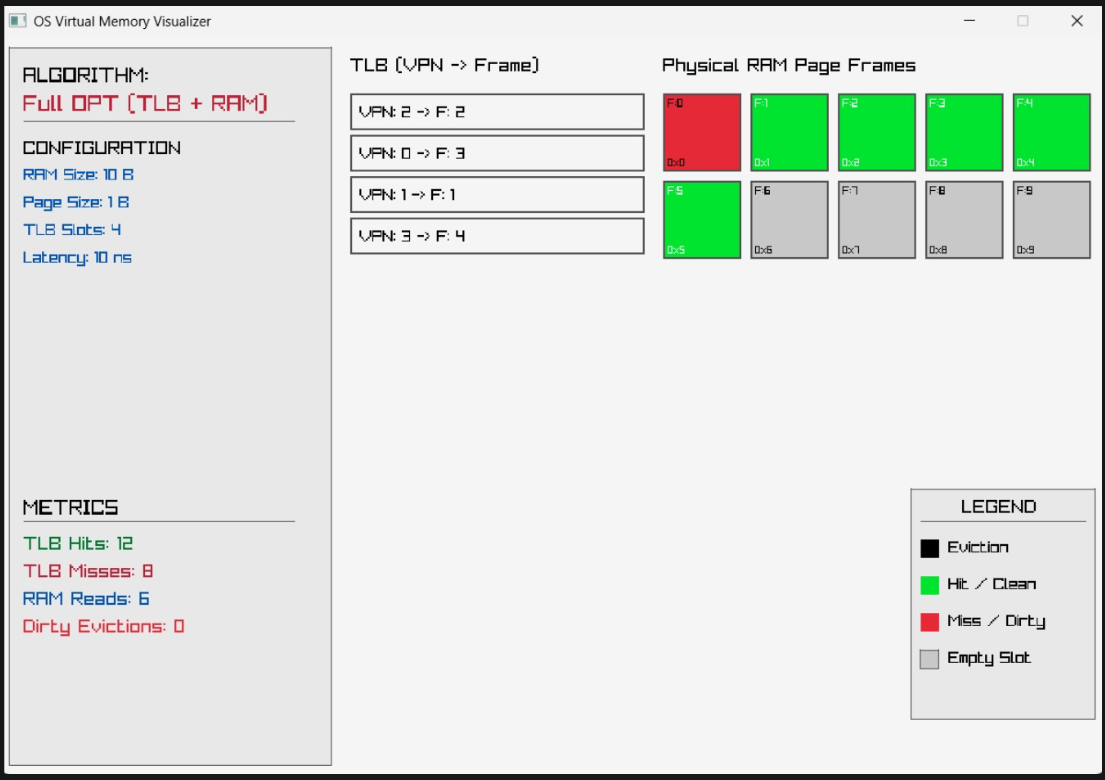
- Optimal (OPT) Replacement Trace:
This project is distributed under the MIT License.