








The Sentimental Analyzer Pro is a versatile tool that can perform sentiment analysis on different types of data, including text, audio, reviews, and news articles. Sentiment analysis is one of the fastest-growing research areas in computer science, making it challenging to keep track of all the activities in the area. In our project, we aim to achieve our goal of accurately predicting a user's sentiment by analyzing the data provided using different types of input data.
- Introduction
- Sentimental Analyzer Pro Features
- How to use Sentimental Analyzer Pro?
- How to setup local docker?
- Roadmap and Progress
- Case Study
- Contributing to the product
- Connect with us
- Team Members
Sentiment analysis, also known as opinion mining, is the process of determining the sentiment or emotional tone in a piece of text, audio, or other forms of data. It involves identifying whether the sentiment expressed is positive, negative, or neutral.
- Sentiment analysis can help businesses and organizations understand how their customers or users feel about their products, services, or experiences.
- Companies can gauge public opinion about their products or services, track trends, and identify emerging issues or opportunities in the market.
- News agencies and media companies use sentiment analysis to analyze public sentiment towards news articles or events. This helps in generating content that aligns with the interests of the audience.
- Sentiment analysis is used in politics to understand public sentiment towards political candidates, parties, or policies. It is also used to gauge public opinion on social issues.
The Sentimental Analyzer provides the following:
- Comprehensive Insights: Different types of data sources provide diverse perspectives. An all-encompassing tool can provide a more comprehensive understanding of public sentiment.
- Multichannel Data Analysis: In today's world, opinions and sentiments are expressed across various channels, including social media, customer reviews, audio recordings, and news articles. A tool that can analyze these diverse data sources offers a more accurate picture of public sentiment.
- Cost-Efficiency: Instead of using multiple specialized tools, a single tool that can handle multiple data types is cost-effective and streamlines the analysis process.
- Businesses and Organizations: Analyze customer feedback and social media mentions to improve products and services.
- Researchers and Academics: Study trends and public opinion in large datasets.
- Media and News Agencies: Gauge public sentiment towards news articles and events.
- Marketing Professionals: Track campaign effectiveness and tailor strategies.
- Developers and Data Scientists: Integrate sentiment analysis into applications.
- Educational Institutions: Use for academic projects and research.
- Python3
- Django
- HTML
- CSS
- Scrapy
- Vader Analysis Tool
- Tensorflow
- Clone this project:
- Create a
sentimental_analysis/.envfile and add the following environment variables (at least): -
Make sure you are using Python 3.10 or higher. You can get it here: https://www.python.org/downloads/release/python-3115/
-
Create a Virtual Environment
- Add environment variable
- Install dependencies for the project from the root directory of the project:
- Install ffmpeg (you may need to restart your terminal/IDE after this step):
For Windows: - Run Django Server migrations manage.py (Note: Make sure you are in root directory of the project.)
- Run Django Server using manage.py (Note: Make sure you are in root directory of the project.) Service now can be discovered from any device in the local network.
-
Next, open your browser and type in
localhost:8000in the search bar to open the user interface of the application. You may also access the server with other device in the local network with<host_ip>:8000 -
To install the chrome extension, go to Chrome, then Manage Extensions. Make sure "Developer Mode" is enabled, and click "Load Unpacked". Select the
extension/folder in the root directory of the project. This will load the extension into your browser. To update it simply make changes in the filesystem then click the reload button in the extension page. -
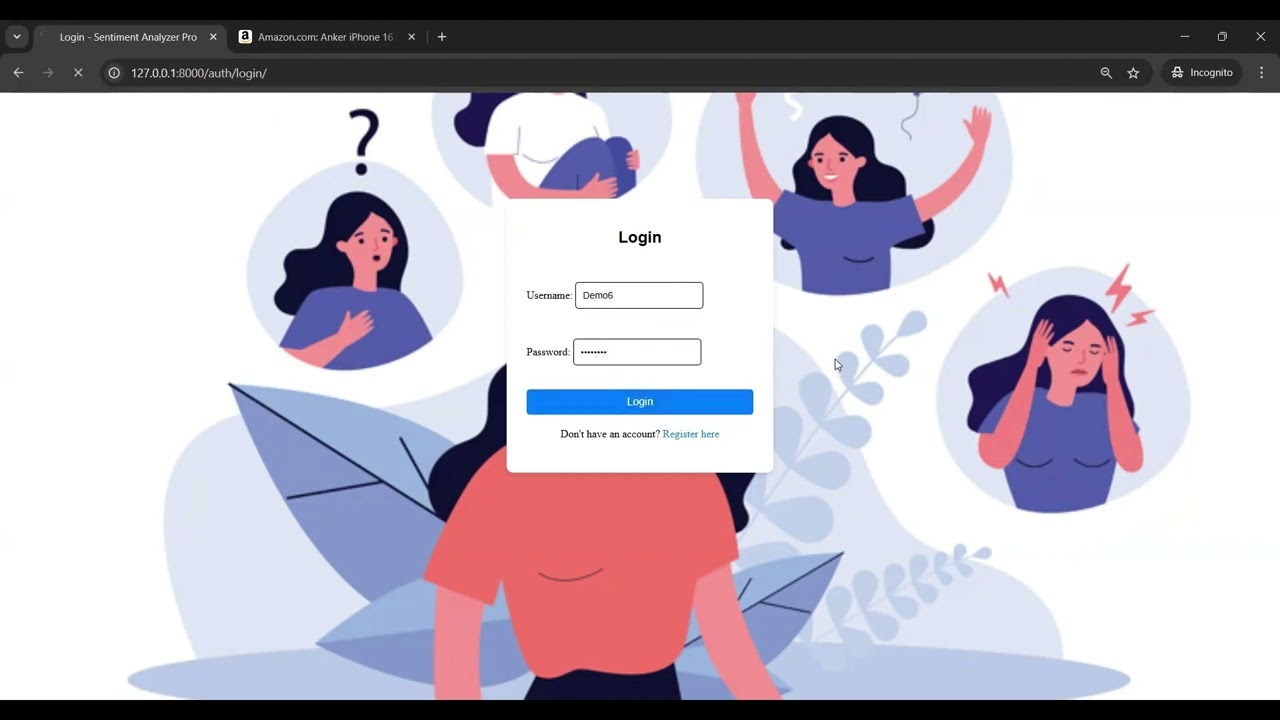
Start the django server to get to the homepage

-
Facebook Analysis

-
Product Analysis
%20(2).gif)
-
Twitter Analysis

-
Text Analysis

-
Image to Document

-
Reddit Analysis

-
Update User Profile

-
Retrieve History

- Build a docker image from the Dockerfile in the repo
- Run the image
- Next, open your browser and type in
0.0.0.0:8000in the search bar to open the user interface of the application. - Implement User Authentication to store the login history of each User
- Visualize the sentiment distribution by each user comment for product analysis
- Upgraded news analysis by transitioning from Google Search to Google News scraping, yielding more relevant insights
- Public facing webpage to get feedbacks, Raise and handle issues, Discuss & Grow with enthusiasts and supportive community
- Docker-Ready Deployment for seamless deployment across any platform with our containerized solution
- Intelligent Caching System to reduce redundant API calls
- Process multiple texts simultaneously with our new batch analysis feature
- Added profile management mechanism for users to update their profiles
- Implemented privacy policy to ensure user data protection
- Introduced "Right to be Forgotten" feature allowing users to delete their data
- Provided opt-out options for users who do not wish to participate
- Enabled "Delete My Data" feature for users to remove their data from the system
- Developed analysis history feature to track user interactions
- Established a user data storage mechanism
- Added a chrome extension to analyze the sentiment of any text on the web
- Supports analyzing both highlighted text and entire webpages
- Added a feature to analyze the transcript or comments of a YouTube video
- FULLY revamped the analysis history page to include extremely clean UI with sentiment previews, and a delete option
- Added data management feature to export analysis history
- Enhanced UI/UX for a more responsive, mobile-friendly, and more generally user-friendly design
- Real-Time Text Analysis: Type or paste text into a live window for instant sentiment analysis!
- Topical Analysis: Scrape the overall sentiment of a topic on news or social media platforms
- Tokenized Analysis: Visualize how each part of the text contributes to the sentiment
- Application Settings: Implement the settings page to create a configurable user experience
- Brandon Troy
- Chris Elchik
- Kanchana Dhana Sadasivan
Sentimental Analyzer Pro is designed for a diverse range of users:
This tool is suitable for adults of all ages, genders, and demographics who need to understand sentiment in various data forms.

The complete development was achieved using the following technologies:
Although HTML and CSS are used for the front end, the users can merge the backend logic with any of the front end frameworks they wish to use such as React, and AngularJS.
| Feature | Description |
|---|---|
| Product Analysis | Sentimental analysis of Amazon product reviews |
| News Analysis | Sentimental analysis of any recent news topic |
| Text Analysis | Sentimental analysis of text input |
| Audio Analysis | Sentimental analysis of audio file |
| File Analysis | Sentimental analysis of text file |
| Live Sentimental Analysis | Sentimental analysis of live recorded audio |
| Facebook Post Analysis | Sentimental analysis of Facebook Post |
| Twitter Post Analysis | Sentimental analysis of Twitter Post |
| Reddit Post Analysis | Sentimental analysis of Reddit Post |
| YouTube Video Analysis | Sentimental analysis of a YouTube video's transcript or comments |
| Website Analysis | Sentimental analysis of any website text with a native, embedded experience via a custom Chrome Extension |
git clone https://github.com/NCSU-SE-Spring2025-Group6/Sentimental-Analyzer-Pro.git
REDDIT_CLIENT_ID=...
REDDIT_CLIENT_SECRET=...
REDDIT_USER_AGENT=...
YOUTUBE_API_KEY=...
SECRET_KEY=...
SCRAPEOPS_API_SECRET=...
For Windows:
python -m venv env
env\Scripts\activate
For Linux (Ubuntu) and Mac:
python3.10 -m venv env
source env/bin/activate
For Windows:
set DJANGO_ALLOWED_HOSTS=0.0.0.0,localhost,127.0.0.1
For Linux (Ubuntu) and Mac:
export DJANGO_ALLOWED_HOSTS=0.0.0.0,localhost,127.0.0.1
pip3 install -r requirements.txt
python -c "import nltk; nltk.download('punkt'); nltk.download('stopwords'); nltk.download('averaged_perceptron_tagger')"
winget install ffmpeg
For Linux (Ubuntu):
sudo apt install ffmpeg
For Mac:
brew install ffmpeg
'''
brew install ffmpeg
python3 .\sentimental_analysis\manage.py makemigrations
python3 .\sentimental_analysis\manage.py migrate
python3 .\sentimental_analysis\manage.py runserver 0.0.0.0:8000
Now, you are good to go.

To run the frontend tests, use the following command:
python3 sentimental_analysis/manage.py test realworld
To run the backend tests, use the following command:
pytest


%20(2).gif)


docker build -t sentimental-analysis .
docker run -p 8000:8000 sentimental-analysis
To Contribute to our application, please refer to CONTRIBUTING.md
This project is a fork of Sentimental-Analyzer-Pro
Forked on: 7 March 2025
Original Commit Hash: 931311ba3497134f32e1e459de7bb5baf6cdea6c
Note: This is an unfunded, non-profit project created for educational purposes.