
A modern, high-performance C++ robotics and game engine powered by Vulkan and Slang.

Unhuman Environment & Game Editor
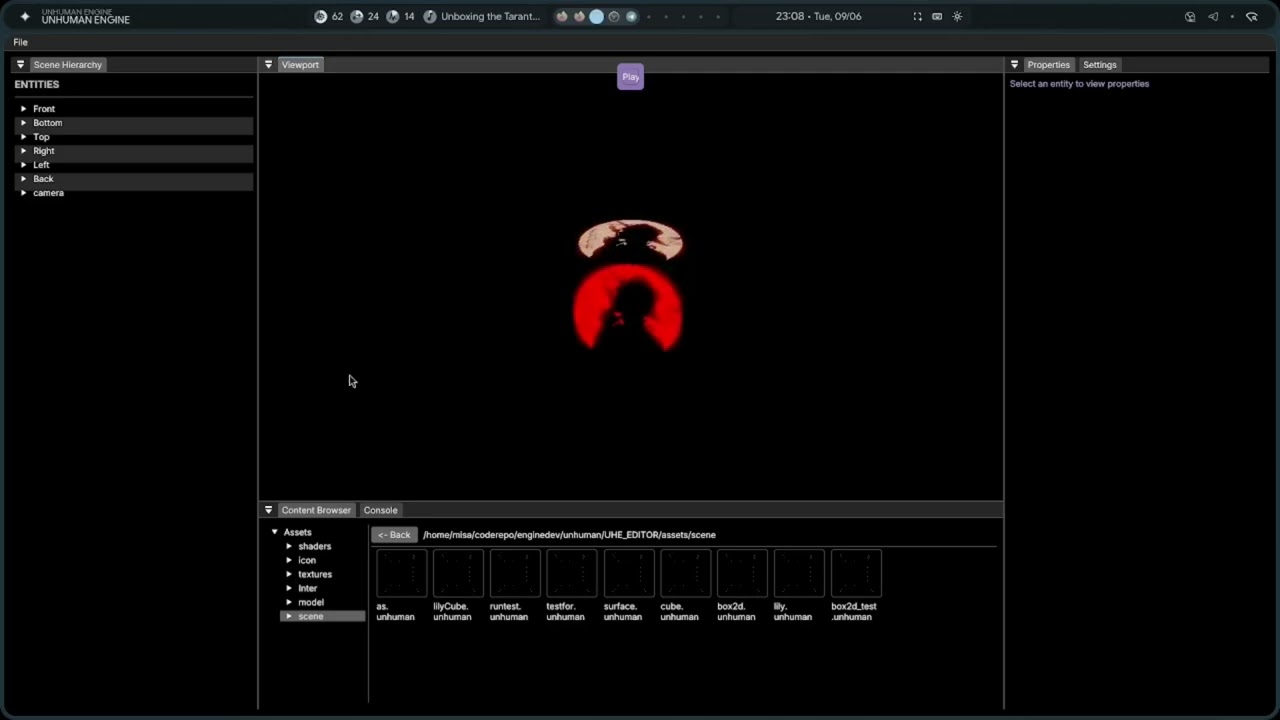
Real-time Simulation, Kinematics & Gameplay Demo
Unhuman Engine (UHE) is a lightweight, highly extensible C++ engine designed for real-time robotics applications, synthetic data generation, embodied AI, and game development. It utilizes a modern Vulkan RHI backend, compiles compute and rendering shaders via Slang, and features a fully integrated ImGui editor for environment authoring, gameplay prototyping, and robot introspection.
- Modern Graphics Backend: Fully abstracted Render Hardware Interface (RHI) running on Vulkan, optimized for high-fidelity sensor rendering (RGB, Depth, Segmentation).
- Slang Shader Compiler: Next-generation shading language support for accelerating robot perception algorithms and compute workloads via SPIR-V.
- Multi-Threading: High-performance Job System and Task Graph architecture for parallel execution of complex multi-agent simulations.
- Text & HUD Rendering: Crisp MSDF text rendering for on-screen telemetry, spatial UI, and diagnostic overlays.
- UHE Editor: A robust, dockable ImGui-based editor (
UHE_EDITOR) for scene inspection, kinematic profiling, and asset management. - Entity Component System: A fast, data-driven scene system (
entt) supporting native script components, massive robot swarms, and deterministic serialization. - 2D & 3D Physics Dynamics: Integrated rigid-body physics handling with
Box2DandJolt(upcoming) for accurate locomotion, grasping, and collision simulation. - AAA Dependency Management: No bloated submodules. The engine fetches precompiled binaries (Slang, GLFW) automatically for rapid environment deployment.
- Cross-Platform Tooling: Generates Ninja builds for Linux (ROS compatibility environments) and Visual Studio 2022 solutions for Windows with a single click.
- Core Job System: Implemented a robust JobSystem and TaskGraph for multi-threading.
- Text Rendering: Added comprehensive MSDF text rendering capabilities within the Vulkan backend.
- Vulkan Enhancements: Setup Vulkan sync2 fallback and implemented improved texture fallback safety.
- Engine Stability & Fixes: Fixed MSVC linker issues, UTF-8 decoding mismatches, and asset loading for standalone distribution.
- Vulkan Refactor & AMD Stability: Resolved texture dynamic indexing validation issues on AMD/RADV drivers by manually binding texture slots in Slang.
- Color Accuracy & Aesthetics: Restored pure black ImGui docking themes and fixed sRGB gamma-correction bugs that were washing out linear textures.
- Improved UI Workflows: Added full Drag-and-Drop payload support for textures directly into the 3D Viewport and Scene Hierarchy component inspectors.
The repository is logically split to ensure the core engine remains separate from the application logic:
UHE/— The core engine, platform abstraction (Windows/Linux), Vulkan RHI, and vendor libraries.UHE_EDITOR/— The standalone editor application built for scene authoring and robot introspection.sandbox/— A lightweight testing application for running isolated control logic and environments.script/Setup.py— The automated dependency fetcher that pulls heavy OS-specific binaries (like Slang) intoUHE/vendor/bin/.docs/— Design docs, architecture notes and the work order. Start atdocs/README.md; the roadmap isdocs/ROADMAP.md.
IDEA.md— what the engine is, why it exists, and its hard constraints.docs/ROADMAP.md— milestones, issue map and the open decision register.docs/architecture/— sync/tiers, render graph, job system, assets & audio, CI/CD.CONTRIBUTING.md— style, workflow and commit conventions.
[!NOTE] Hardware Compatibility: Because the engine relies on a custom Vulkan RHI, it may not compile or run on all machines (especially older hardware or unsupported drivers). If you are unable to compile the project, please check out the video preview in the Showcase section above and stay tuned for future precompiled releases and updates!
UHE uses a fully automated bootstrap system. You do not need to manually configure CMake or download binaries.
- A C++20 compatible compiler (GCC, Clang, or MSVC)
- CMake 3.16+
- Python 3 (Used for fetching precompiled binaries)
- Vulkan SDK
- Clone the repository recursively (to fetch the lightweight submodules like
glmandspdlog):git clone --recursive https://github.com/unhuman-engine/UNHUMAN.git cd unhuman - Run the generation script. This will download the Windows binaries for Slang and generate a
.slnfile:GenerateProject.bat
- Open
build/UHE.slnin Visual Studio 2022 and hit Build.
- Clone the repository recursively:
git clone --recursive https://github.com/unhuman-engine/UNHUMAN.git cd unhuman - Run the generation script. This will download the Linux binaries for Slang and generate
build.ninja:./GenerateProject.sh
- Compile the engine using CMake:
cmake --build build -j$(nproc)
Note: The built executables (UHE_EDITOR, Sandbox) will be placed in the bin/ directory.
Contributions are always welcome! If you want to contribute to the engine:
- Ensure your code complies with the project's
.clang-formatand.clang-tidyrules. (If using Neovim/VS Code withclangd, this will be automatic). - Avoid adding heavy binaries directly to the repository. If you need a new dependency (like Assimp), add its download URL to the
DEPENDENCIESdictionary inscript/Setup.py.
Unhuman Engine is licensed under the MIT License. See the LICENSE file for more details.