
Your Jupyter kernel dies with your client. It shouldn't.



Keep a Jupyter kernel and its output alive independently of the client. Close your editor, lose your connection, or return later; the same session is still there and still streaming.
Status: alpha. It works and it's in daily use, but you will hit rough edges. Bug reports are genuinely useful; please open an issue.
You SSH into a GPU box, start a long run in a notebook, and close your laptop. When you come back, depending on your setup:
- JupyterLab reconnects, but everything printed while you were away is gone. iopub output is streamed over the WebSocket and never persisted server-side, so there is nothing to replay.
- VSCode Jupyter ties the kernel to the extension-host process. Close the window or drop the network and the kernel dies, taking the session with it.
tmux+jupyter consolesurvives the disconnect, but you lose rich output (plots, HTML, widgets) and you can't open the same session from a second client.
In all three cases, the session state lives on the client or in a channel that doesn't survive a disconnect. Tithon keeps it on the host.
The same design that keeps your session alive also makes notebooks much easier for coding agents to work with.
A .pynb is plain Python, so it is small. Outputs and metadata live under
.tithon/, not in the source file. Tokens a model reads for the same notebook:
| Format | Tokens |
|---|---|
.ipynb with outputs |
32,392 |
.ipynb after nbstripout |
1,303 |
.pynb |
643 |
That is about 50× smaller than the .ipynb with outputs, and half the size of
a stripped one. Agents also edit it differently. A .ipynb cell is a string array
inside JSON, so an agent has to write a script that parses, patches, and rewrites
the file. A .pynb cell is ordinary code that the agent's normal patch tool edits
directly.
Clean Git history, with the outputs kept. If you rerun unchanged code, a
.ipynb shows a 26-line diff and two branches conflict on merge. A .pynb shows
no diff and merges cleanly. nbstripout gets the same clean history by deleting
the outputs. Tithon keeps them on the host and optionally committed under
.tithon/ (see Sharing a notebook's outputs).
Plots are images the model can see. Rich outputs are stored as real image files, so an agent can give a plot to the model as an image instead of spending thousands of tokens on base64 strings.
Rerun only what changed, in the live kernel. tithon outputs --summary
summarizes each cell on a single line, and tithon run FILE --cells N reruns
only the cell the agent edited while keeping earlier variables loaded in memory.
Here is a comparison from a debugging run where an agent inspected a failed
training notebook, fixed the config, and retrained:
| Jupyter | Tithon | ||
|---|---|---|---|
| Time to finish | 112.5 s | 78.7 s | 1.4× faster |
| Output tokens | 1,865 | 1,090 | 1.7× fewer |
| Input tokens | 240,813 | 202,102 | 1.2× fewer |
See Install → For AI agents for the skill that teaches agents these commands, and For coding agents for the CLI details.
- Python 3.11+ for the daemon and CLI.
- A Unix-like host. The daemon uses unix domain sockets and
setsid. Linux is the primary development and test platform, and the CLI also runs on macOS. - For the notebook UI, VSCode with the Tithon extension. If the host is remote, connect over a Tunnel or Remote-SSH so the notebook works the same way as it does locally.
On Windows, we recommend running Tithon inside WSL and connecting with VS Code using the WSL extension.
Native Windows is not currently supported.
The CLI ships on PyPI:
pip install tithon # or: uv add tithonThe VSCode extension is on the Marketplace:
code --install-extension rnoro.tithonor search for "tithon" in the Extensions view. (Marketplace page)
Without guidance, models often treat a .pynb as notebook JSON, rerun the whole
file, or write custom kernel clients. The tithon agent skill
shows them how to edit cells as plain text, rerun individual cells in the
persistent kernel, read bounded outputs, inspect saved plot images, and avoid
interfering with a kernel a person is actively using.
You can give your agent this prompt to set itself up:
Install Tithon for this project:
pip install tithon, then install the agent skill fromhttps://github.com/rnoro/tithon/tree/main/skills/tithoninto your skills directory, read it, and follow it whenever you work on.pynbnotebooks.
Or install the skill yourself:
# Claude Code (user-wide; use .claude/skills/ inside a repo for one project)
mkdir -p ~/.claude/skills/tithon
curl -fsSL https://raw.githubusercontent.com/rnoro/tithon/main/skills/tithon/SKILL.md \
  -o ~/.claude/skills/tithon/SKILL.md

# Other agents that support Agent Skills (Codex, Cursor, Gemini CLI, …)
npx skills add rnoro/tithon- Run Tithon: New Python Notebook… to create a saved
.pynb, or open one. - Pick the Tithon kernel and run cells as usual.
The extension starts the daemon if needed, and selecting the kernel attaches
the session. Output is journaled on the host, so when you reopen the notebook
later (VSCode remembers the kernel), it is restored and resumes streaming
automatically. A .pynb is readable percent-format Python (# %% cells).
Over a VSCode Tunnel or Remote-SSH this works the same way: the extension host runs on the remote and talks to the daemon's local socket directly, without port forwarding.
Note
The daemon and the extension must run on the same host (they share
TITHON_HOME, default ~/.tithon). A Tunnel/Remote-SSH satisfies this
automatically. If you instead run the extension on your laptop against a
remote daemon, forward the unix socket yourself (SSH RemoteForward, socat, …).
Daemon state (socket, log, kernel connection files, and per-session journals)
lives under TITHON_HOME (default ~/.tithon), while rich-output artifacts and
shared cell snapshots live under <workdir>/.tithon/.
Start the daemon in the background:
tithon daemon &
tail -f ~/.tithon/daemon.log     # optional
Run a notebook's cells, then read their outputs without running anything:
tithon run train.pynb                 # all cells, in train.pynb's own kernel
tithon run train.pynb --cells 3       # just cell 3; earlier cells' variables stay loaded
tithon outputs train.pynb --summary   # one-line summary per cell
Even if the daemon process is killed, the kernel keeps running:
tithon run -c 'x = 41'
tithon run -c 'x += 1; print(x)'     # -> 42

pkill -9 -f 'tithon daemon'          # kill the daemon; the kernel stays alive
tithon daemon &                      # restart and re-attach to the same kernel

tithon attach --since 0 --once       # full snapshot: the earlier output is back
tithon run -c 'print(x)' # -> 42, kernel state intactA percent-format .pynb or .py holds only code, and the daemon's journal is
machine-local (binary, unbounded, unmergeable). Alongside it, the daemon writes
the folded output state as text in your project:
<project>/.tithon/
  cells/<relpath>.json       # what each cell currently shows (e.g. train.pynb.json)
  notebooks/<relpath>.json   # imported notebook metadata/attachments, when applicable
  outputs/                   # its images, sha256-deduplicated
If you commit that directory, anyone who clones the repository can open the
file with your results already populated, without storing outputs inside the
.py file. Images are referenced rather than embedded, so a plot redrawn every
step of a training loop still commits a single file rather than one per frame.
Leave the directory uncommitted (or .gitignore it) to keep outputs local; your
own session still restores from the journal either way.
Terminating a kernel yourself (tithon kill, or Tithon: Terminate Kernel…)
marks that session as finished, so reopening the file will not restore its
cells automatically. The history is still kept and can be restored via
Tithon: Restore Previous Outputs. Any involuntary disconnect (daemon
restart, host reboot, dropped tunnel, idle GC) restores automatically.
tithon import analysis.ipynb analysis.pynb   # source to .pynb; outputs and metadata to .tithon/
tithon export analysis.pynb analysis.ipynb   # back to .ipynb, without executing code
In VS Code, use Import Jupyter Notebook… and Export to Jupyter Notebook….
Existing .py scripts still open as text. Open as Notebook shows them as
cells, and Copy as Python Notebook… makes a separate .pynb (live variables
do not carry over to the copy). The exact copy rules are in
docs/reference.md.
A long-lived daemon on the host owns the kernel and serves clients:
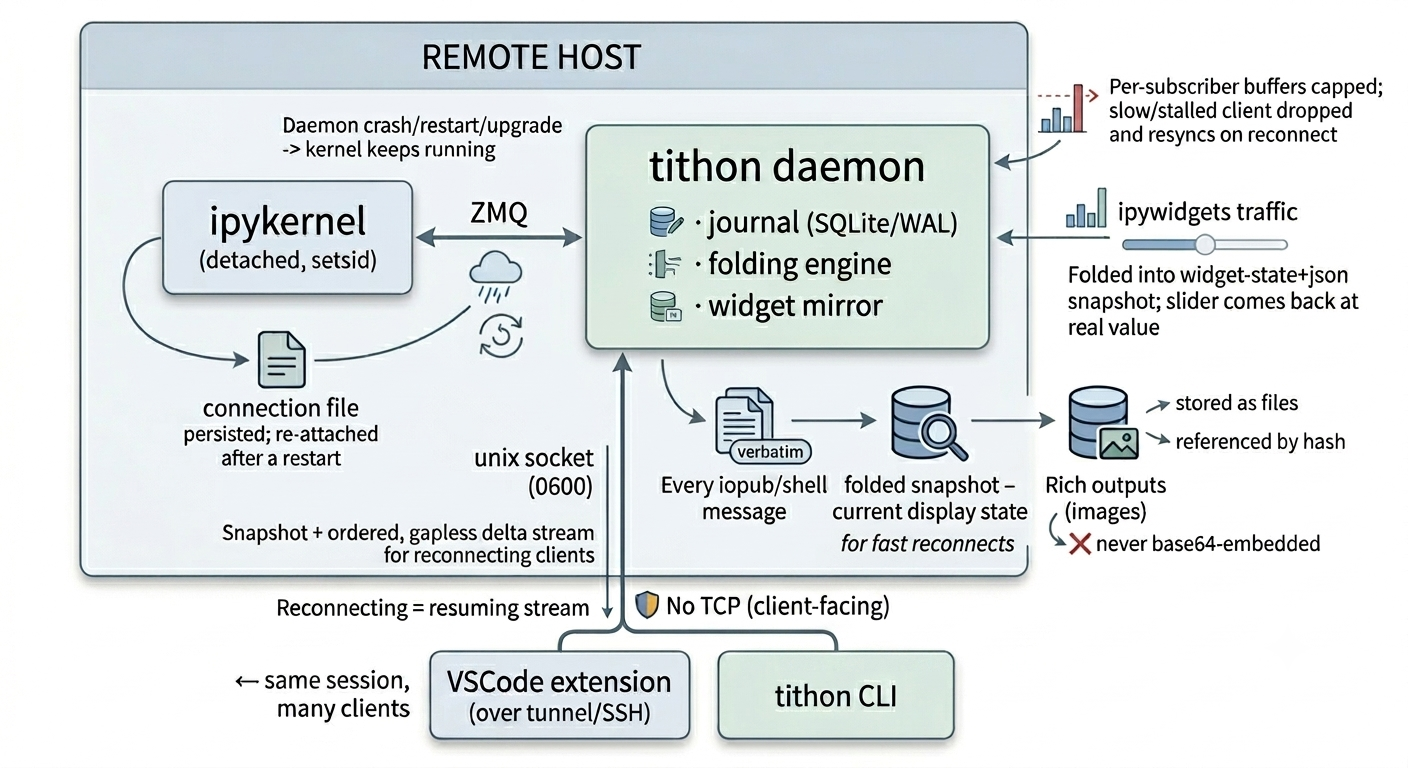
- The kernel runs detached (
setsid), so it is not a child of the daemon. The daemon can crash, restart, or be upgraded while the kernel keeps running and re-attaches through a persisted connection file. - Every execution iopub message (plus daemon lifecycle and widget comm events) is journaled to append-only SQLite (WAL) by default, alongside a per-execution folded snapshot of the current display state for fast reconnects.
- Clients attach with the last sequence number they saw and receive a snapshot plus an ordered, gapless delta stream.
- Rich outputs (images) are stored as files and referenced by hash rather than
base64-embedded.
ipywidgetstraffic is folded into awidget-state+jsonsnapshot, so atqdmbar or a slider comes back at its current value. - Backpressure is bounded: per-subscriber buffers are capped, and a client that falls too far behind is dropped and resyncs on reconnect, preventing a slow client from growing daemon memory or blocking others.
- The daemon binds a
0600unix domain socket with no TCP listener.
The kernel itself is standard ipykernel; Tithon only manages the session layer
around it. See docs/SPEC.md for the full design.
| Command | Description |
|---|---|
tithon daemon |
Run the daemon (foreground). Supports --log-level, --idle-timeout, --history-retention-days, and --history-target-mib. |
tithon run -c CODE |
Submit code and stream its output (--session <uri>, --no-wait to print the exec id and exit, --timeout N to bound the wait). |
tithon run FILE |
Run a notebook file's cells (--cells 1,3-4, default all) in its persistent kernel and print their bounded outputs; exit 1 if a cell raised. |
tithon outputs FILE |
Print a notebook file's current outputs, bounded for agents (--cells, --errors, --summary, --tail/--head N, --grep RE, --json). |
tithon import SRC DEST |
Import a Python nbformat 4 .ipynb as percent source (.pynb or .py) plus saved outputs and metadata (--workdir PROJECT). |
tithon copy SRC DEST |
Copy percent source, current outputs, and metadata into an independent file session within one project (--workdir PROJECT). |
tithon export SRC DEST |
Export saved source plus current/saved outputs as a Python nbformat 4 .ipynb without executing code (--workdir PROJECT). |
tithon attach |
Stream events as NDJSON (--session <uri>, --since N resume point, --once exit after backlog sync, --until-done exit after next completion). |
tithon status |
Print daemon, session, queue, kernel, widget-model, and storage status (all sessions, or one with --session <uri>). |
tithon restart |
Restart a session's kernel with a fresh namespace (--session <uri>, default default). |
tithon interrupt |
Send SIGINT to the running cell of a session (--session <uri>, default default). |
tithon kill |
Terminate one session's kernel (--session <uri>) or all running kernels (--all); journals are kept. |
tithon shutdown |
Stop the daemon; kernels stay detached unless --kill-kernels is passed. |
tithon version |
Print the installed tithon package version. |
attach --since controls how history is replayed on reconnect:
--since 0: full folded snapshot, then live delta.--since N: replay only events after seqN, then asyncmarker, then live.--since -1: live only, ignore history.
tithon run and tithon outputs let an agent run specific cells and inspect
bounded outputs from the same persistent kernel open in VSCode:
tithon run exp/train.pynb --cells 2-4      # rerun only what changed, print bounded outputs
tithon outputs exp/train.pynb --summary    # status, time, and last line per cell
tithon outputs exp/train.pynb --errors     # just the cells that raised, traceback tail
tithon outputs exp/train.pynb --cells 2 --grep "val_loss"
Cells are numbered as in the file (markdown cells count), and each header shows
the cell's line span for editing. Each text output keeps its last 5 lines by
default (20 for tracebacks) and notes how many lines were omitted. Images are
listed as file paths under .tithon/outputs/, and widgets as text of their
final state. outputs never starts a daemon or a kernel: it reads from the
running daemon (including cells still running) or from the saved output file. An
edited cell shows no output until it runs again, so an agent does not read stale
results from older code.
Multiple edit-and-run steps can also be chained in a single shell command (see
tithon run --help) to save tool calls during iterative debugging.
The settings you are most likely to change, read by the daemon and CLI:
| Variable | Default | Purpose |
|---|---|---|
TITHON_HOME |
~/.tithon |
Root for the socket, daemon log, kernel connection files, and per-session journals. |
TITHON_KERNEL_IDLE_TIMEOUT |
0 |
Seconds of inactivity before an unattached idle kernel is reaped (0 = disabled). |
TITHON_HISTORY_RETENTION_DAYS |
0 |
Opt-in age limit (days) for raw output-message compaction (0 = disabled). |
TITHON_HISTORY_TARGET_MIB |
0 |
Opt-in soft size target (MiB) per session for raw output-message compaction (0 = off). |
The backpressure and polling knobs are listed in docs/reference.md.
Notebook cells use the Python language, so Pylance, ty and Ruff work inside them.
Ruff's default file selection excludes .pynb; add this to your project's
ruff.toml (or the equivalent tool.ruff setting in pyproject.toml):
extend-include = ["*.pynb"]Some language-server features are not yet at parity with plain .py files. See
docs/known_issue.md and the
verification status.
Bug reports are especially welcome, particularly for disconnect scenarios on remote setups. See CONTRIBUTING.md for what makes a report actionable, how to set up a development environment, and how to propose a change to the design.
MIT.