
A TypeScript vector search engine with an HNSW index, WAL-backed storage and a browser visualization of search traversal.
Node.js 20.11+ · ESM · Zero runtime dependencies
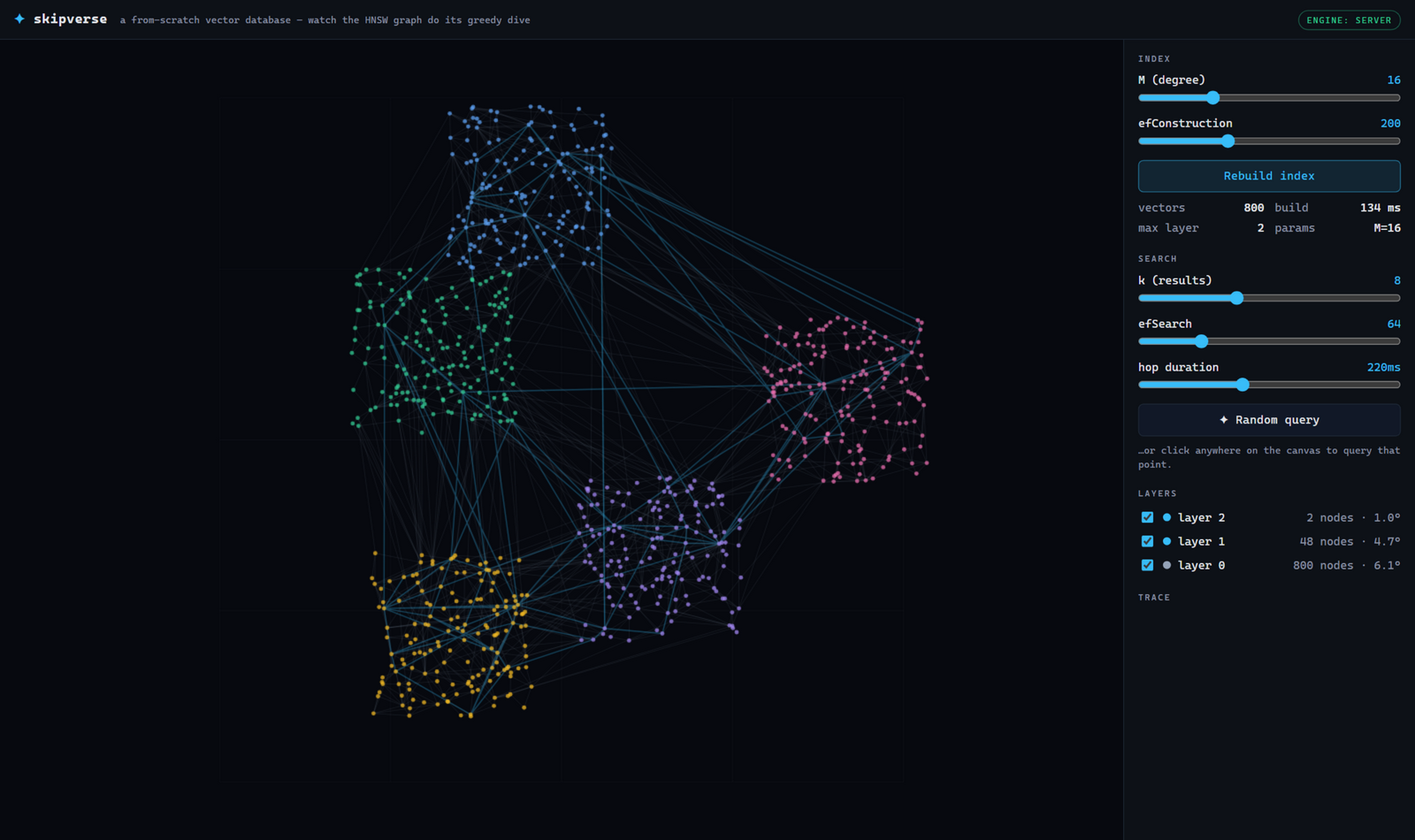
The browser demo uses the same HnswIndex core as the Node.js engine. Watch the search descend through graph layers and select the nearest results.
- HNSW search with cosine, Euclidean and dot-product metrics.
- Filtered search, soft deletion and compaction.
- SQ8, SQ4 and product quantization with one-shot calibration.
- CRC-framed WAL, snapshot checkpoints and deterministic replay.
- HTTP API, CLI and worker-thread read snapshots.
npm install skipverseimport { HnswIndex, VectorStore } from "skipverse";Start the HTTP server and browser demo:
npx skipverse serve --port 8787 --data ./skipverse-data --dim 64 --metric cosineOpen http://127.0.0.1:8787 . All vectors in a store must have the configured dimension. Use a separate data directory when changing dimensions or metrics.
| Option | Default | Purpose |
|---|---|---|
--port |
8787 |
HTTP port |
--data |
./skipverse-data |
Persistent store directory |
--dim |
64 |
Vector dimension |
--metric |
cosine |
cosine, euclidean or dot |
--M |
16 |
HNSW neighbor budget |
--ef-construction |
200 |
HNSW build search budget |
Set query-time ef in the /search request body. Quantization and fsync are configured
through the VectorStore API; the current CLI does not expose these settings.
To develop or build locally:
git clone https://github.com/qiyuhuating/skipverse.git
cd skipverse
npm ci
npm run build
node dist/node/cli.js serve --port 8787 --data ./example-data --dim 3 --metric cosine
Insert and search:
curl -X POST localhost:8787/vectors -H 'content-type: application/json' \
  -d '{"vectors":[{"id":"a","vec":[0.1,0.2,0.3]}]}'
curl -X POST localhost:8787/search -H 'content-type: application/json' \
  -d '{"vec":[0.1,0.2,0.3],"k":1,"ef":64,"trace":true}'
Stop the server before starting the local browser demo:
npm run demo:build
npm run serve
Open http://localhost:8787 .
From the repository root:
import { HnswIndex } from "./dist/node/index.js";

const index = new HnswIndex({ dim: 3, metric: "cosine" });
index.add("doc-1", [0.1, 0.2, 0.3]);
const hits = index.search([0.1, 0.2, 0.3], 1, { ef: 64 });
Persistent storage:
import { VectorStore } from "./dist/node/index.js";

const store = VectorStore.open({
  dataDir: "./data",
  dim: 3,
  metric: "cosine",
  fsync: true
});
store.upsert("doc-1", [0.1, 0.2, 0.3]);
const hits = store.search([0.1, 0.2, 0.3], 1);
store.close();npm run typecheck
npm test
npm run bench
npm run bench:ciThe benchmark uses seeded data and reports recall, throughput and nodes visited. Results depend on workload, search budget and quantization; measure with representative vectors before choosing a configuration.
A store supports one writer. Worker-thread readers hold explicit snapshots; call refresh() after writes.
Deletes leave traversal anchors until compaction. Quantization trades precision for storage and uses frozen calibration ranges.
WAL recovery scans the valid CRC-framed prefix and truncates torn tails. Enable fsync: true when writes must be synced to disk; the default append path does not sync each write.
| signature | what it does | notes |
|---|---|---|
new HnswIndex({ dim, metric?, M?, efConstruction?, seed?, quantization?, pqSubspaces?, extendCandidates? }) |
create an index | metric: cosine (default) / euclidean / dot · M 16 · efConstruction 200 · seed pins layer assignment · quantization: none / sq8 / sq4 / pq |
add(id, vec) |
insert or replace | replace soft-deletes the old vector · vec: number[] / Float32Array |
remove(id) |
soft delete | stays as traversal anchor, filtered from results · returns false if absent |
search(q, k?, { ef?, filter? }) |
k nearest | ef defaults to max(k, 16) · filter(id): excluded nodes are traversed, never returned |
searchWithTrace(q, k?, opts?) |
search + traversal | returns { results, trace } — the demo animates trace.layers |
vector(id) |
stored vector | dequantized after calibration · null when absent/deleted |
adjacency(id) |
per-level neighbor ids | for visualization / introspection |
compacted() |
rebuild without tombstones | deterministic · calibration carries over |
calibrate() |
freeze ranges, rewrite codes | one-shot calibration |
serialize() / HnswIndex.deserialize(data) |
binary round-trip | format v2 · v1 indexes still load |
stats() |
counts, per-level degree stats | |
size · deletedCount · isCalibrated · bytesPerVector |
live metrics |
| signature | what it does | notes |
|---|---|---|
new SearchPool({ store, workers? }) |
N workers hold read-only snapshots | default: cpus−1 capped at 4 |
searchAsync(vec, k?, ef?) |
search off the main thread | promise per request, round-robin dispatch |
refresh() |
broadcast a fresh snapshot | required after writes — snapshots are explicit |
close() |
drain and exit all workers | in-flight searches settle first |
Single file, worker re-enters the module itself, zero dependencies. Results are identical to the synchronous path.
| signature | what it does | notes |
|---|---|---|
VectorStore.open({ dataDir, dim, metric?, M?, efConstruction?, seed?, quantization?, fsync?, checkpointEvery? }) |
open or create | validates meta.json on reopen · fsync: true = real power-loss durability |
upsert(id, vec) / upsertBatch(entries) |
writes | batch = one WAL syscall (one fsync per batch) |
remove(id) · get(id) |
tombstone / read back | get is dequantized post-calibration |
search(q, k?, opts?) / searchWithTrace(...) |
queries | delegates to the index |
calibrate() |
calibrate + rotate snapshot | |
compact() |
rebuild + snapshot rotation | returns { before, after } |
checkpoint() |
snapshot + WAL truncate | automatic every checkpointEvery ops (default 4096) |
close(checkpoint?) |
release lock + fd | |
info() |
stats + WAL bytes |
Single-writer: a store held by a live process refuses a second open; stale locks from dead processes are cleared automatically.
| route | body | response |
|---|---|---|
POST /vectors |
{ vectors: [{id, vec}] } |
{ upserted, count } |
GET /vectors/:id |
— | { id, vec } · 404 if absent |
DELETE /vectors/:id |
— | { removed } |
POST /search |
{ vec, k?, ef?, trace? } |
{ results, tookMs } · + trace when asked |
GET /stats |
— | index + WAL stats |
POST /checkpoint |
— | { ok } |
GET /healthz |
— | { ok, count } |
Every response carries an x-response-time header.
| command | flags | purpose |
|---|---|---|
skipverse serve |
--port --data --dim --metric --M --ef-construction |
HTTP + demo |
skipverse import |
--file vectors.jsonl + store flags |
bulk load (500/batch) |
skipverse calibrate |
store flags | freeze ranges + rewrite codes |
MIT © 2026 qiyuhuating