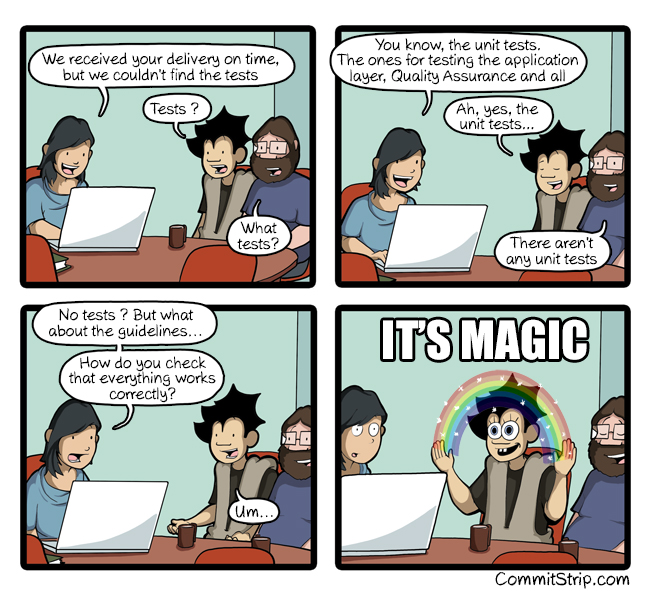
Source: http://www.commitstrip.com/en/2017/02/08/where-are-the-tests/
This is a small library developed at 42 to help with the task of unit testing. It's tiny and doesn't have a lot of features, but it gets the job done.
Your testing executable will run a list of test suites, which will run
individual tests. There are two kinds of tests: simple, which return 0
or -1 based on success, and out, which will capture stdout and check for a
predefined output.
unit_add_suiteadds a suite to a list.unit_add_testadds a test to a suite.unit_add_test_outputadds an stdout test to a suite.unit_run_allexecutes the suite list.
There are also some functions to call from within your tests:
unit_assert_outputchecks stdout output.TEST_SUCCESSandTEST_ERRORcontain the return variables for results.
Here's a basic example:
#include "testproject.h"
#include "libunit.h"
#include <signal.h>

int             main(int argc, char **argv)
{
    static t_unit_list *list = NULL;

    (void)argc;
    unit_add_suite(&list, "Basic tests", basic_tests());
    // Add more suites as needed

    return (unit_run_all(list, argv[0]));
}

t_unit_suite    *basic_tests(void)
{
    static t_unit_suite *suite = NULL;

    if (suite)
        return (suite);

    unit_add_test(&suite, "Simple test", &simple_test, 0);

    // Your tests can also write to stdout!
    unit_add_test_output(&suite, "Stdout test", &another_test, 0);

    // You can also add tests that are expected to fail
    unit_add_test(&suite, "Segfault test", &segv_test, SIGSEGV);

    return (suite);
}

// a simple equality test
int             simple_test(void)
{
    if (ft_strlen(test) == strlen(test))
        return (TEST_SUCCESS);
    else
        return (TEST_ERROR);
}

// p here is a pointer to the stdout/stdin pipe
int             stdout_test(int *p)
{
    ft_putstr("abc");
    return (unit_assert_output(p, "abc"));
}

// this test is meant to fail
int             segv_test(void)
{
    ft_strlen(NULL);
    return (TEST_SUCCESS);
}
By default, all tests time out after 10 seconds. If you would like to change
this, check out libunit.h
and edit the TEST_TIMEOUT define.
This project is licensed under the GNU General Public License 3.0 or later.