English · 简体中文
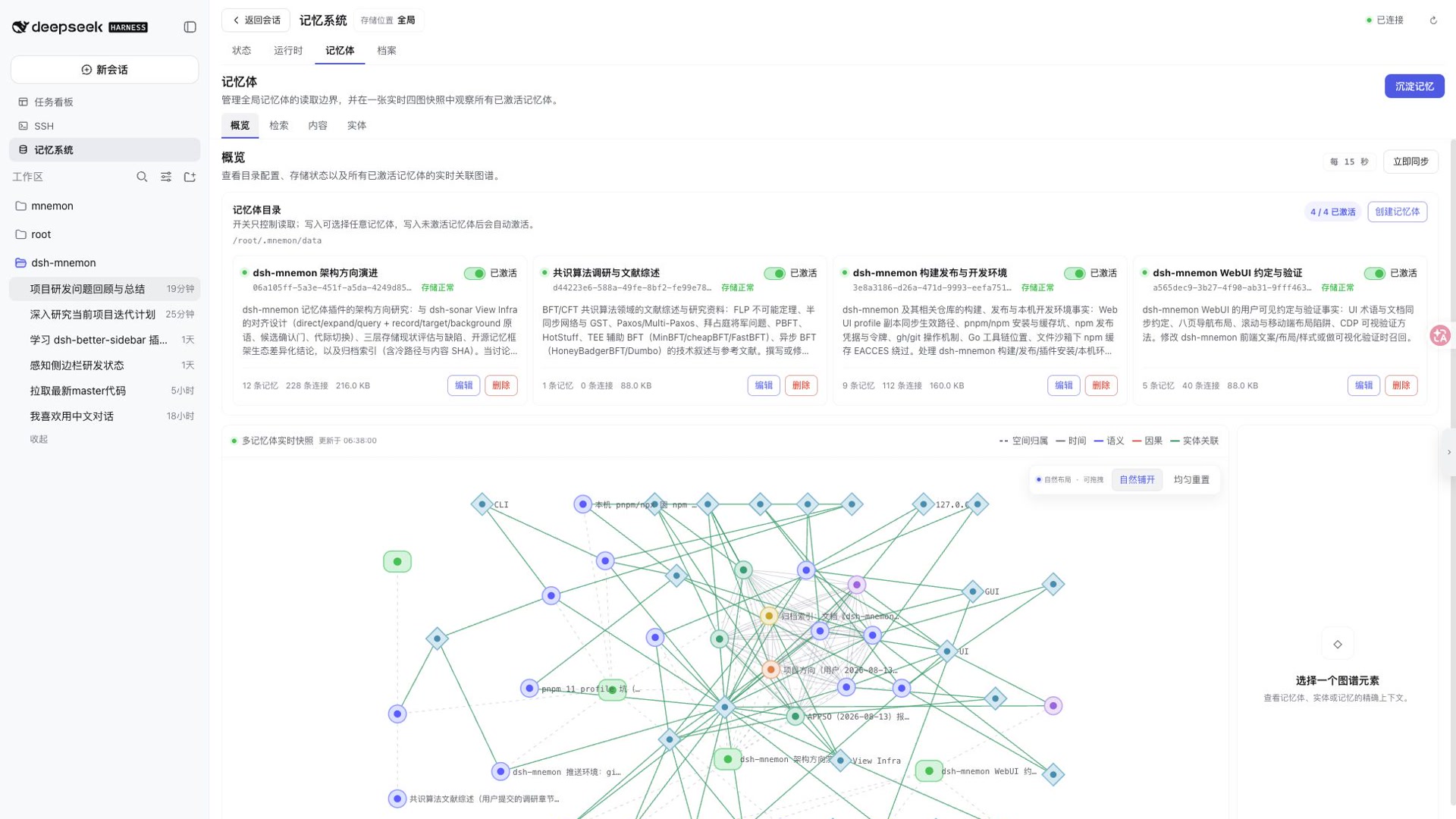
Local, layered, supervised memory for DeepSeek Harness—with cross-agent sharing through Mnemon.
dsh-mnemon integrates Mnemon with DeepSeek Harness (DSH). It brings hot memory needed every turn, full project Documents, and on-demand long-term Memory Spaces into one workbench. Other agents can share DSH's long-term memory when they also integrate Mnemon and use the same accessible local Mnemon storage.
- Local first: memory stays in local SQLite, JSON, and Markdown; no remote memory service is required.
- Cross-agent sharing: Mnemon-enabled agents can read and reuse DSH's Mnemon Memory Spaces.
- Three cooperating tiers: Runtime Memory, Project Documents, and Memory Spaces retain information at the right granularity.
- Supervised writes: isolated memory subagents make semantic decisions; the Host enforces paths, permissions, capacity, locks, and revisions.
- Web and Headless: a complete Sidebar workbench for interactive management, plus the same Agent tools, memory context, and cwd routing in one-shot Headless tasks.
Current user instructions, repository files, and live tool results always take precedence over historical memory.
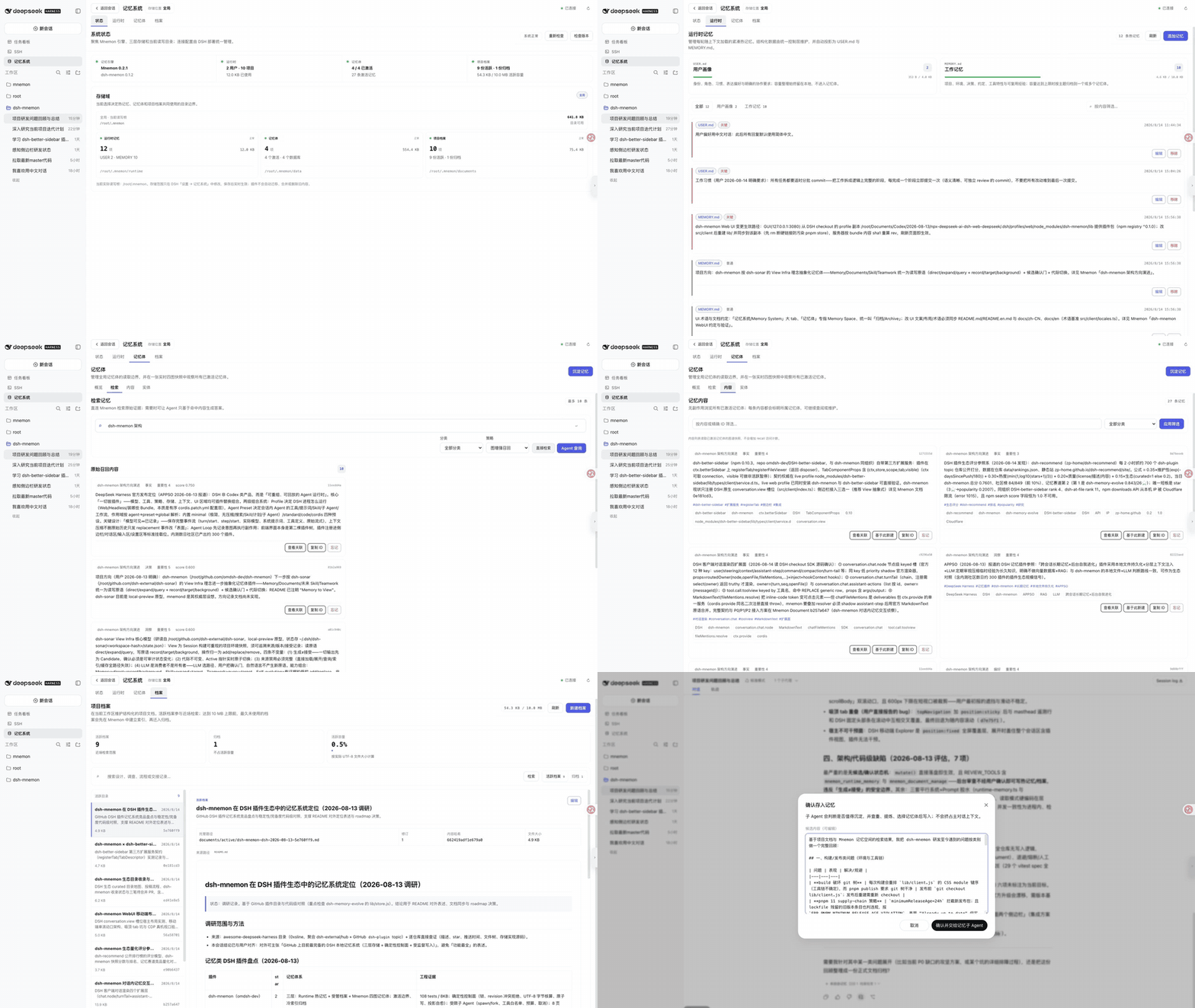
See the Sidebar and conversation UI guide for the complete visual walkthrough.
# macOS
brew install --cask mnemon-dev/tap/mnemon

# macOS / Linux via Go
go install github.com/mnemon-dev/mnemon@latest

mnemon --version
On Windows, install the official v0.2.3-or-newer release ZIP. This path is auto-discovered without changing PATH; see Getting Started for checksum verification:
$version = '0.2.3'
$arch = if ([System.Runtime.InteropServices.RuntimeInformation]::OSArchitecture -eq 'Arm64') { 'arm64' } else { 'amd64' }
$archiveName = "mnemon_${version}_windows_${arch}.zip"
$archive = Join-Path $env:TEMP $archiveName
Invoke-WebRequest "https://github.com/mnemon-dev/mnemon/releases/download/v${version}/${archiveName}" -OutFile $archive
$installDir = Join-Path $env:LOCALAPPDATA 'Programs\mnemon'
New-Item -ItemType Directory -Force -Path $installDir | Out-Null
Expand-Archive -Path $archive -DestinationPath $installDir -Force
& (Join-Path $installDir 'mnemon.exe') --versionFor the complete Web workbench:
dsh plugin --profile web add dsh-mnemon
dsh --profile web
DSH profiles have independent plugin rosters. Install it separately for one-shot Headless tasks:
dsh plugin --profile headless add dsh-mnemon
dsh --profile headless "Check durable project context before answering this task."
Use an absolute path for a local development checkout:
dsh plugin --profile web add "link:/absolute/path/to/dsh-mnemon"
dsh plugin --profile headless add "link:/absolute/path/to/dsh-mnemon"New installations use sidebar by default. Click Memory System in the DSH sidebar, then follow this first-run path:
- Confirm the Mnemon CLI, Runtime, Memory Spaces, and Documents are healthy under Status.
- Create a narrowly scoped Memory Space under Memory Spaces → Overview.
- Submit one stable, future-useful item through Remember.
- Verify it with a focused question under Recall.
- Return to the conversation and expand Turn memory below the answer.
See Getting Started for provider requirements and complete verification.
Headless has no workbench or conversation buttons. It still mounts Runtime context, Documents, Memory Space tools, lifecycle guidance, and supervised writes. With storageScope=workspace, its memory root follows the invocation directory. Because the process exits as soon as the one-shot Agent becomes idle, delayed background review is cancelled at shutdown; explicit or model-guided writes completed during the task remain durable.
| Tier | Best for | How it reaches context |
|---|---|---|
| Runtime | User preferences, collaboration rules, project conventions, environment facts | Compact USER.md / MEMORY.md projections on every turn |
| Documents | Designs, investigations, procedures, postmortems, and handoffs | Deterministic search of active Documents, then full text on demand |
| Memory Spaces | Cross-session facts, decisions, entities, and relations | Bounded evidence recalled on demand from active spaces only |
The tiers are not simple copies of the same content. Knowledge is routed by frequency, narrative length, and retrieval needs. See Storage and the three-tier model.
Cross-agent sharing applies to the Memory Spaces backed by Mnemon. Another Mnemon-enabled agent can recall from or contribute to the same durable facts, entities, and relations when it targets the same storageRoot and Store. DSH-managed Runtime Memory and Project Documents are not automatically exposed to other agents.
The default global scope uses ~/.mnemon, making it the simplest shared memory root for local agents. custom and workspace roots can also be shared, but every participant must align its directory explicitly. A shared root is shared data: establish a trust boundary first, and avoid incompatible offline migration or directory operations while another process is using it.
| Page | Main purpose |
|---|---|
| Status | Inspect connection, storage root, tier summaries, and Mnemon / dsh-mnemon versions |
| Runtime | Inspect USER / MEMORY capacity; filter, add, edit, or remove hot memory |
| Memory Spaces | Manage activation; switch among Overview, Recall, Content, and Entities; open Remember |
| Documents | Search, read, create, edit, and archive managed Markdown documents |
Add and edit use consistent dialogs, destructive actions require confirmation, long collections expose filters and progressive loading, and Documents use a dedicated reader.
| Turn memory | Save to memory |
|---|---|
 |
 |
- Turn memory summarizes recalls, writes, and Document searches for the turn; expand it to jump to the matching page.
- Save to memory loads an editable candidate. Only confirmation sends it to the memory subagent for qualification, deduplication, distillation, and writing.
Both are on by default. Disable them independently under Settings → Memory System → Conversation interface; saved changes apply live.
Configuration lives in $DSH_HOME/settings.yaml (commonly ~/.dsh/settings.yaml):
mnemon:
  displayMode: sidebar # sidebar | buildin; sidebar by default
storageScope: global # global | workspace | custom| Choice | Behavior |
|---|---|
sidebar |
Default dedicated workbench aligned with official DSH panel styling |
buildin |
Preserves the original conversation-area presentation and visuals |
global |
Shares ~/.mnemon (or MNEMON_DATA_DIR) across workspaces |
workspace |
Uses <workspace>/.mnemon; the workbench may inspect another workspace while the Agent still follows the current session |
custom |
Uses an absolute or ~/... path supplied through dataDir |
Saved settings apply live without a manual refresh. Changing scope never migrates, merges, or deletes old data. If the inspected workspace differs from the session's effective workspace, the header explains the mismatch and offers one-click alignment.
/mnemon status
/mnemon recall <query>
/mnemon related <full memory ID>
/mnemon remember <stable, self-contained durable insight>
/mnemon forget <full memory ID>
Recommended lookup order: Runtime Memory → active Documents → active Memory Spaces → archived original referenced by a hit.
- The plugin reaches durable memory through the local
mnemonCLI. The WebUI neither reads SQLite directly nor starts processes. - CLI calls use argument arrays with shell disabled, bounded output, timeouts, and cancellation.
- The plugin stores no API keys. Subagent inference uses the provider already configured in DSH.
- There is no deterministic secret scanner yet. Never store keys, tokens, private keys, or raw sensitive logs in any tier.
- Uninstalling the plugin does not remove data under
~/.mnemon, workspace.mnemonroots, or custom directories.
See Operations, security, and troubleshooting for complete boundaries, backup, recovery, and diagnostics.
| I want to… | Start here |
|---|---|
| Install and complete first-run verification | Getting Started |
| Learn every page and conversation entry | Sidebar and conversation UI guide |
| Understand the three tiers and complete flow | Project overview · Lifecycle and workflows |
| Choose storage scope or advanced switches | Configuration reference |
| Back up, update, or troubleshoot | Operations, security, and troubleshooting |
| Integrate tools, commands, or RPC | Interface reference |
| Develop, test, or publish | Development and verification |
See the documentation hub for the full map.
pnpm install
pnpm run verify
verify runs TypeScript checks, Vitest, a reproducible double build, an isolated real Headless-profile activation check, and published-package validation. lib/ is generated and intentionally not tracked.
MIT. Report security issues privately through SECURITY.md, not a public issue.