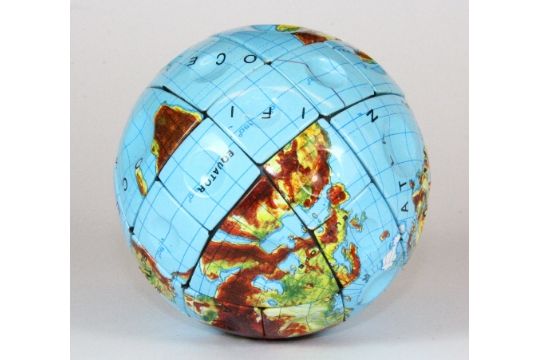
The Globe puzzle is a spherical tile rotation puzzle similar to a Rubik’s Cube. The puzzle presents as a globe with three intersecting rings containing 12 tiles each. The rings are arraigned perpendicularly to one-another with one ring corresponding to the equator, and the other two corresponding to lines of longitude. The rings rotate freely with each tile occupying 30◦ of either latitude or longitude. In normal latitude and longitude the globe is divided into Noth and South Hemispheres with latitude being defined relative to the equator, while longitude is divided into East and West hemispheres relative to the prime meridian.
For the sake of this project we use a simpler notation where latitude coordinates run from 0◦ at the north pole to 180◦ at the south. Longitude goes for 360◦ around the globe. Thus in this coordinate system the vertical rings run along longitude 0◦ to 180◦ and 90◦ to 270◦, and the equator ring contains tiles at ◦◦◦ latitude 90 . The vertical rings intersect at the ”North Pole” (latitude 0 , longitude 0 ) and the ”South Pole” (latitude 180◦ and longitude 180◦). And they intersect with the equator at the following points: (90◦, 0◦), (90◦, 180◦), (90◦, 90◦), and (90◦, 270◦).
We number the tiles around the rings as follows: • Longitude 0/180: (0◦, 0◦), (30◦, 0◦), (60◦, 0◦), (90◦, 0◦), (120◦, 0◦), (150◦, 0◦), (180◦, 180◦), (150◦, 180◦), (120◦, 180◦), (90◦, 180◦), (60◦, 180◦), (30◦, 180◦) • Longitude 90/270: (0◦, 0◦), (30◦, 90◦), (60◦, 90◦), (90◦, 90◦), (120◦, 90◦), (150◦, 90◦), (180◦, 180◦), (150◦, 270◦), (120◦, 270◦), (90◦, 270◦), (60◦, 270◦), (30◦, 270◦) • Equator: (90◦, 0◦), (90◦, 30◦), (90◦, 60◦), (90◦, 90◦), (90◦, 120◦), (90◦, 150◦), (90◦, 180◦), (90◦, 210◦), (90◦, 240◦), (90◦, 270◦), (90◦, 300◦), (90◦, 330◦)
Because each tile covers 30◦ of either latitude or longitude then all rotations of the tiles will increment or decrement tile values by multiples of 30. Thus a single increment of the equator would increase all tiles 1 by 30◦ longitude save for (90◦, 330◦) which would become (90◦, 0◦). An increment of longitude 0/180 would increase the latitude of all tiles with longitude 0◦ by 30◦ and decrease all with longitude 180◦ by 30 save for (30◦, 180◦) which becomes (0◦, 0◦). A similar process takes place for the longitude 90/270 save that it also moves (0◦, 0◦) and (180◦, 180◦) to (30◦, 90◦) and (150◦, 270◦) respectively.
We have a set of files that describe marble puzzles. Each line of the file looks as follows: Tile(30-180, (90,270), Exact(30,180)) This specifies a single tile. In this case we have a tile with ID "30-180" that is currently at latitude and longitude (90,270) and which has an exact target coordinates of latitude and longitude (30,180) to match. A puzzle is complete when all of its tiles are at their target locations.
The files are organized into two groups: • PathN-.mb specify a puzzle with a guaranteed solution of exactly N steps. • Puzzle-.mb specify a puzzle with a an unknown number of steps required.