
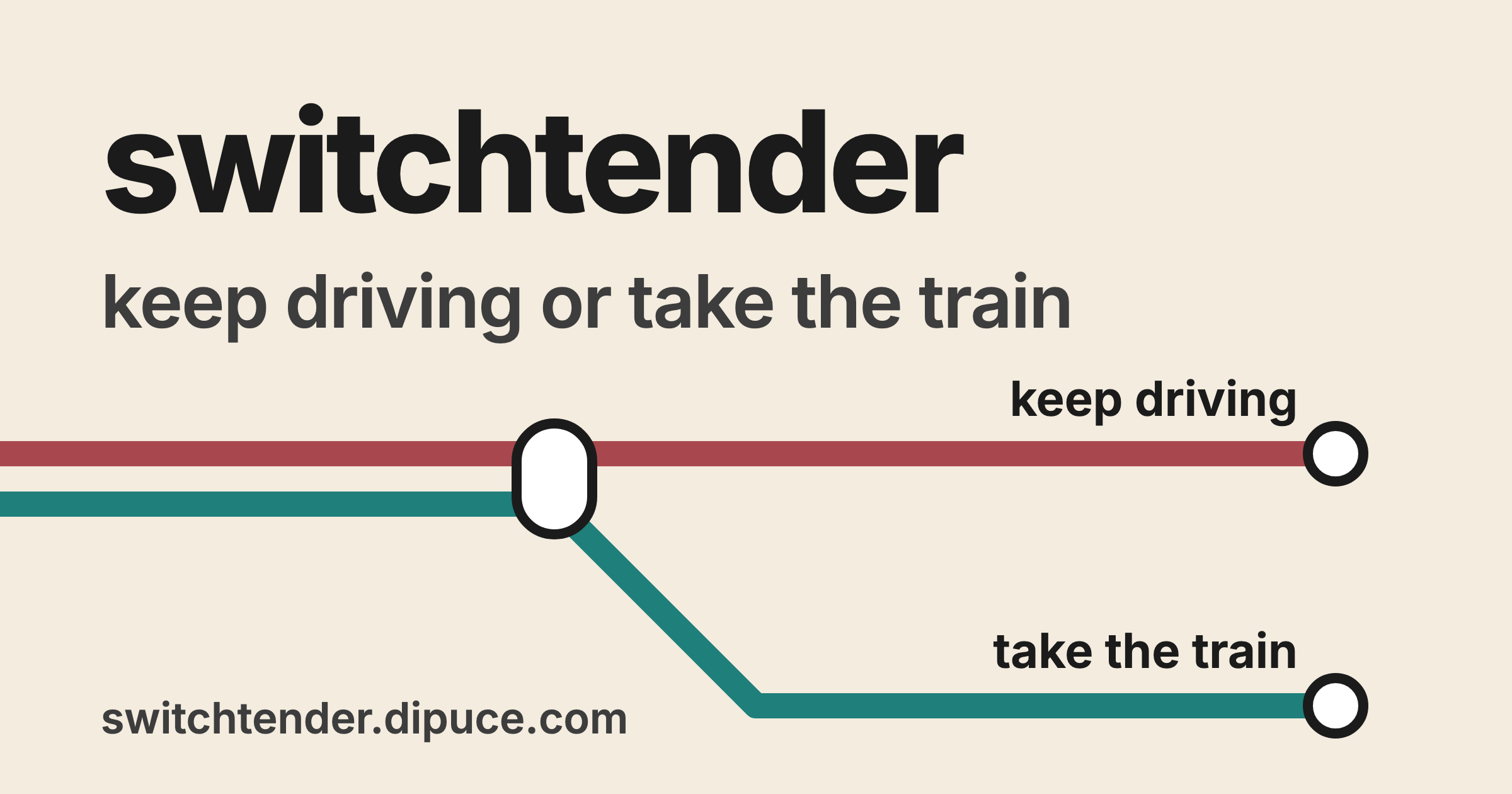
A switchtender is the railway worker who sets the switch at a junction and decides which track a train takes. This tool does that for a commute. At a fork you pass every morning, it reads live conditions and says, out loud, whether to keep driving or park and take the train.
To see it work, visit switchtender.dipuce.com.
Keep driving. Driving is 38 minutes, the train is 84 minutes.
Driving saves 46 minutes, more than the 5 needed, the road ahead is clear,
planned road closure at Rochambeau Bridge. Confidence is moderate.
Keep driving.
One sentence, heard once at highway speed, then repeated so a half-heard verdict is still unambiguous.
Plenty of commutes share this shape: you drive the first stretch no matter what, then reach a point where you can either stay on the highway all the way in or pull off to a park-and-ride and let transit finish the trip. The right answer changes daily and the moment to decide is one exit wide.
Take the example commute this repository ships with. You live north-west of Boston and drive Route 2 inbound. Where Route 2 meets I-95 you choose: stay on Route 2 through Cambridge to downtown, or drop into the Alewife garage and ride the Red Line. Most mornings driving wins by twenty minutes. On a morning with a crash on Memorial Drive, a Bruins game letting out early, or single-tracking on the Red Line, the answer flips, and you cannot tell which morning it is from the driver's seat.
switchtender makes the call 1.5 miles before the fork, from a phone in the cupholder, without you touching it.
Both options share the leg before the fork, so only the legs after it are measured. The engine asks a routing API for two things: the drive from the fork to the destination, and the drive from the fork to the garage plus the transit ride from there. Transit wins ties. Driving is recommended only when it beats transit by a margin that grows with how congested the road ahead already is, because a drive estimate taken in heavy traffic is the one most likely to be wrong.
Everything else only moves the confidence figure and the spoken reason, never the verdict, until logged history proves it should:
| Signal | Source | Needs a key |
|---|---|---|
| Durations and congestion along the polyline | Google Routes API | yes |
| Live incidents in the destination city | TomTom Traffic Incidents | yes |
| Live incidents on the highway approach | Maryland CHART (swap for your state's feed) | no |
| Planned road closures near the destination | DDOT permits (swap for your city's) | no |
| Events at venues you name | Ticketmaster, or MLB's schedule for a ballpark | yes / no |
| Planned rail track work | Operator's published schedule | no |
Every verdict and every input is appended to a Google Sheet and exposed to BigQuery, so the starting guesses in the rule can be tuned against what actually happened.
You need Node 24 and a Google Routes API key. Everything else is optional and degrades gracefully: a missing key lowers confidence, it never blocks a verdict.
git clone https://github.com/moneymikeMD/switchtender.git
cd switchtender
nvm use            # reads .nvmrc
npm ci
npm test           # no network, a few hundred milliseconds

cp config.example.toml config.toml
ROUTES_API_KEY=your-key npm start
The example config is a real, runnable Boston commute, so the first run works
before you edit anything. Then open config.toml and describe your own fork:
where you start, where the road splits, where the garage is, where you end
up, and which venues and rail lines matter to you. The engine holds no
coordinates of its own. Full key reference: docs/configuration.md.
To hear it the way you would in the car:
npm start 2>/dev/null | tail -1 | say # macOS; use espeak or similar elsewhereStill at home and wondering about the whole trip rather than the fork?
npm start -- --from origin- Serve it. docs/deploy.md deploys the same engine to Cloud Run behind a shared-secret header, scale-to-zero, secrets in Secret Manager, config mounted as a file. One script.
- Fire it from the phone. docs/phone.md and docs/switchtender.category give you the MacroDroid macros for Android: a geofence 1.5 miles before the fork triggers an HTTP call and speaks the answer over the car audio, weekday mornings only, and two more record when you actually arrived.
- Know what it costs. docs/cost-routes.md works through the Routes API tiers. Two verdicts a weekday sits inside the free quota.
Issues and pull requests are welcome. Good first contributions:
- A feed for your region. The incident and closure sources are Maryland
and DC specific behind small interfaces (
src/chart.js,src/closures.js). A module for another state DOT or city permit feed, with a recorded fixture and tests, is exactly the shape this project wants. - Another operator's track-work page.
src/trackwork.jsparses WMATA's table; other operators publish something similar. - A phone recipe for iOS. The Android path exists; Shortcuts should be able to do the same.
- Tuning evidence. If you run this for a few weeks, the Sheet you build up is the data the rule's starting guesses are waiting for.
House rules, all enforced by tests where a test can reach:
- No coordinates in source. Every place comes from
config.toml. - Unknown is not clear. A signal that fails returns
null, never0. - Unproven signals change confidence, not the verdict.
- Data sources are ranked on live queries against the real area, never on their documentation, and a source with no current-month data is dropped.
- Fixtures recorded from public feeds get their free-text contact fields blanked before commit.
npm test must pass, and a new feed comes with a live-recorded fixture so the
tests never touch the network.
The v1 of this idea compared home-to-office against home-to-garage-to-office and got nowhere, because the shared first leg cancelled out and hid the signal. Measuring only the legs after the fork is the whole trick, and the person who stands at the fork and throws the switch is the switchtender.
MIT. See LICENSE.