Classify why your agent failed. Recover intelligently.
pip install triage-agent


Current agent frameworks know that your agent failed. They don't know why — and without knowing why, every failure gets the same blunt response: retry from scratch or give up.
triage adds a classification-and-routing layer between the failure and the recovery:
agent fails → classify failure type → route to matching strategy → recover
It works with any async agent callable — OpenAI, LangGraph, raw LLM loops — without requiring you to change your framework.
Routing correctness across three failure modes (RulesClassifier, zero API calls):
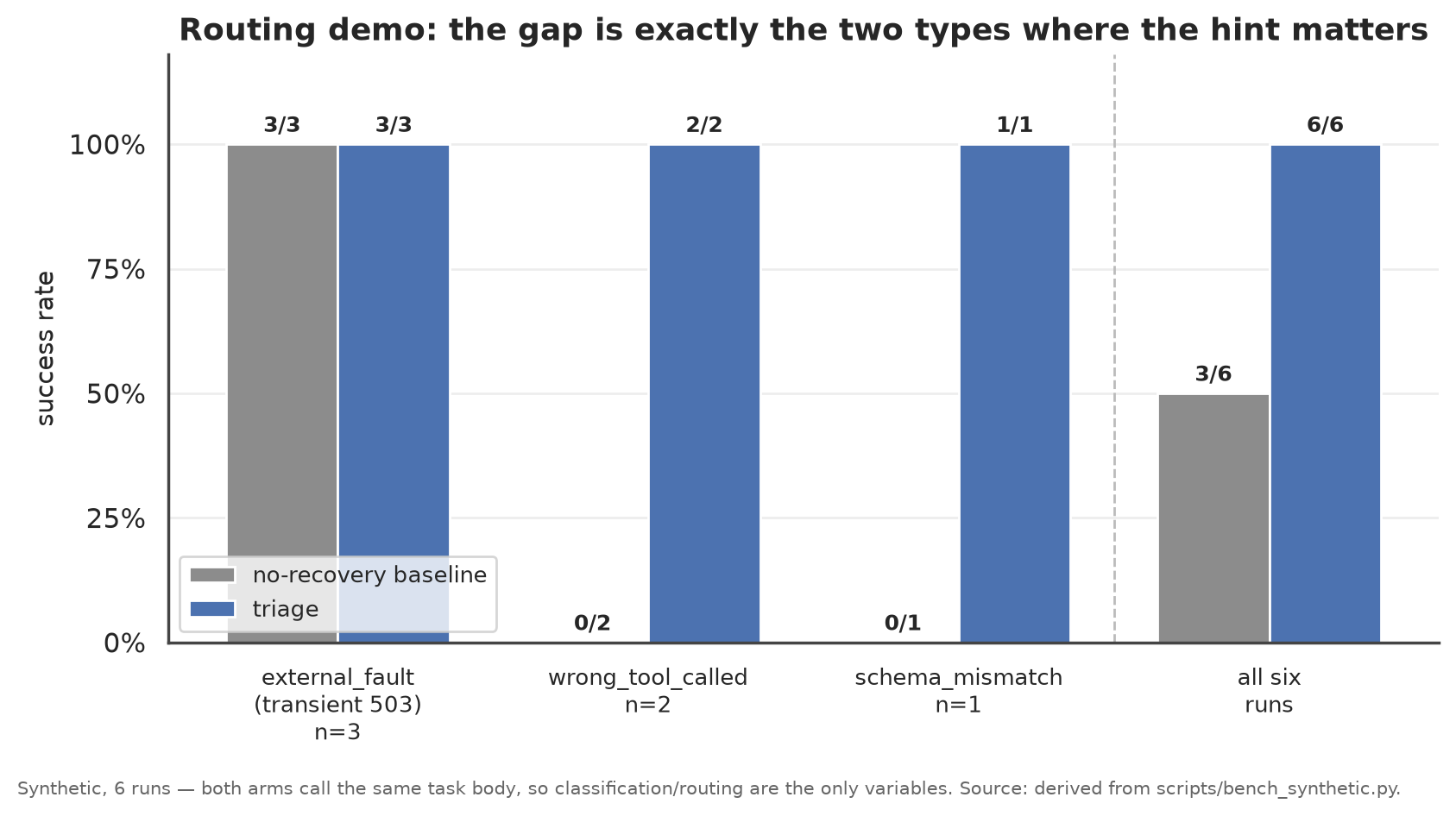
| Task | Failure type | No-recovery baseline | Triage |
|---|---|---|---|
| fetch_weather, call_payments, send_email | external_fault (transient 503) |
✓ heals on any retry | ✓ |
| lookup_user, create_ticket | wrong_tool_called |
✗ no hint → fails again | ✓ routes to manifest hint |
| parse_response | schema_mismatch |
✗ no hint → fails again | ✓ routes to schema hint |
| no-recovery | triage | |
|---|---|---|
| success rate | 50% | 100% |
| recoveries | — | 6 |
The 50 % gap is attributable to the two types where classification changes the outcome.
external_fault heals on any retry — triage gives no advantage there, and this is
intentional: conceding the transient case makes the comparison honest.
This demo assumes correct classification. The error strings here are ones rules.py
recognises, so it measures routing, not detection. On held-out error strings
RulesClassifier currently detects these same two types at 1/12 — see
per-type recall below, and read the
two sections together before drawing a conclusion.
Reproduce: PYTHONPATH=. python scripts/bench_synthetic.py
Ten-block measurement, RulesClassifier default configuration:
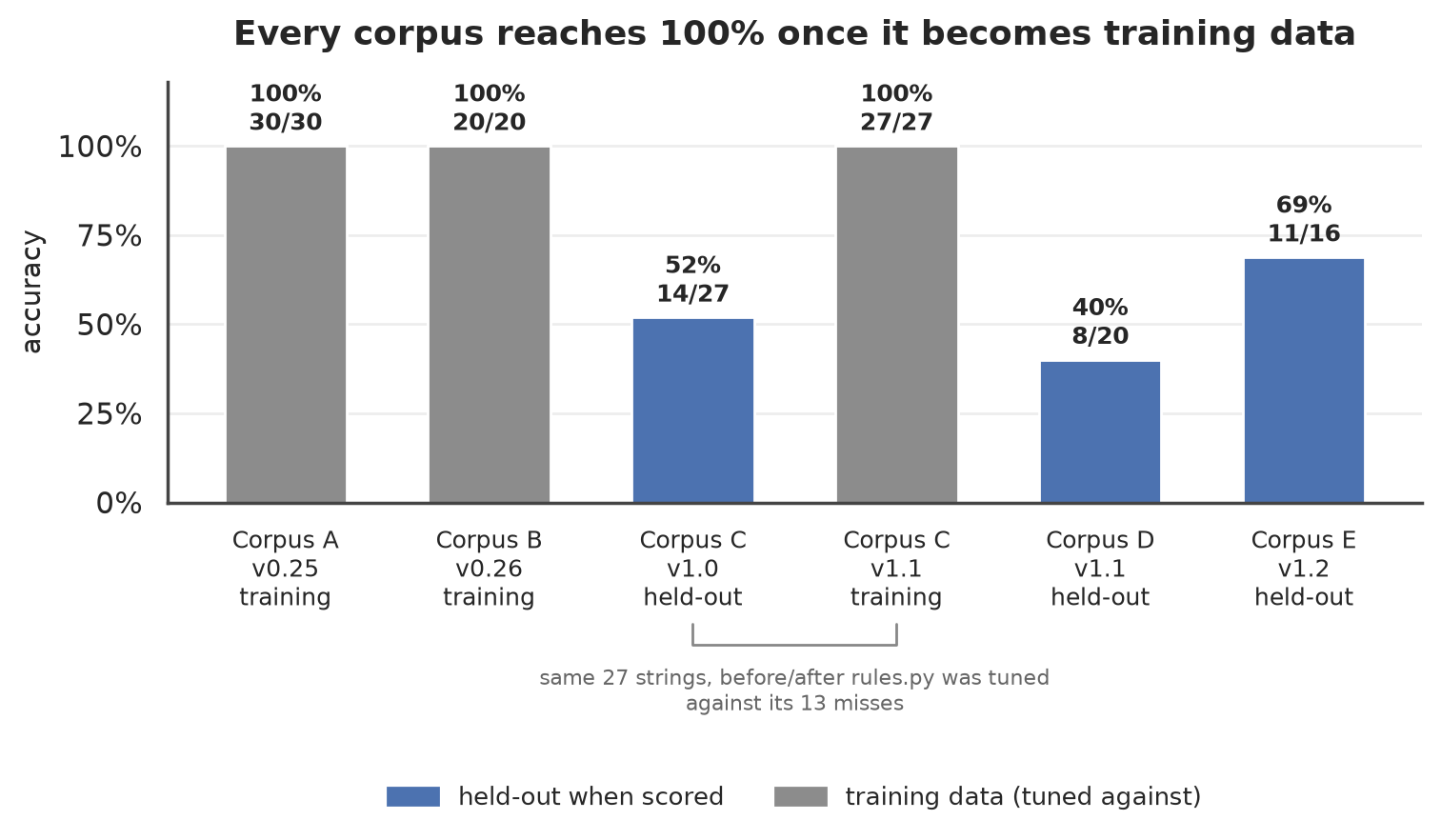
| Block | What it measures | Score |
|---|---|---|
| Regression | In-corpus positives from test_classifier_rules.py |
100% (17/17) |
| False-positive resistance | Near-miss strings that must NOT fire a rule | 100% (12/12) |
| Corpus A (training, v0.25) | SDK exceptions used to guide v0.25 fixes | 100% (30/30) |
| Corpus B (training, v0.26 + v1.1) | Guided v0.26 fixes; last 2 misses closed in v1.1 | 100% (20/20) |
| Corpus C (training, v1.1) | Held-out through v1.0 (52%); v1.1 tuned against its misses | 100% (27/27) |
| Corpus D (held-out, v1.1) | Scored once, right after tuning against C | 40% recall, 100% precision |
| Corpus E (held-out, v1.2) | Scored once, after structured error codes shipped | 69% recall, 100% precision |
Corpus C is no longer held-out. It was genuinely held-out through v1.0 — scored once,
100% precision, 52% recall. The v1.1 release tuned rules.py directly against its 13 misses,
which is the exact act that converts a corpus to training data (the same thing that happened
to corpus A in v0.25 and corpus B in v0.26). Its 100% here reflects tuning, not generalization.
Corpus D is the current held-out measurement, built from sources disjoint from A, B, and C
(huggingface_hub, Ollama, OpenRouter, MCP, CrewAI, Semantic Kernel, novel phrasings) and
scored exactly once, immediately after the v1.1 tuning pass, before any further edit to
rules.py. 100% precision — the one misroute this pass found (a name collision between two
unrelated SDKs' same-named exception class) was fixed as a precision bug before freezing this
number, not used to chase recall.
The 40% aggregate on corpus D averages two groups of failure types whose value to you is opposite:
| Failure type | Corpus D held-out recall | Does classification change the outcome? |
|---|---|---|
timeout |
3/3 — 100% | No — any retry heals it |
external_fault |
3/4 — 75% | No — any retry heals it |
schema_mismatch |
1/4 — 25% | Yes — recovery needs the schema hint |
wrong_tool_called |
0/8 — 0% | Yes — recovery needs the manifest hint |
| Self-healing types | 6/7 — 86% | classification buys nothing over blind retry |
| Routing-sensitive types | 1/12 — 8% | classification is the entire value proposition |
The same split, tracked across every corpus that was ever scored held-out — the flat blue line is the finding:
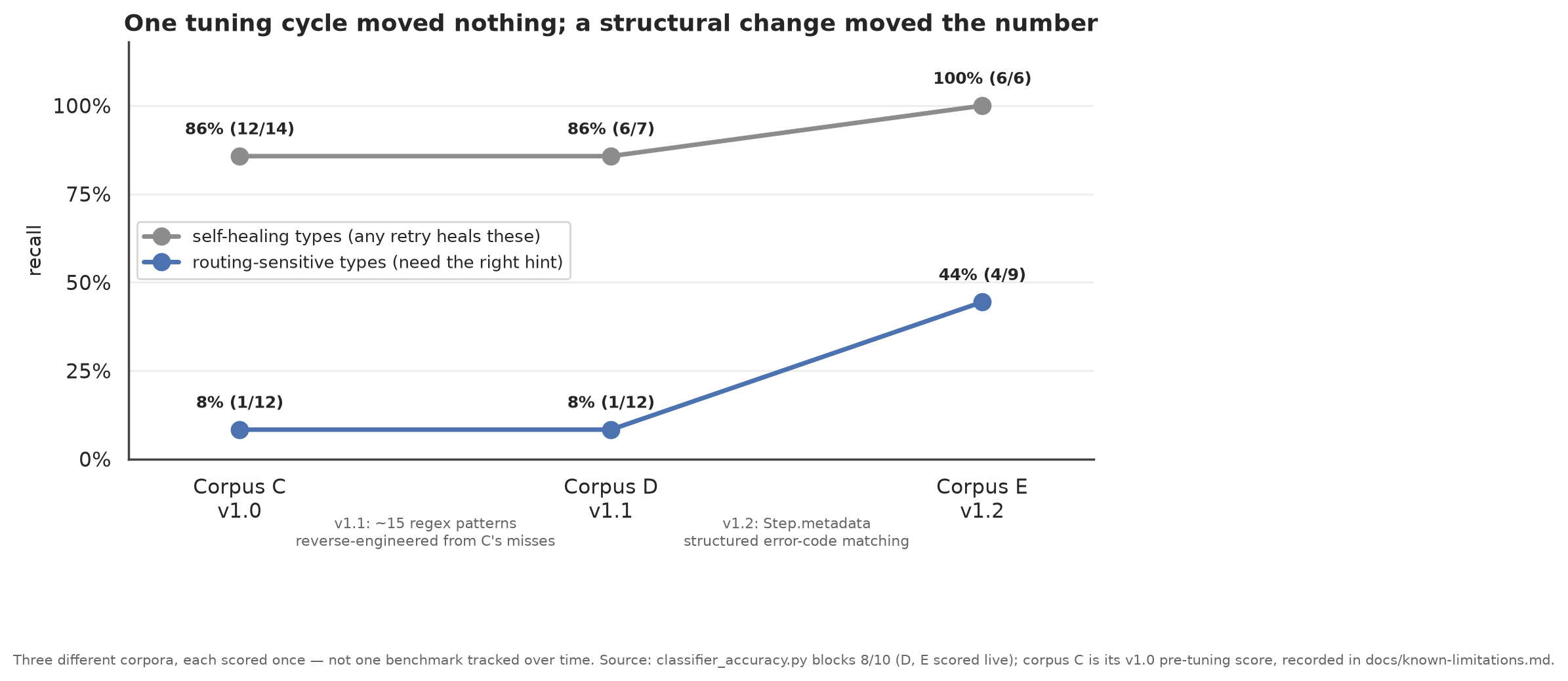
The headline finding of the v1.1 cycle: routing-sensitive recall on corpus D (1/12 = 8%)
is statistically unchanged from corpus C's pre-tuning number — also 1/12 = 8%. The v1.1 pass
added ~15 new patterns, closed all 13 of corpus C's misses, and it did not move the needle on
fresh data at all. Those patterns were narrow string literals keyed close to corpus C's exact
wording (e.g. "tool with name 'x' was not found", an Azure resource-path shape) and simply
didn't overlap with how Ollama, MCP, CrewAI, Semantic Kernel, HuggingFace, and OpenRouter phrase
the same failures. Self-healing recall held at 86% both before and after, for the same reason
it's easy to get right: that group clusters around a small, largely SDK-independent vocabulary
(HTTP status codes, the words "timeout" and "rate limit") that routing-sensitive failures do
not share — every SDK invents its own wording for "no such tool" and "bad request shape."
Put plainly: pattern-tuning against one held-out corpus's specific misses does not generalize to a different corpus of the same failure types. This is evidence about the regex-pattern-matching approach itself, not just this particular pattern set — see Known Limitations for the full writeup and what it implies for where classifier effort goes next.
What this means if you are evaluating triage today. On a stack whose error formats
happen to match the specific strings in rules.py (OpenAI, Anthropic, LangChain, botocore,
azure-core, Mistral, Cohere, Groq, LiteLLM, Vertex AI, LlamaIndex — corpora A, B, and C),
routing works as demonstrated in the synthetic benchmark above. On any other stack — which,
per corpus D, is most of them — expect most tool and schema failures to land in UNKNOWN
and fall through to your default policy: safe, but no better than the retry loop you would
have written yourself.
LLMClassifier/HybridClassifier don't have RulesClassifier's wording ceiling by
construction — semantic classification reads the meaning, not a literal string. That claim
sat in this README untested for most of the v1.1 cycle. It's now measured: corpus D scored
with HybridClassifier(llm=LLMClassifier(model="gpt-oss:120b-cloud")), a real reasoning
model via Ollama Cloud (reproduce with scripts/llm_classifier_accuracy.py):
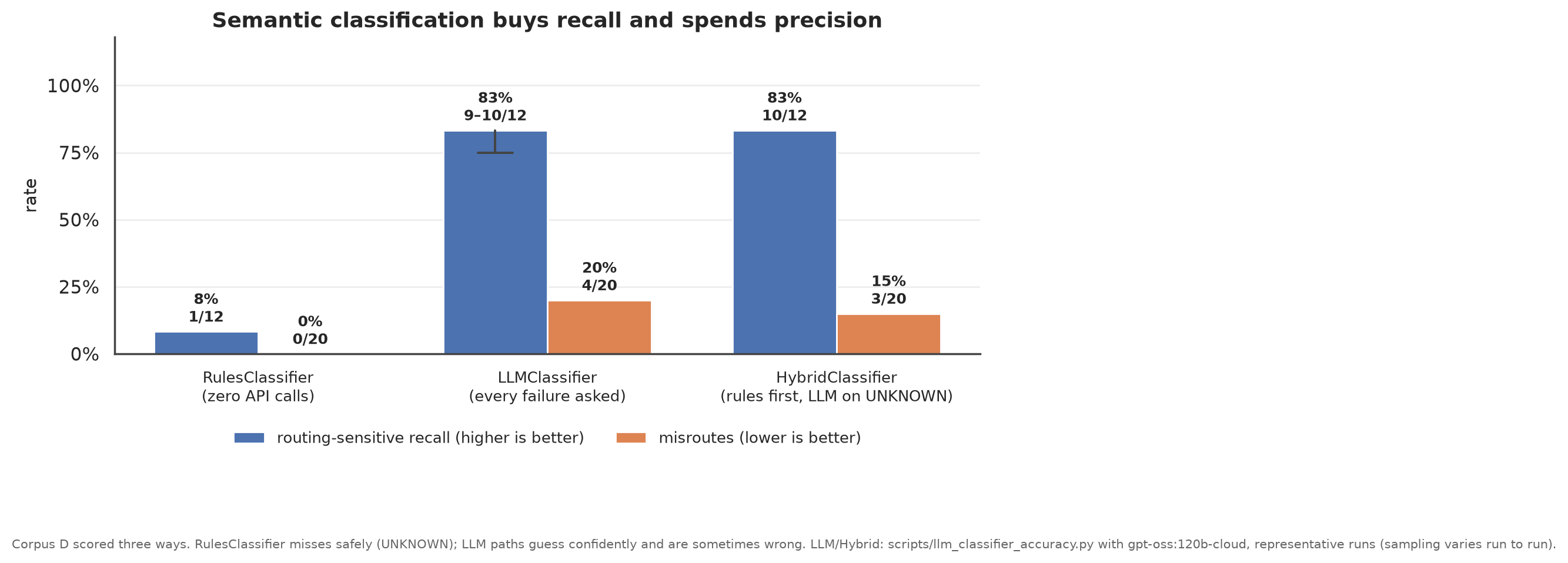
| Classifier | Routing-sensitive recall | Misroutes (of 20) |
|---|---|---|
RulesClassifier |
1/12 — 8% | 0 |
LLMClassifier alone |
9–10/12 — 75–83% (two runs) | 4/20 — 20% |
HybridClassifier (recommended) |
10/12 — 83% | 3/20 — 15% |
The recall claim holds: 8% → 83%. But it's not free — RulesClassifier's 100%-precision
guarantee (every miss falls to safe UNKNOWN, never a wrong guess) does not carry over.
HybridClassifier still misrouted 3 of 20 entries. One misroute is structural, not just LLM
noise: corpus D's one genuinely unclassifiable entry (true label unknown) was correctly
left as UNKNOWN by RulesClassifier — and HybridClassifier overturned that correct,
conservative answer into a confident wrong guess anyway, because its fallback rule is
if rules_result is UNKNOWN: ask the LLM, with no way to distinguish "rules doesn't
recognize this wording but there's a real answer" from "this genuinely has no answer." Every
LLM-involving run in this measurement misrouted that same entry. (n=1 in corpus D — a
real, reproducible mechanism, not yet a measured rate.) The remaining 2 misroutes were both
in wrong_tool_called, at a consistent 6/8 across runs — some tool-not-found phrasings
apparently read as ambiguous to this model even semantically.
Results vary run to run (reasoning-model sampling, not a bug) — these are representative
runs, not a frozen benchmark the way RulesClassifier's corpus D floor is. If you adopt
HybridClassifier for routing-sensitive types, budget for occasional confident misroutes,
not just occasional UNKNOWNs — a stronger or more expensive model, or a stricter
classification prompt, may trade some recall back for precision if that matters more for
your recovery strategies.
Supply constraints=, a framework= hint, or please
open an issue with strings that miss.
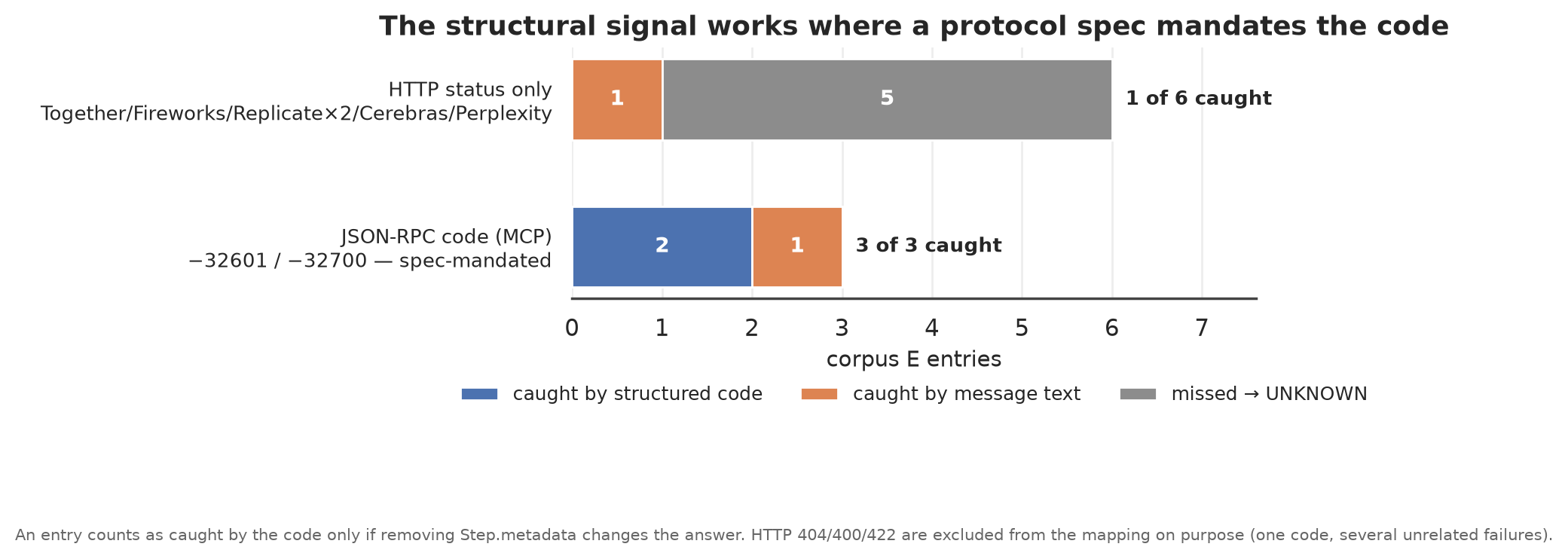
Corpus D stays frozen. The structural fix that finding pointed at — matching a caller-supplied
structured code in Step.metadata ("http_status", "json_rpc_code") rather than message
text — shipped and was scored against a fresh corpus E: routing-sensitive recall rose to 44%
(4/9), but almost entirely via MCP's spec-guaranteed JSON-RPC codes, not HTTP status. Every
fresh HTTP-only vendor's "wrong tool"/"bad schema" failure used a code (404/400/422)
deliberately excluded from the mapping as too ambiguous to resolve safely. See Known
Limitations' "Corpus E scoping" for the full breakdown.
PLAN_INCOMPLETE and CONTEXT_OVERFLOW are not scored — RulesClassifier returns
UNKNOWN for them by design; use LLMClassifier or HybridClassifier for those.
Reproduce:
PYTHONPATH=. python scripts/classifier_accuracy.py    # the numbers
PYTHONPATH=. python scripts/gen_readme_charts.py      # the charts above, redrawn from them
Every chart on this page is generated by that second script, which scores the corpora itself
rather than transcribing the tables — so a rules.py change that moves a held-out number moves
the charts too, and the two cannot silently disagree.
# Core only
pip install triage-agent

# With framework adapters
pip install "triage-agent[langgraph]"
pip install "triage-agent[langchain]"

# With LLM-based classifier
pip install "triage-agent[anthropic]"

# With durable checkpoint storage
pip install "triage-agent[sqlite]"
pip install "triage-agent[redis]"

# With OpenTelemetry spans and metrics
pip install "triage-agent[otel]"

# With YAML/TOML policy config
pip install "triage-agent[yaml]"
Python 3.10+ required. Core dependencies: anyio>=4.0, pydantic>=2.0.
import triage
from triage.strategies.retry import retry_with_tool_manifest, backoff_and_retry
from triage.strategies.replan import replan
from triage.taxonomy import Step

# 1. Define your agent — it receives record_step and update_state callbacks
async def my_agent(task: str, *, record_step, update_state, _triage_hint=None, **kwargs):
    data = fetch_data(task)
    record_step(Step(index=0, action="called search", tool_called="search",
                     tool_input={"q": task}, tool_output=data))
    update_state({"data": data})   # persisted into checkpoints; restored on rollback
    return "done"

# 2. Declare a recovery policy
policy = triage.FailurePolicy(
    WRONG_TOOL_CALLED  = retry_with_tool_manifest(max_attempts=3),
    EXTERNAL_FAULT     = backoff_and_retry(max_attempts=5),
    LOOP_DETECTED      = replan(hint="Try a different approach."),
    default            = triage.FailurePolicy.escalate_by_default(),
)

# 3. Wrap and run
agent = triage.Agent(my_agent, policy=policy)
result = await agent.run("search for recent AI papers")
Or use the decorator form:
@triage.agent(policy=policy)
async def my_agent(task: str, *, record_step, **kwargs):
...Drop-in wrappers let you add triage to an existing agent without changing its internals.
from triage.adapters.langgraph import wrap_langgraph

agent = wrap_langgraph(compiled_graph, policy=policy)
result = await agent.run("your task")
Streams events via graph.astream_events(..., version="v2") to capture tool calls and LLM turns.
from triage.adapters.langchain import wrap_langchain

agent = wrap_langchain(executor, policy=policy)
result = await agent.run("your task")
Injects a fresh BaseCallbackHandler per call via config={"callbacks": [...]}.
All adapters accept the same optional kwargs as triage.Agent: classifier, checkpoint_store, max_recovery_attempts, auto_checkpoint.
Your agent calls record_step(Step(...)) for each observable action. triage injects the callback — you don't need to import or construct anything:
async def my_agent(task: str, *, record_step, **kwargs):
    result = call_tool("search", {"q": task})
    record_step(Step(
        index=0,
        action="called search tool",
        tool_called="search",
        tool_input={"q": task},
        tool_output=result,
    ))
Alternatively, avoid signature changes entirely using context-var injection:
from triage.agent import get_recorder, get_state_updater, get_usage_recorder

async def my_agent(task: str, **kwargs):
    record_step = get_recorder()
    update_state = get_state_updater()
    record_usage = get_usage_recorder()
    ...
Already have OpenTelemetry spans? If your framework emits its own spans for tool calls and
errors (openllmetry/traceloop-style auto-instrumentation, or the OTel GenAI semantic
conventions), you don't have to hand-write Steps at all — convert the spans instead:
from triage.observability.otel_ingest import trajectory_from_spans

async def my_agent(task: str, *, record_step, **kwargs):
    try:
        return await already_instrumented_framework.run(task)
    finally:
        for step in trajectory_from_spans(exporter.get_finished_spans()).steps:
            record_step(step)
See examples/otel_trajectory.py for a full runnable version, including which fields this
extracts reliably (error info, from OTel's stable exception-event convention) versus
best-effort (tool name/input, from the still-Development-stability GenAI conventions).
When your agent raises an exception, triage runs the classifier over the recorded trajectory and returns one of 9 FailureType values:
| FailureType | Trigger | Default recovery |
|---|---|---|
WRONG_TOOL_CALLED |
Error matches "tool not found" / "no tool named" |
Retry with correct manifest |
CONSTRAINT_IGNORED |
LLM output contains a forbidden string | Replan with constraint reminder |
LOOP_DETECTED |
Last 3 steps identical tool + input | Replan or rollback |
PLAN_INCOMPLETE |
Success declared but sub-goals incomplete | Resume from subgoal |
SCHEMA_MISMATCH |
Error matches "validation error" / JSON parse failure |
Retry with schema hint |
CONTEXT_OVERFLOW |
Agent lost earlier context | Replan with compressed context |
EXTERNAL_FAULT |
HTTP 429 / 500 / 502 / 503 in error | Exponential backoff + retry |
TIMEOUT |
timeout / timed out / deadline exceeded in error |
Backoff and retry |
UNKNOWN |
None of the above | Escalate to human |
The default RulesClassifier is pattern-based and makes zero API calls. For semantic classification use LLMClassifier, or use HybridClassifier to get the best of both:
from triage.classifier.llm import LLMClassifier
from triage.classifier.hybrid import HybridClassifier

# LLM only — every failure classified by Claude
agent = triage.Agent(
    my_agent,
    policy=policy,
    classifier=LLMClassifier(model="claude-haiku-4-5-20251001"),
)

# Hybrid — rules first, LLM only when rules return UNKNOWN (~20% of failures)
agent = triage.Agent(
    my_agent,
    policy=policy,
    classifier=HybridClassifier(llm=LLMClassifier()),
)
LLMClassifier supports Anthropic and any OpenAI-compatible provider. Configure via constructor args or env vars:
# Anthropic (default)
ANTHROPIC_API_KEY=sk-ant-... python my_agent.py

# Ollama (local, no key)
TRIAGE_LLM_BASE_URL=http://localhost:11434/v1 TRIAGE_LLM_MODEL=llama3.2 python my_agent.py

# Groq
TRIAGE_LLM_BASE_URL=https://api.groq.com/openai/v1 TRIAGE_LLM_API_KEY=gsk_... TRIAGE_LLM_MODEL=llama-3.1-8b-instant python my_agent.pyThe policy maps each FailureType to a strategy callable. The strategy returns a RecoveryAction that tells triage what to do next.
triage executes the action and re-runs your agent with injected context:
| Action | What happens |
|---|---|
RETRY |
Re-runs the agent; injects _triage_hint into kwargs |
REPLAN |
Re-runs the agent; injects _triage_hint with new plan instruction |
ROLLBACK |
Restores trajectory from checkpoint, re-runs agent |
RESUME |
Re-runs agent; injects _triage_subgoal pointing at incomplete subgoal |
SUSPEND |
Serializes run state to SuspensionStore; raises TriageSuspendedError |
ESCALATE |
Raises TriageEscalationError(message, context) |
ABORT |
Raises TriageAbortError(reason, context) |
FailurePolicy is a plain dataclass — one field per FailureType:
policy = triage.FailurePolicy(
    WRONG_TOOL_CALLED  = retry_with_tool_manifest(max_attempts=3),
    CONSTRAINT_IGNORED = replan(hint="Re-read the task constraints carefully."),
    LOOP_DETECTED      = replan(max_replans=2),
    PLAN_INCOMPLETE    = resume_from_subgoal(),
    SCHEMA_MISMATCH    = retry_with_tool_manifest(max_attempts=2),
    EXTERNAL_FAULT     = backoff_and_retry(max_attempts=5),
    default            = triage.FailurePolicy.escalate_by_default(),
)
Any FailureType not explicitly listed falls through to default. If default is also unset, triage escalates automatically.
Step through strategies in order across successive failures of the same type:
policy = triage.FailurePolicy(
    EXTERNAL_FAULT=triage.FailurePolicy.sequence(
        backoff_and_retry(max_attempts=2),
        replan(hint="External service may be down. Try a different approach."),
    ),
)policy = triage.FailurePolicy.from_yaml("policy.yaml")
policy = triage.FailurePolicy.from_yaml("policy.toml")from triage.strategies.retry import retry_with_tool_manifest, backoff_and_retry
retry_with_tool_manifest(max_attempts=3) # retry with hint to use correct manifest
backoff_and_retry(max_attempts=5) # exponential backoff (2^attempt seconds)from triage.strategies.replan import replan, resume_from_subgoal
replan(hint="The previous approach used the wrong API endpoint.")
resume_from_subgoal()from triage.strategies.rollback import rollback_to_checkpoint
rollback_to_checkpoint() # latest checkpoint
rollback_to_checkpoint(checkpoint_id="before-api-call")Wrap any strategy with a cross-run failure-rate guard:
from triage.breaker import CircuitBreaker
from triage.strategies.circuit_breaker import circuit_breaker

breaker = CircuitBreaker(failure_threshold=5, window_seconds=60, cooldown_seconds=30)

policy = triage.FailurePolicy(
    EXTERNAL_FAULT=circuit_breaker(breaker, backoff_and_retry(max_attempts=3)),
)

# Notify the breaker when a run completes cleanly (closes HALF_OPEN state)
agent = triage.Agent(my_agent, policy=policy, circuit_breakers=[breaker])
States: CLOSED → OPEN (threshold reached) → HALF_OPEN (cooldown elapsed) → CLOSED (probe succeeds). When OPEN, recovery is skipped and TriageEscalationError is raised immediately.
Save agent state at key points so triage can roll back to them on failure.
store = triage.InMemoryCheckpointStore()
agent = triage.Agent(my_agent, policy=policy, checkpoint_store=store)from triage.checkpoint.sqlite import SQLiteCheckpointStore
store = SQLiteCheckpointStore("runs/checkpoints.db")
agent = triage.Agent(my_agent, policy=policy, checkpoint_store=store)import redis.asyncio as aioredis
from triage.checkpoint.redis import RedisCheckpointStore
client = aioredis.Redis.from_url("redis://localhost:6379")
store = RedisCheckpointStore(client)
agent = triage.Agent(my_agent, policy=policy, checkpoint_store=store)Enable automatic checkpointing after every successful step:
agent = triage.Agent(my_agent, policy=policy, checkpoint_store=store, auto_checkpoint=True)When a failure needs a human decision, use SUSPEND instead of ESCALATE. The run pauses, serializes its state, and returns a token. Call agent.resume(token, action=...) with the human's decision to continue from the exact point of suspension.
from triage.suspension import InMemorySuspensionStore

suspension_store = InMemorySuspensionStore()

async def needs_approval(ctx: triage.FailureContext) -> triage.RecoveryAction:
    return triage.RecoveryAction.SUSPEND(
        message=f"Agent hit {ctx.failure_type.value} — approve recovery?",
        metadata={"channel": "#ops"},   # routing hints for your notification layer
    )

policy = triage.FailurePolicy(EXTERNAL_FAULT=needs_approval)
agent = triage.Agent(my_agent, policy=policy, suspension_store=suspension_store)

try:
    result = await agent.run("task")
except triage.TriageSuspendedError as e:
    token = e.token
    # route token to human (Slack, webhook, CLI — your code, not triage's)
    notify_human(token, e.run.message, e.run.metadata)

# ... later, after human responds ...
result = await agent.resume(token, action=triage.RecoveryAction.RETRY())
# or: action=triage.RecoveryAction.ABORT(reason="rejected")
# or: action=triage.RecoveryAction.REPLAN(hint="try a different approach")
The core stores and reloads state; routing the token to Slack, an HTTP callback, or a CLI prompt is userland. Swap InMemorySuspensionStore for RedisSuspensionStore in production so tokens survive process restarts — experimental: tested, but with no known production users as of this writing; see the module docstring in triage/suspension_redis.py.
Three callbacks are always injected, plus recovery context on retry:
async def my_agent(
    task: str,
    *,
    record_step,
    update_state,
    record_usage,          # report token/cost usage for budget tracking
    _triage_hint=None,
    _triage_subgoal=None,
    _triage_state=None,
    **kwargs,
):
    if _triage_state:
        data = _triage_state["data"]   # restored from checkpoint on rollback
    else:
        data = fetch_data(task)

    record_step(Step(index=0, action="fetch", tool_output=data))
    update_state({"data": data})

    response = await call_llm(prompt)
    record_usage(triage.Usage(
        input_tokens=response.usage.input_tokens,
        output_tokens=response.usage.output_tokens,
        cost_usd=0.0001,
))| Key | Set when |
|---|---|
record_step |
Always |
update_state |
Always |
record_usage |
Always |
_triage_hint |
RETRY, REPLAN, or ROLLBACK action |
_triage_subgoal |
RESUME action |
_triage_state |
ROLLBACK action, when checkpoint has non-empty state |
_triage_context |
All recovery actions — typed TriageContext object |
Cap the total tokens or dollars spent per run() call. The check fires at each failure point — if the budget is already exceeded when the agent raises, triage escalates instead of attempting recovery.
agent = triage.Agent(
    my_agent,
    policy=policy,
    max_tokens=50_000,      # escalate after 50k tokens total
    max_cost_usd=0.10,      # escalate after $0.10 total
)
LLMClassifier automatically reports its own token usage to the meter. For agent LLM calls, report via record_usage(triage.Usage(...)) in the agent body or via get_usage_recorder().
Strategies can inspect everything that was tried before they were called:
async def smart_strategy(ctx: triage.FailureContext) -> triage.RecoveryAction:
    replan_count = sum(1 for _, kind in ctx.attempt_history if kind == "replan")
    if replan_count >= 2:
        return triage.RecoveryAction.ESCALATE(message="Replanned twice, still failing.")
    return triage.RecoveryAction.REPLAN(hint="Try a different approach.")
attempt_history is empty on the first failure and grows by one entry per recovery attempt. Each entry is (failure_type, action_kind) where action_kind is one of "retry", "replan", "rollback", "resume", "suspend", "escalate", "abort".
try:
    result = await agent.run(task)
except triage.TriageSuspendedError as e:
    # Run paused — route e.token to a human for a decision
    # Call agent.resume(e.token, action=...) to continue
    notify_human(e.token, e.run.message)
except triage.TriageEscalationError as e:
    # Automatic recovery exhausted — needs human review
    print(f"Failure type: {e.context.failure_type.value}")
    print(f"Trajectory: {[s.action for s in e.context.trajectory]}")
except triage.TriageAbortError as e:
print(f"Hard stop: {e}")Intercept escalations before they raise — useful for last-chance recovery or routing:
async def on_escalate(ctx: triage.FailureContext) -> triage.RecoveryAction | None:
    if ctx.failure_type == triage.FailureType.EXTERNAL_FAULT:
        await notify_oncall(ctx)
        return triage.RecoveryAction.SUSPEND(message="on-call notified")
    return None  # proceed with escalation

agent = triage.Agent(my_agent, policy=policy, on_escalate=on_escalate)agent = triage.Agent(
my_agent,
policy=policy,
on_step=lambda step: print(f"step {step.index}: {step.action}"),
on_failure=lambda ctx: metrics.increment(f"failure.{ctx.failure_type.value}"),
on_recovery=lambda ctx, action: print(f"recovering via {action.kind}"),
)Hook exceptions are swallowed with a warning so they never interrupt a run.
from opentelemetry.sdk.trace import TracerProvider
from opentelemetry import trace

trace.set_tracer_provider(TracerProvider(...))

# triage auto-detects the configured provider — no explicit tracer needed
agent = triage.Agent(my_agent, policy=policy)
Three spans per run() call: triage.run (root), triage.classify (per failure), triage.dispatch (per recovery). Pass Agent(tracer=my_tracer) to override. Install: pip install "triage-agent[otel]".
Five instruments emitted automatically when a MeterProvider is configured:
| Instrument | Type | Attributes |
|---|---|---|
triage.runs |
Counter | outcome |
triage.failures |
Counter | failure_type |
triage.recoveries |
Counter | failure_type, action_kind |
triage.run.duration |
Histogram | outcome |
triage.recovery.attempts |
UpDownCounter | failure_type |
Pass Agent(meter=my_meter) to override the auto-detected meter.
All triage decisions emit structured log records via the "triage" logger:
import logging
logging.getLogger("triage").setLevel(logging.INFO)
Events: failure_classified, action_dispatched, retry_backoff, attempt_start, run_suspended, hook_error. Each includes extra={"triage_event": ..., ...}.
agent = triage.Agent(
    my_agent,
    policy=policy,
    max_recovery_attempts=3,       # per-run attempt cap (default 3)
    max_total_attempts=10,         # cross-type global cap
    max_recovery_seconds=30.0,     # wall-clock budget for recovery
    max_tokens=50_000,             # token budget
    max_cost_usd=0.10,             # cost budget
    strict_idempotency=True,       # escalate instead of retrying non-idempotent steps
)A single Agent instance is safe for concurrent run() calls — per-run state (trajectory, checkpoints, usage meter) is isolated via contextvars.ContextVar. Use agent.clone() when you need independent lifecycle hooks or a dedicated checkpoint store per task:
agents = [agent.clone() for _ in tasks]
results = await asyncio.gather(*[ag.run(t) for ag, t in zip(agents, tasks)])Any class implementing classify(trajectory, task) -> FailureType satisfies the protocol:
from triage.classifier.base import Classifier
from triage.taxonomy import FailureType
from triage.trajectory import Trajectory

class MyClassifier:
    def classify(self, trajectory: Trajectory, task: str) -> FailureType:
        ...

agent = triage.Agent(my_agent, policy=policy, classifier=MyClassifier())See examples/raw_openai.py for a full working example that deliberately triggers a WRONG_TOOL_CALLED failure on the first attempt:
OPENAI_API_KEY=sk-... python examples/raw_openai.pytriage/
taxonomy.py FailureType enum (9 types), Step, FailureContext, TriageContext
trajectory.py Trajectory (append / replay_from / last_n_steps)
checkpoint/
base.py Checkpoint, CheckpointStore protocol, serialization helpers
memory.py InMemoryCheckpointStore
sqlite.py SQLiteCheckpointStore (requires aiosqlite)
redis.py RedisCheckpointStore (requires redis[asyncio])
policy.py RecoveryAction (7 constructors), FailurePolicy
agent.py Agent, TriageEscalationError, TriageAbortError,
TriageSuspendedError, @agent decorator
suspension.py SuspendedRun, SuspensionStore protocol,
InMemorySuspensionStore
breaker.py CircuitBreaker, BreakerState
usage.py Usage, UsageMeter
classifier/
base.py Classifier protocol
rules.py RulesClassifier — 6 rules, sync, zero API calls
llm.py LLMClassifier — Anthropic or OpenAI-compatible backend
hybrid.py HybridClassifier — rules first, LLM fallback on UNKNOWN
strategies/
retry.py retry_with_tool_manifest(), backoff_and_retry()
replan.py replan(), resume_from_subgoal()
rollback.py rollback_to_checkpoint()
circuit_breaker.py circuit_breaker()
adapters/
langgraph.py wrap_langgraph() (requires langgraph)
langchain.py wrap_langchain() (requires langchain)
observability/
otel.py Span helpers (lazy OTel import)
metrics.py Metric helpers (lazy OTel import)
scorer/
base.py StepRiskScorer protocol, RiskScore
rules.py RulesRiskScorer — destructive pattern detection
bench.py run_benchmark(), BenchReport, BenchResult
feedback.py Correction, record_correction(), load_corrections()
testing.py make_step(), RecordingAgent, assert_classifies_as()
MIT