This project is a basic versión of a DAO that allows users to manage a crypto currency fund by making proposals over how the funds should be spent.
This DAO was developed using Hardhat + Typescript + React as the main technological stack.
- About the project
- Main Features
- Demo
- Architecture and Design
- Run the project on your machine
- Author
- License
This is a personal project created with the goal of exploring and understanding the latest Ethereum tecnologies, and building a complete fullstack blockchain app from scratch. It does not aim to be a real life solution, although possible extensions will always be welcome. Special thanks to this Dapp University video which served as inspiration for the basic idea.
During deployment, a treasury is created with some initial funds (ethers). Those funds are given by the address who deploys the app. The idea is that users of the DAO should come to agreements on how this money should be spent by deciding what addresses should receive payments from the treasury money. These decisions are made through proposals. Each proposal suggests a transaction that should be made with the treasury money and has a description to justify why that transaction should be made. The proposals undergo a voting process to determine if they are approved. In case of approval, the proposed transaction is excecuted.
The app has 2 types of users: voters and participants.
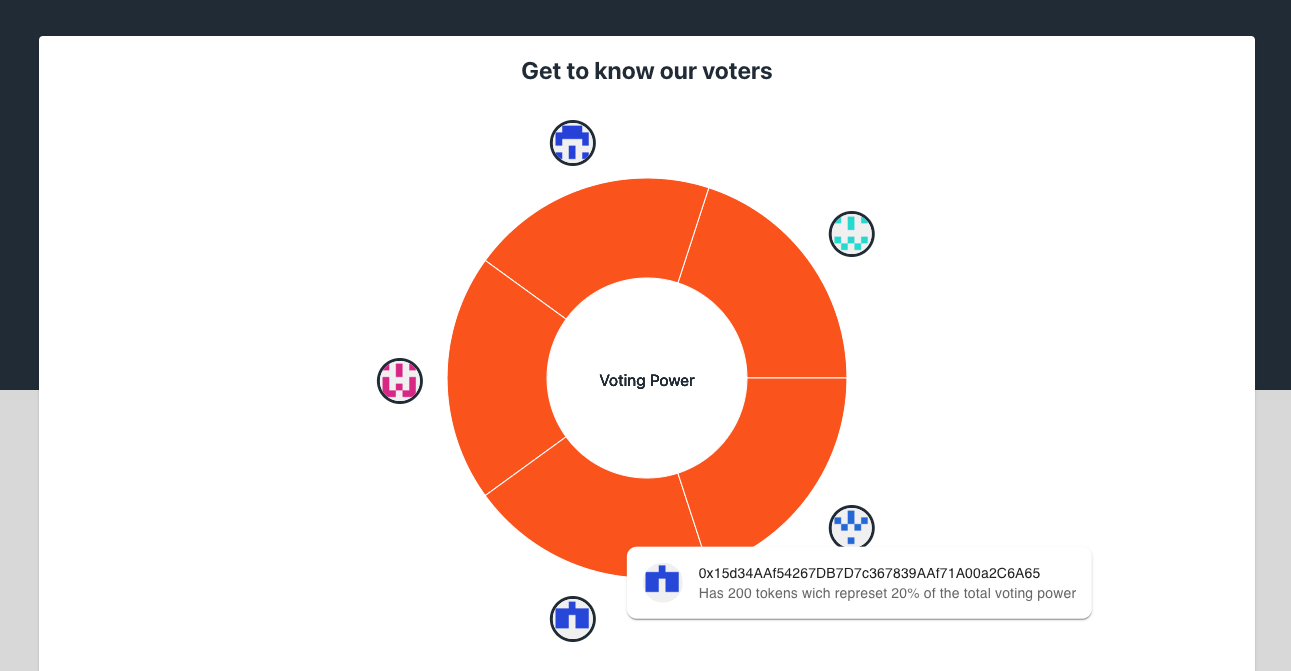
- Voters are defined during the deployment process, and are the addresses that can vote for or against a proposal.
- Participants are any other addresses that want to participate in the DAO by making proposals.
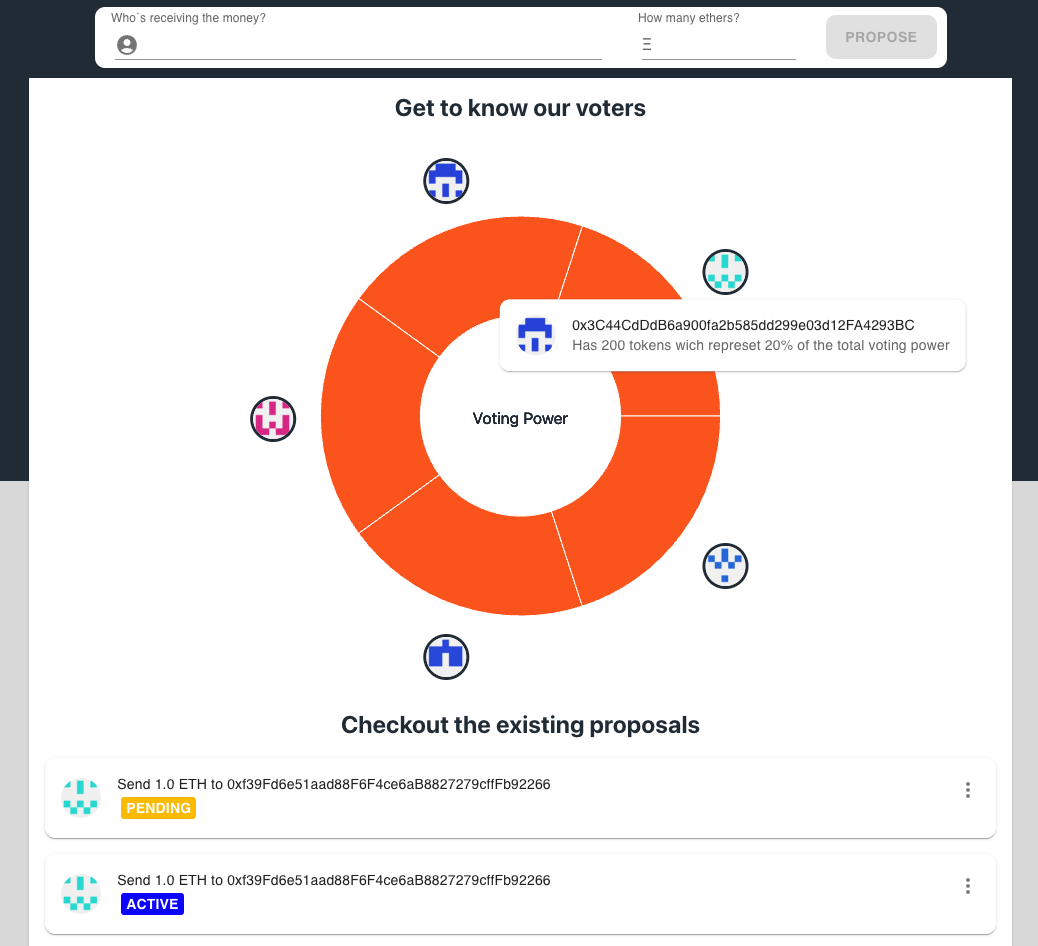
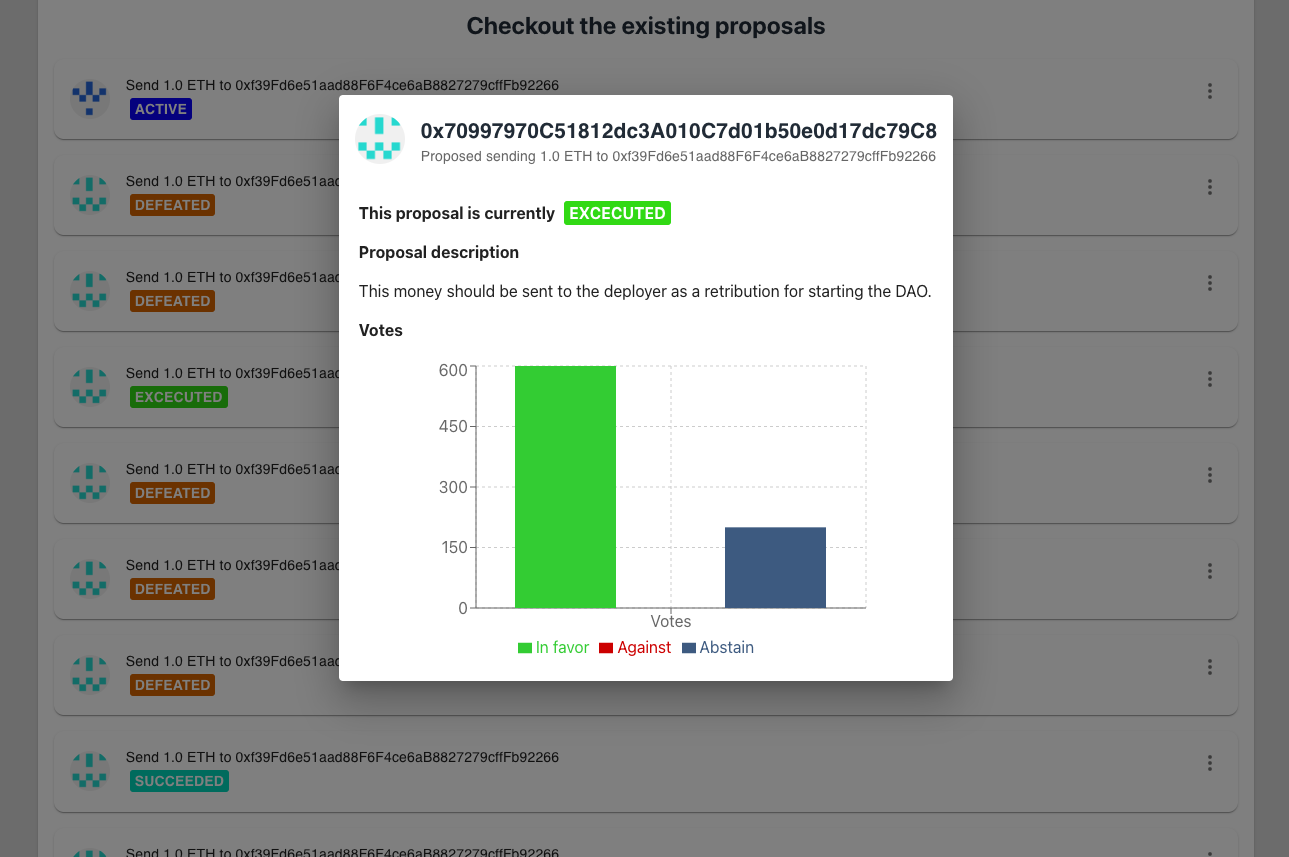
Any user can see the list of proposals that have been created. Each proposal shows the address that created the proposal, the target address, the proposed amount, the description, the proposal state, and the results of the voting process in real time. The proposal state determines in which phase of the voting process the proposal is currently at.
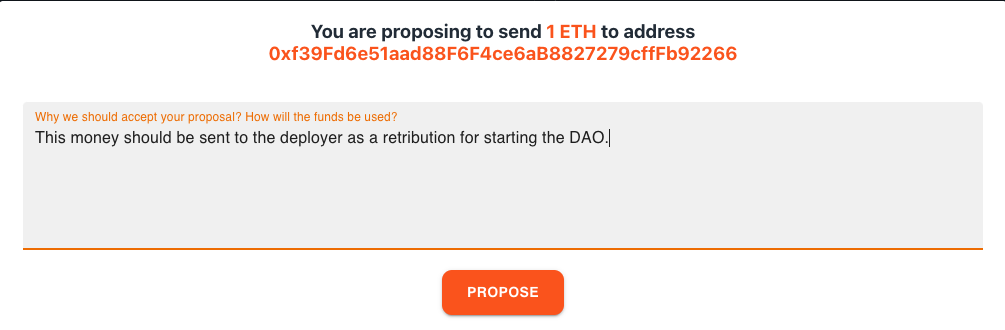
Any user can create a proposal. A proposal consists of a target address (address that will receive the money), the amount of money that should be transferred to the target address, and a description of why the money should be transferred. Any user can create a proposal if they have enough ethers to pay the gas fee for creating the proposal.
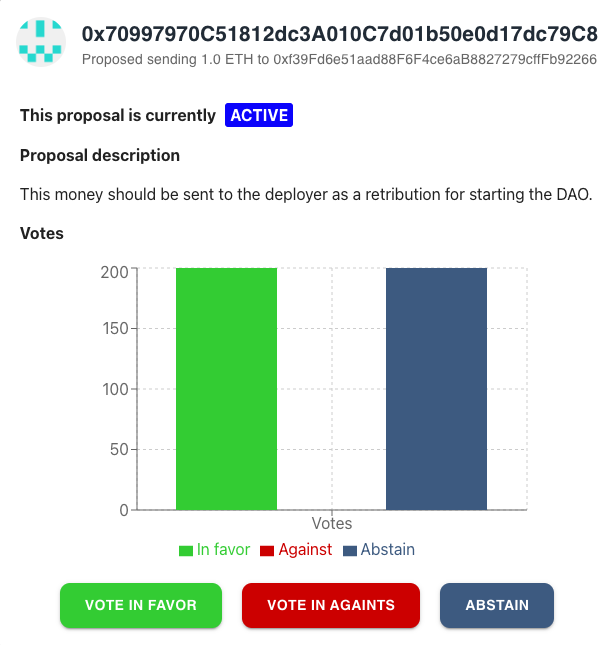
Only the voters can vote for a proposal. When a proposal´s state is active the voters are able to vote in favor, against, or abstain if they have enough ethers to pay the gas fee for voting.
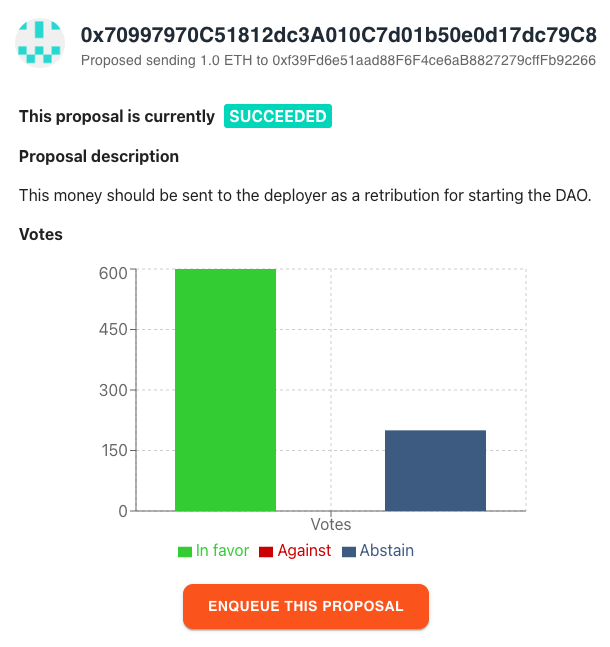
When a proposal succeeds, any user is allowed to enqueue the proposal if they have enough ethers to pay the gas fee for enqueuing.
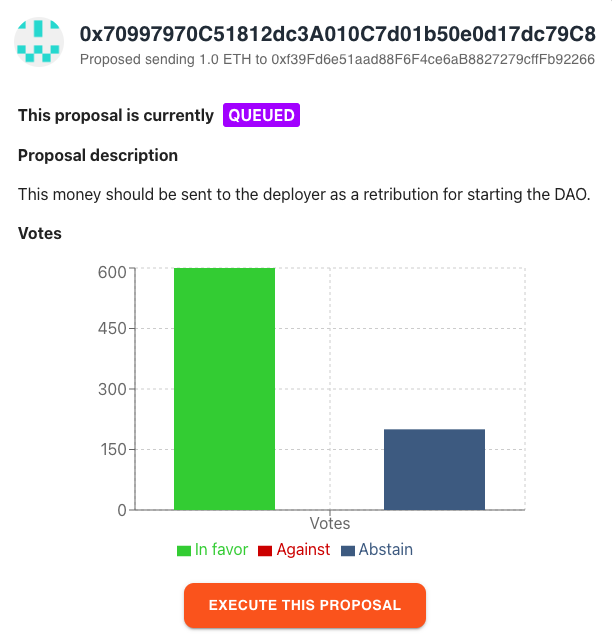
When a proposal is queued, any user is allowed to execute the proposal if they have enough ethers to pay the gas fee for execution.
You can try the app right here. The contracts were deployed on the Sepolia test net, and the front end is being hosted on IPFS.
To be able to vote you can import the following addresses in your Metamask:
Public key: 0xf39Fd6e51aad88F6F4ce6aB8827279cffFb92266
Private key: 0xac0974bec39a17e36ba4a6b4d238ff944bacb478cbed5efcae784d7bf4f2ff80
Public key: 0x70997970C51812dc3A010C7d01b50e0d17dc79C8
Private key: 0x59c6995e998f97a5a0044966f0945389dc9e86dae88c7a8412f4603b6b78690d
Public key: 0x3C44CdDdB6a900fa2b585dd299e03d12FA4293BC
Private key: 0x5de4111afa1a4b94908f83103eb1f1706367c2e68ca870fc3fb9a804cdab365a
Public key: 0x90F79bf6EB2c4f870365E785982E1f101E93b906
Private key: 0x7c852118294e51e653712a81e05800f419141751be58f605c371e15141b007a6
Public key: 0x15d34AAf54267DB7D7c367839AAf71A00a2C6A65
Private key: 0x8b3a350cf5c34c9194ca85829a2df0ec3153be0318b5e2d3348e872092edffba
⚠️ These are the Hardhat default development accounts, thus they are publicly known. Any funds sent to them on the Mainnet or any other live network WILL BE LOST
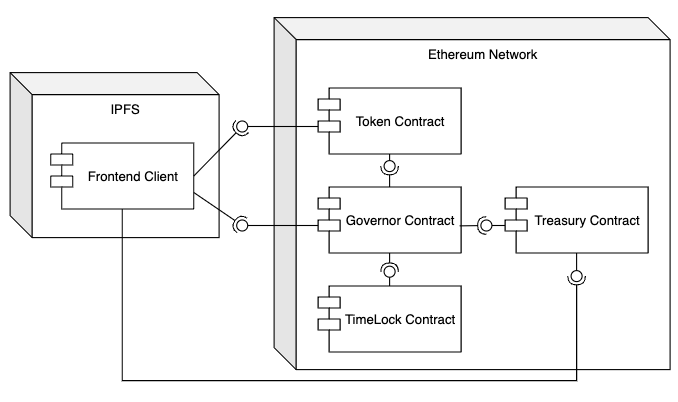
It is an ERC20 compliant currency contract. It uses the ERC20Votes Open Zeppeling library to implement the specification. This crypto currency is used to determine the amount of voting power one has on the DAO. The more tokens one possesses, the more weight one´s vote will have during the voting process.
This contract is in charge of controling time gaps between the varios stages on the voting process. It determines when the actions can take place and when they cannot.
This contract is used to store the funds of the DAO. This contract´s address will have the ethereum funds that are available.
This is the main contract of the project, it is in charge of orchestrating the other contracts in order to perform the creation of proposals, the voting processes and all the main features of the DAO. It uses the token contract to determine the voting power of each voter during the voting process. It uses the timelock contract to get a sense of time during the excecution of the processes, and it controls the treasury contract to release funds whenever a proposal is approved.
This component is a React JS built client that exposes a user interface for humans to interact with the developed smart contracts. It uses the library Ethers JS to connect directly to the smart contracts, and for state management in the app, it uses Redux and React Context in conjuction.
As a prerequisite you need to have Node JS installed on your computer, and Metamask installed on your browser.
Install dependencies
npm iStart a local Ethereum network
npx hardhat nodeDeploy the contracts on the the network you just started
npx hardhat node run scripts/deploy.ts --network localhostMove into the frontend folder
cd frontendInstall frontend dependencies
npm iStart the frontend app
npm startThe app should open up on your browser. To use it you can use the Hardhat addresses listed on the demo section of this document.
Mateo Devia -> Check out my personal web page!

This repository has the standard MIT license. You can find it here.