Oren is a rolling, self-hosted language and toolchain for programs that need to run under explicit effect boundaries.
It is not a Zig clone, a scripting toy, or only a compiler experiment. Oren's center is a single language surface that can target native code, portable C, and deterministic AVM bytecode while preserving capability-governed execution, resource budgets, and machine-readable verification evidence.
import http "std:net/avm/http"

fn main() {
    var title = http.get("https://note.local/data.json").text().json()["o"]["title"]["s"]
    print(title)
    exit(0)
}

main()
Most languages optimize for one of these surfaces: native performance, scripting ergonomics, sandboxed execution, package distribution, or machine-readable tooling. Oren is built around their intersection:
- Native plus bytecode parity. Build the same program through C, native machine code, or OBC bytecode for AVM.
- Capability-governed effects. FS, NET, PROC, ENV, TIME, RNG, GFX, and package permissions are explicit runtime-policy surfaces rather than hidden ambient access.
- Deterministic app execution. AVM provides VirtualFS, VirtualNET, VirtualPROC, virtual time, budgets, snapshots, UI mailboxes, and replayable host-effect boundaries.
- Agent-readable engineering evidence. Fixtures, manifests, readiness reports, status pages, and API-shape guards are part of the product surface, not afterthought scripts.
Oren is still rolling. The macOS arm64 native path is the most mature native backend; x64 Linux/Windows and full production app lifecycle hardening remain active work. See docs/STATUS.md for the current truth table.
Oren's current proof is not just syntax. The live OBC store publishes runnable
bytecode packages with source, screenshots, permissions, and installable
.obc.zip releases:
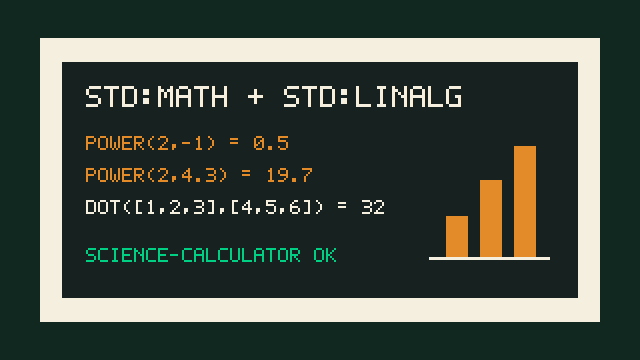
Numeric/linalg stdlib, deterministic OBC packaging, source assets, and portal presentation metadata.
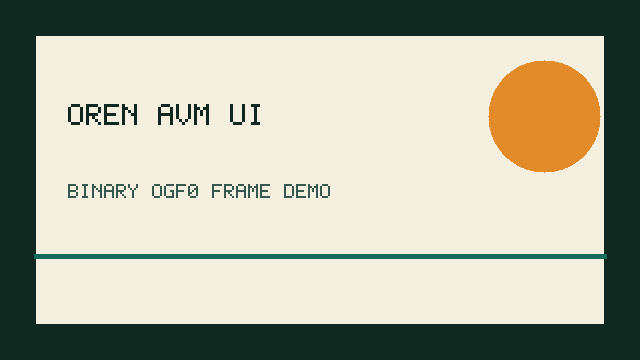
Retained 2D UI commands, AVM raster conformance, iOS rendering paths, and rendered Oren source with AST outline.
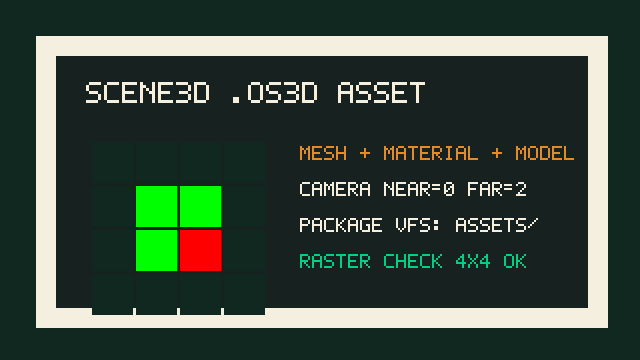
Byte-native .os3d package assets, retained Scene3D meshes/materials/models,
camera metadata, and package VFS mounting.
Screenshots are store presentation metadata, not client runtime assets: they are not declared in package manifests and are not included in downloaded OBC bundles. Declared Oren source renders in the portal with syntax highlighting and an AST-style outline, while host apps can still install and run the signed bundle.
Oren is designed to feel like a modern language while keeping low-level control available where it matters:
- Functions, closures, structs/classes, maps, lists, generators, and coroutines for application code.
- Traits, generics, method syntax, and call chaining with deterministic compile/link-time method lowering.
- Typed buffers and byte-native paths for efficient binary, graphics, crypto, and package-asset workloads.
- Structured fallible APIs using normal verbs that return values or
oren_err; low-level numeric errno contracts are explicit*_rawAPIs. - Feature-rich stdlib domains for JSON, YAML, CBOR, XML/HTML readers, regex, base64, crypto, buffers, linalg, UI, Scene3D, HTTP, WebSocket, TCP, UDP, TLS, DNS, and host-neutral AVM services.
Example: method-style APIs and chaining are first-class, not compatibility wrappers:
import bytes "std:bytes"
import sha256 "std:crypto/sha256"

fn main() {
    var digest = bytes.from_string("hello").sha256().hex()
    print(digest)
}

main()
Example: OBC packages can render UI/Scene3D through AVM without direct host graphics access. The host owns policy; bytecode sees virtualized mailboxes and budgets.
import scene3d "std:ui/scene3d"
import ui_avm "std:ui/avm"

fn main() {
    var commands = scene3d.commands_from_binary_file("assets/scene3d_card.os3d")
    if oren_is_err(commands) { exit(1) }

    var rc = ui_avm.present_frame(commands, 4, 4, {"strict_bounds": true})
    if oren_is_err(rc) { exit(1) }

    exit(0)
}

main()
For the practical language guide, start with docs/LANGUAGE.md.
Oren currently has three execution paths:
| Path | Use | Status |
|---|---|---|
| C backend | Portable bootstrap and cross-checking through a host C toolchain. | Useful baseline. |
| Native backend | Mach-O / ELF / PE output for local/server/desktop execution. | Most mature on macOS arm64; x64 is active bring-up. |
| OBC + AVM | Deterministic bytecode for capability-governed host apps. | Strong smoke/conformance gates; still rolling for production embedding. |
Build native:
./oren build examples/hello.oren -o build/hello
./build/hello
Build and run bytecode:
./oren build examples/hello.oren --backend bytecode -o build/hello.obc
make avm
./avm build/hello.obc
Run the default high-signal verification path:
./oretest./oretest is the repo-local fast entrypoint. Broader gates remain available
when needed:
make test
make test-avm
make verify-libavm-ios
make verify-obc-store-service
make test intentionally runs negative fixtures; parse/typecheck diagnostics in
the log are expected when the command exits successfully.
AVM is Oren's deterministic bytecode runtime. It supports app-facing embedder APIs, iOS xcframework packaging, compiler-in-AVM smoke coverage, VirtualFS, VirtualNET, VirtualPROC, virtual time, UI/GFX frame mailboxes, input events, permission prompts, and package install/run flows.
The public OBC store is live:
- Portal: https://store.hubstack.cn/
- Health: https://store.hubstack.cn/healthz
- Index: https://store.hubstack.cn/api/v0/index.json
The live store currently publishes first-party oren-labs demos for science,
2D UI, and Scene3D package assets. Host apps can install verified .obc.zip
bundles, mount package assets into VirtualFS, apply package permissions, and run
bytecode under AVM policy.
- docs/LANGUAGE.md: practical language guide.
- docs/OREN_THESIS.md: product thesis and differentiation.
- docs/CAPABILITY_RUNTIME_CONTRACT.md: capability/runtime-profile contract.
- docs/STATUS.md: current readiness and known gaps.
- docs/README.md: full documentation index.
- benchmarks/README.md: benchmark usage.
- benchmarks/RESULTS_LATEST.md: latest benchmark snapshot.
Oren is intentionally rolling, but not casual. Changes are expected to come with fixtures, conformance gates, docs updates, and fast verification. "Small" implementation means low resource consumption: CPU time, memory, disk, bandwidth, build overhead, and runtime overhead. It does not mean toy features or ad-hoc prototypes.
Copyright (c) 2025 Lu Zongbao (rikusouhou@gmail.com).
This project is licensed under the Apache License, Version 2.0. See LICENSE.