
MCP-native secret scanner — verified findings, agent-applied rewrites.
Ruby gem wrapper around the native leakferret
binary. This gem ships no scanning logic of its own: it installs a tiny Ruby
shim plus a small executable, and downloads the prebuilt, statically-linked
binary (written in Rust) from GitHub Releases once per platform at install
time. All the work — scan, classify, verify, rewrite — happens in that single
binary.
This is the same packaging pattern used by ruff, biome, and esbuild:
distributing the toolchain to build a Rust engine on every machine is
unfriendly, so we ship the compiled engine instead.
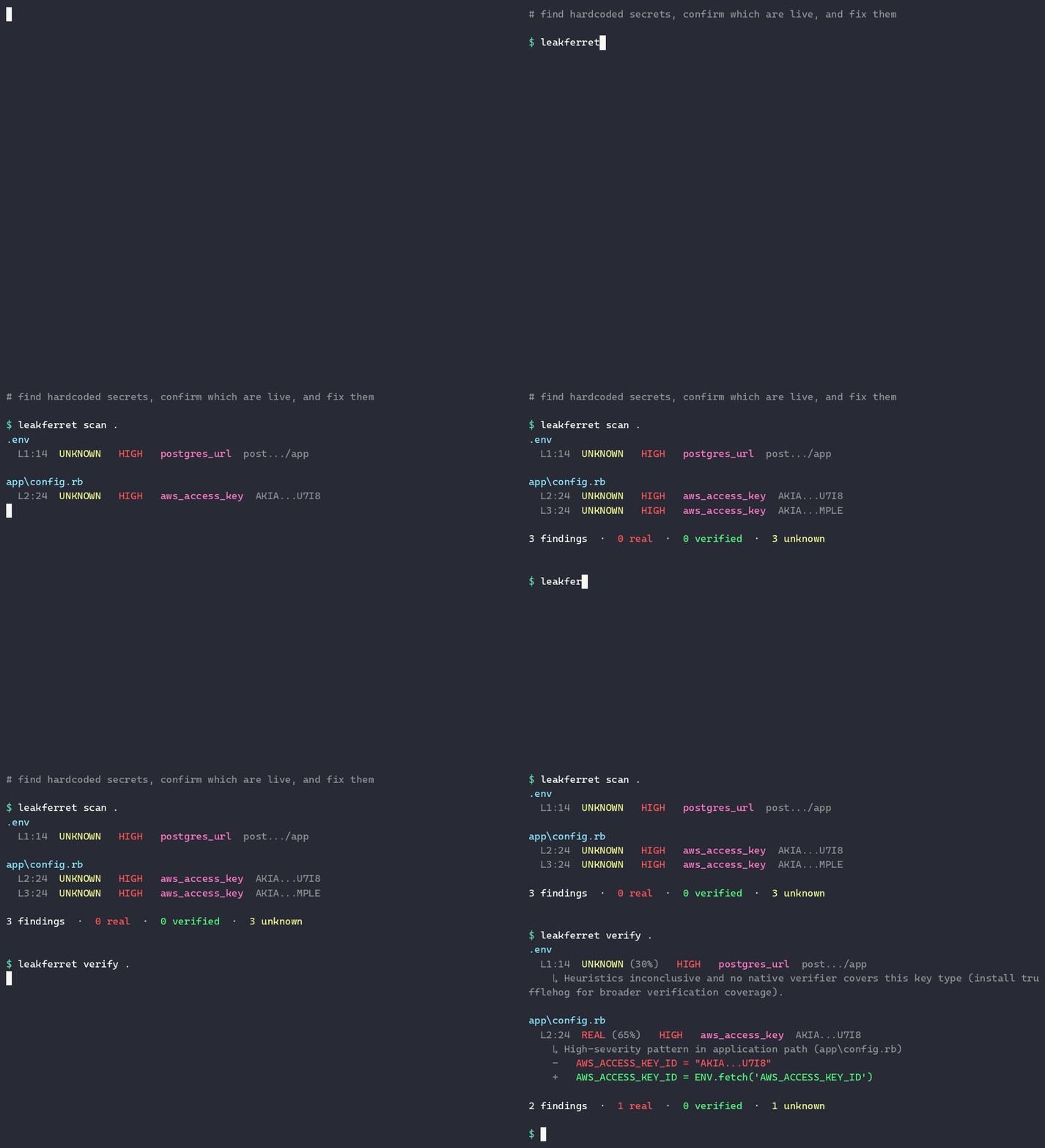
leakferret finds hardcoded secrets and API keys in your code and helps you remove them, in five stations:
- Scan — regex pre-filter over files; respects
.gitignoreand also reads dotfiles like.env. - Catalog — a signed database of known-public example credentials (Stripe
test keys,
AKIAIOSFODNN7EXAMPLE, jwt.io samples) so documented examples are markedFIXTUREinstead of false-alarming. - Classify — a
REAL/FIXTURE/UNKNOWNverdict, from offline heuristics or by asking the host editor/agent language model (no extra API key, no cost). - Verify — a real but harmless API call to the provider (AWS SigV4, GitHub, GitLab, Stripe, OpenAI, Anthropic, Slack, Twilio, SendGrid, Mailgun, Datadog, Heroku, npm, PyPI, DigitalOcean) to confirm a key is live, plus a trufflehog fallback.
- Rewrite — swap a hardcoded literal for an environment-variable lookup
(
ENV.fetchin Ruby,process.envin JS,os.environin Python), add a.env.exampleline, and print secret-manager seed commands.
Privacy invariant: the full secret value never leaves your machine. Only a
redacted first-4-plus-last-4 preview (e.g. AKIA...4XYZ) is ever written to a
report, log, network message, or model prompt. Verification calls go straight
from your machine to the provider — leakferret has no servers.
gem install leakferretThe platform binary (leakferret-{version}-{platform}.tar.gz from GitHub
Releases) is downloaded automatically on first use and cached under your home
directory — no Rust toolchain required.
Add it to a Gemfile for project-local use:
gem 'leakferret'Requires Ruby >= 3.1.
The gem installs a leakferret executable that simply execs the binary, so
every subcommand and flag works exactly as upstream:
leakferret scan .
leakferret verify . --only-verified
leakferret rewrite . --apply --backend doppler
leakferret baseline init
leakferret catalog info
leakferret mcp                 # MCP server on stdio
leakferret scan --git walks commit history. Output formats are pretty
(colored terminal), json, and sarif (for GitHub Code Scanning).
require 'leakferret'

# Regex pre-filter only.
findings = Leakferret.scan('.')

# + provider-verified (live HTTP to GitHub / Stripe / AWS / ...).
findings = Leakferret.verify('.', mode: 'only-verified')

# + propose rewrites for REAL findings.
findings = Leakferret.rewrite('.', backend: 'doppler')

# Apply rewrites in place.
Leakferret.rewrite('.', apply: true)
Each Finding is a hash with path, line, column, pattern, severity
(critical/high/medium/low), verdict (real/fixture/unknown),
match_redacted, confidence, verification, and fingerprint.
rewrite turns a hardcoded secret into an env-var lookup and helps you move it
into a secret manager:
leakferret rewrite . --dry-run-diff               # preview the change, touch nothing
leakferret rewrite . --apply                      # write `ENV.fetch("KEY")` in place + add to .env.example
leakferret rewrite . --apply --backend doppler    # also print seed commands for your manager
--backend accepts env (default), vault, doppler, aws-secrets-manager,
infisical. By default it only rewrites findings confirmed REAL/live; add
--include-unknown to also fix unconfirmed candidates.
leakferret is one binary with clear exit codes (0 = clean, 1 = findings), so
it drops into any CI. The recommended pattern: baseline once, then verify
on every build so you only fail on new secrets.
# One-time, on a repo that may already have findings:
leakferret baseline init            # fingerprints current findings (HMAC, never the raw secret)
git add .leakferret-baseline.json   # commit it — the per-repo salt is auto-gitignored
After that, verify ignores anything in the baseline and fails only on new leaks.
GitHub Actions — use the dedicated action (uploads SARIF to Code Scanning):
- uses: leakferrethq/leakferret-action@v1
  with: { path: ., fail-on: any }
CircleCI:
jobs:
  secrets:
    docker: [{ image: cimg/ruby:3.3 }]
    steps:
      - checkout
      - run: gem install leakferret
      - run: leakferret verify . --format sarif > leakferret.sarif
      - store_artifacts: { path: leakferret.sarif }
GitLab CI / Argo Workflows / Jenkins / anything else — identical recipe:
gem install leakferret
leakferret verify .                 # exits 1 on any REAL finding -> fails the job
Useful flags: --only-verified (fail only on provider-confirmed live keys),
--verify-mode ever-verified (with a baseline, fail on anything that ever
verified live), --format sarif|json.
leakferret is also an MCP server, so a coding agent (Cursor, Claude, Continue) can scan, verify, and rewrite before it commits. Add it to your editor's MCP config:
{
  "mcpServers": {
    "leakferret": { "command": "leakferret", "args": ["mcp"] }
  }
}
In Cursor: Settings → MCP → Add. In Claude Desktop: the mcpServers
block of claude_desktop_config.json. Tools exposed: scan_repository,
classify_candidates, verify_finding, propose_rewrite, baseline_diff.
Running
leakferret mcpdirectly in a terminal looks like it hangs — that's correct. It's a stdio JSON-RPC server waiting for your editor to connect, not a command you run by hand.
Every leakferret wrapper honors the LEAKFERRET_BIN environment variable. Point
it at a binary on disk and the wrapper runs that instead of the downloaded copy:
export LEAKFERRET_BIN=/opt/leakferret/leakferret
leakferret scan .
For air-gapped or offline installs, set LEAKFERRET_SKIP_DOWNLOAD=1 to skip the
release download and position the binary yourself.
MIT for this gem and the bundled binary. The fixture catalog data is
CC-BY-SA-4.0 — see leakferret-catalog.
Part of leakferret · leakferret.com · maintained by Maria Khan <missusk@protonmail.com>.