


This is the repository for inference with CCPFN (Continuous Causal Prior-Fitted Network), a causal foundation model for use in domains with a continuous treatment variable. This setting often requires the estimation of a full treatment-response curve, a non-trivial task as illustrated in Figure 1. Observational (historic) data is supplied as context, and queries are passed at inference time. No further training is required. This is the inference repository; the full research reposistory (including training code and our prior) is forthcoming.
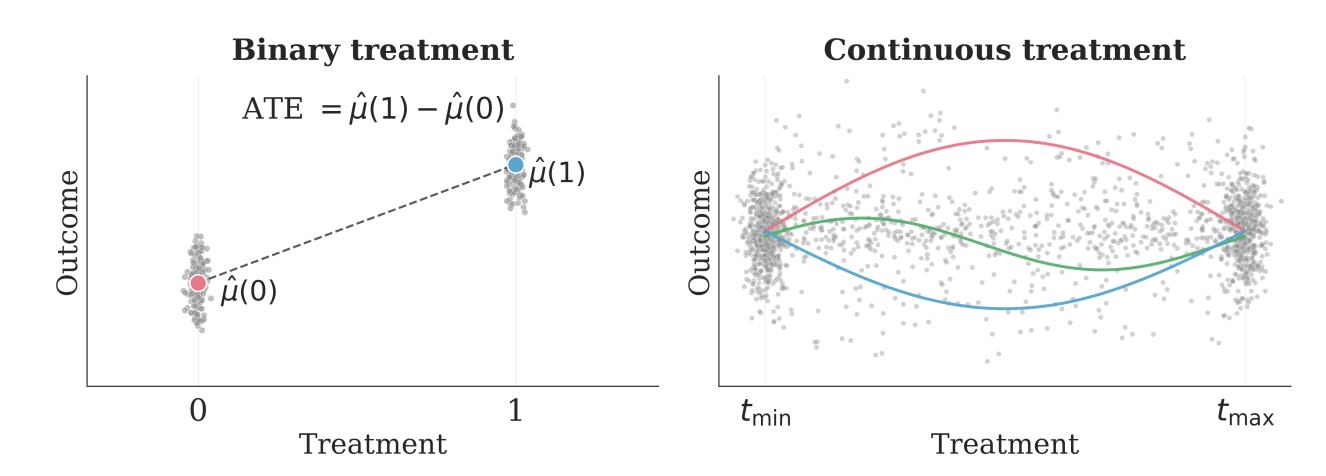 Figure 1: Estimating causal effects for continuous treatments (right) is much more challenging than
for binary treatments (left), as multiple treatment-response curves fit the observed data equally well.
Figure 1: Estimating causal effects for continuous treatments (right) is much more challenging than
for binary treatments (left), as multiple treatment-response curves fit the observed data equally well.
Install with pip:
pip install ccpfnModel weights are available on Hugging Face and will be automatically downloaded on first use.
To install from source, ensure you have Python ≥3.10. Then run the following:
git clone https://github.com/layer6ai-labs/CCPFN-inference.git
cd CCPFN-inference
pip install -e .
Example notebooks on CCPFN usage, including individual treatment-response curve reconstruction tasks, can be found in the notebooks directory. Here is a simple example demonstrating how to run CCPFN for conditional expected potential outcome (CEPO) estimation:
import numpy as np
import torch
from ccpfn import CEPOEstimator

device = torch.device("cuda:0" if torch.cuda.is_available() else "cpu")

# Define true individual treatment-response function
def treatment_response(x, t):
      return np.cos(x[..., 0]) + 2 * x[..., 1] * t

# Define treatment assignment function
def treatment(x):
      return 1 + np.sin(x[..., 2])

# Create synthetic data - covariates, treatment, outcome
rng = np.random.default_rng(seed=42)
n_samples, n_features = 2048, 3
X = rng.standard_normal((n_samples, n_features))
T = treatment(X)
Y = treatment_response(X, T) + 0.1 * rng.standard_normal((n_samples,))

# Context/query (train/test) split
test_ratio = 0.3
ctx_idx = rng.choice(n_samples, int((1 - test_ratio) * n_samples), replace=False)
qry_idx = np.setdiff1d(np.arange(n_samples), ctx_idx)
X_ctx, X_qry = X[ctx_idx], X[qry_idx]
T_ctx, Y_ctx = T[ctx_idx], Y[ctx_idx]
T_qry = rng.random((X_qry.shape[0],))  # Counterfactual treatments

# CEPO Estimation
estimator = CEPOEstimator(device=device)
estimator.fit(X_ctx, T_ctx, Y_ctx)
cepo_pred = estimator.estimate_cepo(X_qry, T_qry)

# Evaluation and results
cepo_true = treatment_response(X_qry, T_qry)
rmse = np.sqrt(np.mean((cepo_true - cepo_pred) ** 2))
print("Results:")
print(f"RMSE: {rmse:.4f}")CCPFN uses in-context learning (ICL) to estimate the effects of a continuously-varying treatment (for example, the dosage of a medication, or the sensitivity of economic outcomes to prices or rates). Specifically, it estimates the conditional expected potential outcome (CEPO), defined as
Our model achieves state-of-the-art performance on individual treatment-response curve reconstruction tasks compared to causal models which are trained specifically for those tasks.
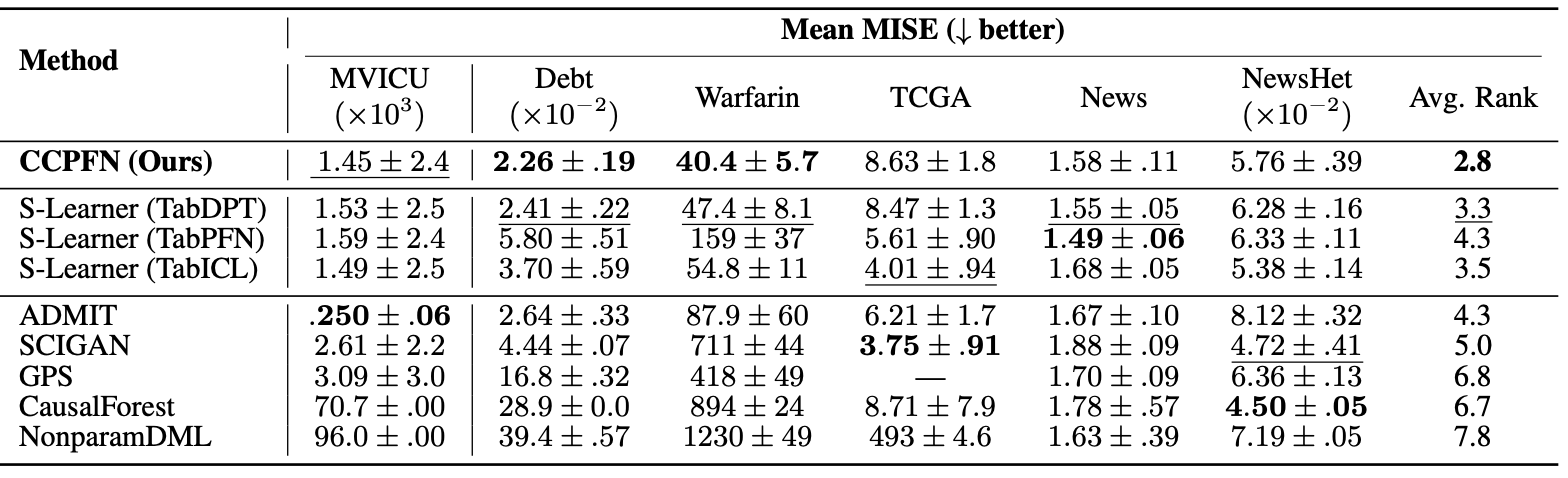 Table 1: Comparative evaluation of mean MISE across benchmark test datasets. Columns correspond
to different benchmark datasets; values represent mean MISE ± standard deviation as computed
with 5-fold cross-validation. First place is bold, second place is underlined. Dashes (—) indicate no
meaningful results were obtained. When evaluating TabPFN we apply PCA to reduce the dimension
to 100, due to memory constraints and to match the dimensionality reduction used in CCPFN. DRNet,
VCNet, and EBCT did not produce meaningful results for the MISE metric and hence are omitted.
Table 1: Comparative evaluation of mean MISE across benchmark test datasets. Columns correspond
to different benchmark datasets; values represent mean MISE ± standard deviation as computed
with 5-fold cross-validation. First place is bold, second place is underlined. Dashes (—) indicate no
meaningful results were obtained. When evaluating TabPFN we apply PCA to reduce the dimension
to 100, due to memory constraints and to match the dimensionality reduction used in CCPFN. DRNet,
VCNet, and EBCT did not produce meaningful results for the MISE metric and hence are omitted.
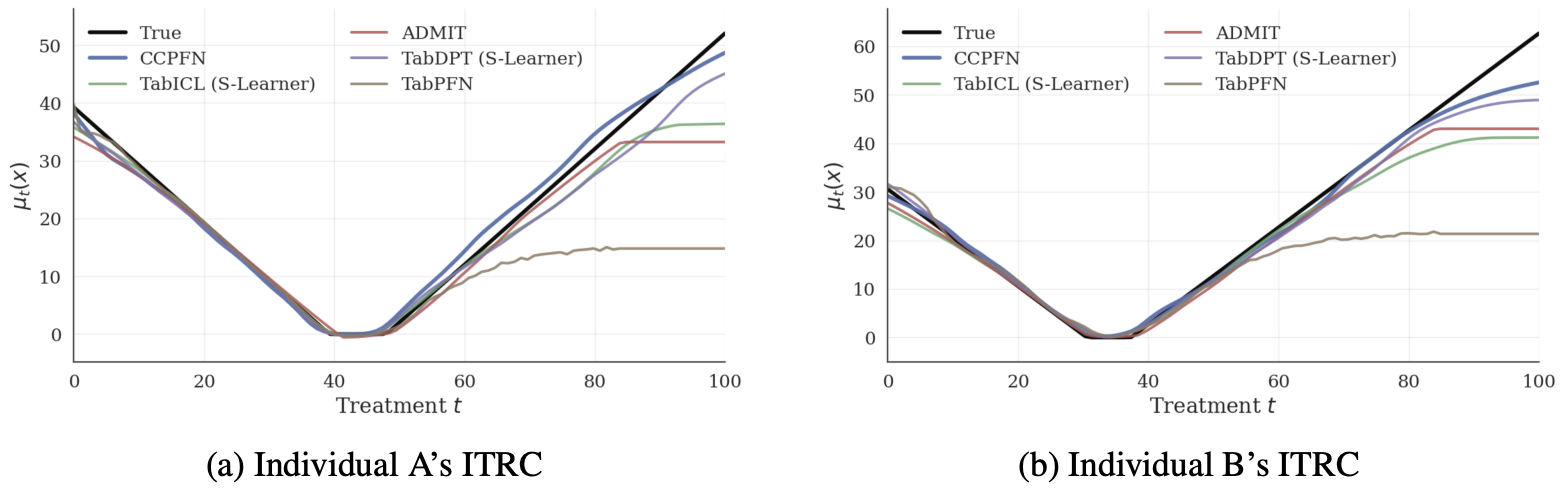
Figure 2: Predicted individual treatment-response curves (ITRCs) and true ITRC for two randomly selected individuals from the Warfarin benchmark, where the outcome represents the loss between a patient’s administered dose and the optimal dose, as determined by the IWPC pharmacogenetic dosing algorithm.
     title={Causal Foundation Models with Continuous Treatments},
     author={Christopher Stith and Medha Barath and Vahid Balazadeh and Jesse C. Cresswell and Rahul G. Krishnan},
     year={2026},
     eprint={2605.15133},
     archivePrefix={arXiv},
     primaryClass={cs.LG},
     url={https://arxiv.org/abs/2605.15133},
}