This repository is aimed with to build different types of Generative Models.
Till now, I've implemented DC-GAN(Deep Convolution Generative Adverserial Networks) only!
Generative Adversarial Networks (GANs) are one of the most interesting ideas in computer science today. Two models are trained simultaneously by an adversarial process. A generator ("the artist") learns to create images that look real, while a discriminator ("the art critic") learns to tell real images apart from fakes.
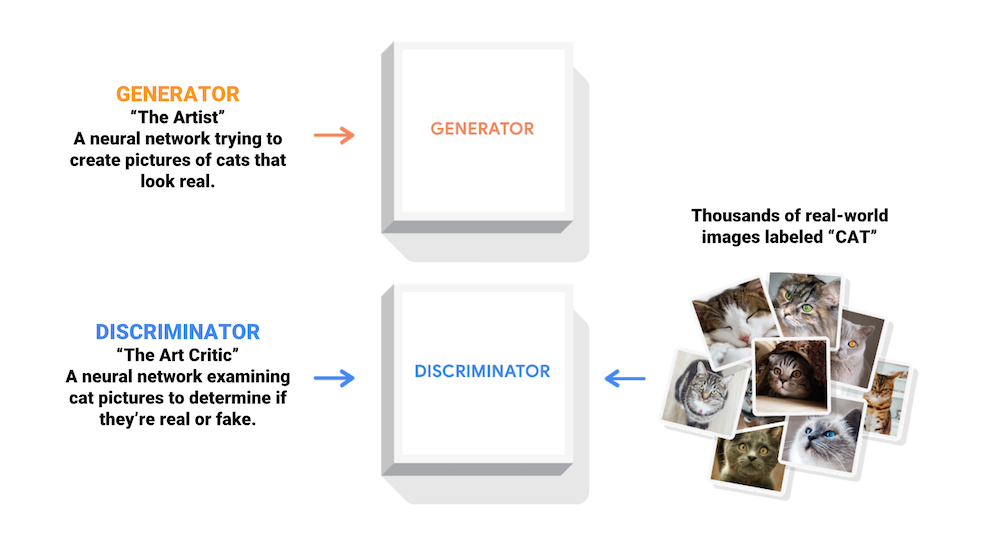
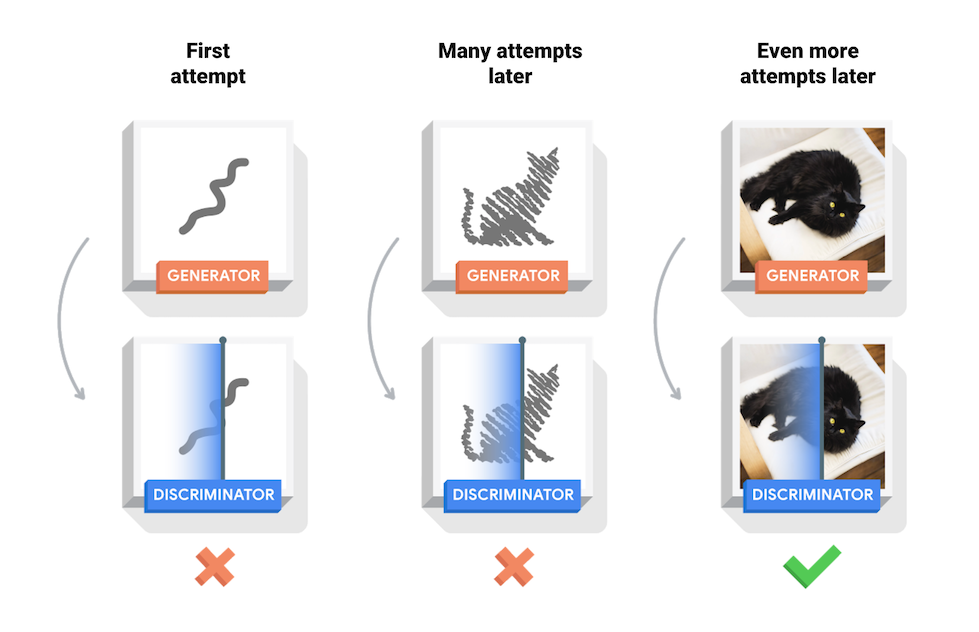
During training, the generator progressively becomes better at creating images that look real, while the discriminator becomes better at telling them apart. The process reaches equilibrium when the discriminator can no longer distinguish real images from fakes.
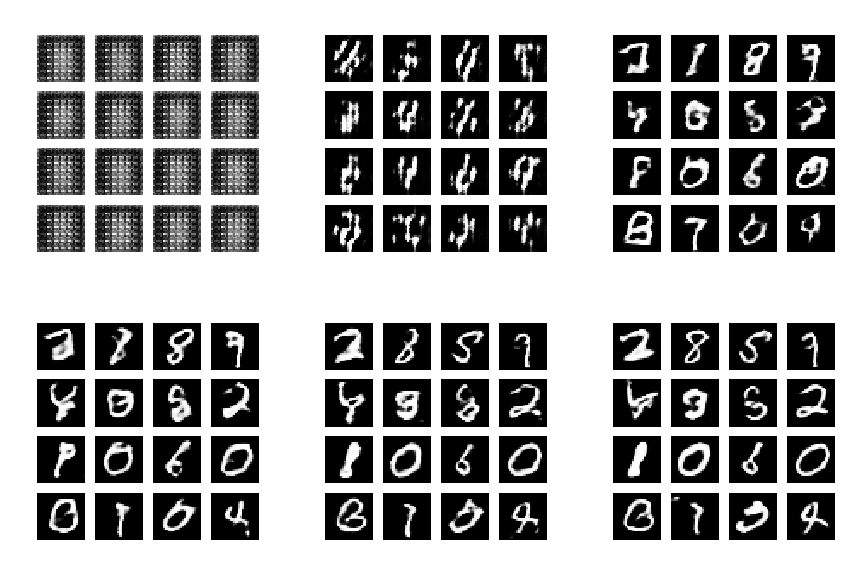
This notebook demonstrates this process on the MNIST dataset. The following animation shows a series of images produced by the generator as it was trained for 50 epochs. The images begin as random noise, and increasingly resemble hand written digits over time.
The generator uses tf.keras.layers.Conv2DTranspose (upsampling) layers to produce an image from a seed (random noise). Start with a Dense layer that takes this seed as input, then upsample several times until you reach the desired image size of 28x28x1. Notice the tf.keras.layers.LeakyReLU activation for each layer, except the output layer which uses tanh.
The discriminator is a CNN-based image classifier.
This method quantifies how well the discriminator is able to distinguish real images from fakes. It compares the discriminator's predictions on real images to an array of 1s, and the discriminator's predictions on fake (generated) images to an array of 0s.
The generator's loss quantifies how well it was able to trick the discriminator. Intuitively, if the generator is performing well, the discriminator will classify the fake images as real (or 1). Here, we will compare the discriminators decisions on the generated images to an array of 1s.
NIPS 2016 Tutorial: Generative Adversarial Networks
GAN — DCGAN (Deep convolutional generative adversarial networks)
MIT's Intro to Deep Learning course.
Anyone interested in GANs and other generative models like VAEs, are always welcome to contribute and feel free to contact me.