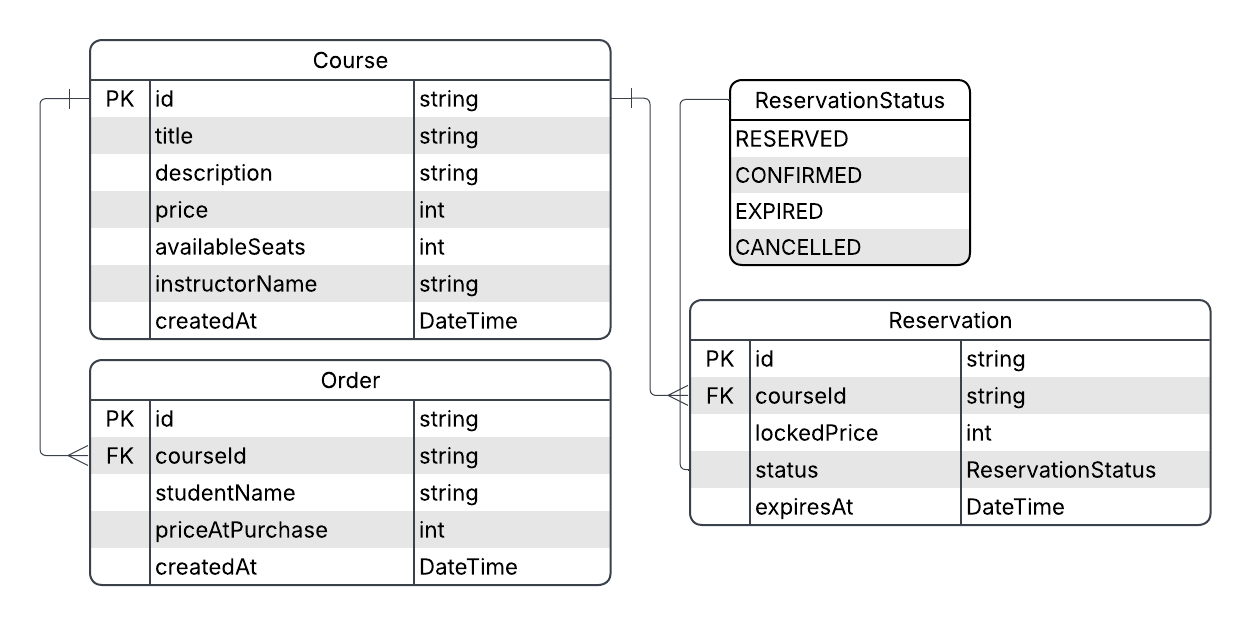
This project implements a microservice-based online course marketplace. It consists of two microservices:
-
Course Service
- Manages course creation, pricing, inventory (available seats), and instructor ownership.
- Supports dynamic pricing and atomic seat reservations.
-
Order Service
- Handles student course purchases.
- Verifies real-time price and seat availability via the Course Service.
- Implements seat reservation → order creation → reservation confirmation workflow.
This setup ensures strong data consistency, prevents race conditions, and handles service failures gracefully.

-
Seat Reservation System
Ensures atomic seat deduction and prevents double bookings. -
Retry & Fallback
Internal service-to-service API calls include retry logic for transient failures. -
Concurrency Safe
Locking mechanisms are implemented to avoid race conditions during seat reservation. -
Reservation Expiry
A cron job automatically releases seats if reservations are not confirmed within a defined time. -
Health Check
Each microservice exposes a dedicated health endpoint for monitoring. -
Dockerized Architecture
All services run in isolated Docker containers and communicate over a shared Docker network.
- Node.js + Express.js for microservices
- Docker + Docker Compose for containerization and orchestration
- Axios for internal service communication
- In-memory data storage (no database required for this assignment)
course-service
├── dist/               # Compiled JavaScript output (after build)
├── node_modules/       # Project dependencies
├── src/                # Application source code
│ ├── controllers.ts    # Handles incoming API requests
│ ├── cron.ts           # Cron jobs (reservation expiry, cleanup tasks)
│ ├── routes.ts         # API route definitions
│ ├── services.ts       # Business logic (seat reservation, pricing)
│ ├── models.ts         # Data models / in-memory storage
│ ├── interface.ts      # TypeScript interfaces & types
│ └── index.ts          # Application entry point
├── .dockerignore       # Files ignored by Docker
├── .gitignore          # Files ignored by Git
├── Dockerfile          # Docker build configuration
├── package-lock.json   # Locked dependency versions
├── package.json        # Project metadata & scripts
└── tsconfig.json       # TypeScript configuration

order-service
├── dist/               # Compiled JavaScript output (after build)
├── node_modules/       # Project dependencies
├── src/                # Application source code
│ ├── controllers.ts    # Request handlers (business logic entry points)
│ ├── routes.ts         # API route definitions
│ ├── services.ts       # Core business logic & service layer
│ ├── models.ts         # Data models / schemas
│ ├── interface.ts      # TypeScript interfaces & types
│ └── index.ts          # Application entry point
├── .dockerignore       # Files ignored by Docker
├── .env                # Environment variables (local)
├── .env.example        # Example env file for setup
├── .gitignore          # Files ignored by Git
├── Dockerfile          # Docker build configuration
├── package-lock.json   # Locked dependency versions
├── package.json        # Project metadata & scripts
└── tsconfig.json       # TypeScript configuration
- Clone the repository
git clone https://github.com/junayednoman/microservice-assignment
cd microservice-assignment- Create .env file in the Order Service
COURSE_API_URL=http://course-service:5001/api/courses- Build and run services with Docker Compose
docker compose up -d --build- Stop services
docker-compose down| Method | Endpoint | Description |
|---|---|---|
| POST | /api/courses |
Create a new course |
| GET | /api/courses/:id |
Get a single course |
| PATCH | /api/courses/:id/price |
Update course price |
| PATCH | /api/courses/:id/reserveSeat |
Reserve a seat atomically |
| PATCH | /api/courses/:reservationId/confirmReservation |
Confirm a reservation |
| PATCH | /api/courses/:reservationId/cancelReservation |
Cancel a reservation |
| GET | /api/health |
Health check |
| Method | Endpoint | Description |
|---|---|---|
| POST | /api/orders |
Create a new order (handles reservation & confirmation) |
| GET | /api/health |
Health check |
- Start services via Docker Compose.
- Use Postman to:
- Create courses in Course Service.
- Place orders via Order Service.
- Test race conditions by simulating multiple users trying to reserve the last seat simultaneously.
- Check health endpoints:
http://localhost:5001/api/healthhttp://localhost:5002/api/health
- No database is used; in-memory storage is implemented for simplicity.
- Services communicate using Docker network:
COURSE_API_URL=http://course-service:5001/api/courses - Cron jobs handle automatic expiration of reserved seats to prevent ghost reservations.
Built with ❤️ by Junayed Noman