  _____                   _             _ _____
 |_   _|                 (_)           | |  __ \
   | | ___ _ __ _ __ ___  _ _ __   __ _| | |__) |___  ___  ___ _   _  ___
   | |/ _ \ '__| '_ ` _ \| | '_ \ / _` | |  _  // _ \/ __|/ __| | | |/ _ \
   | |  __/ |  | | | | | | | | | | (_| | | | \ \  __/\__ \ (__| |_| |  __/
   |_|\___|_|  |_| |_| |_|_|_| |_|\__,_|_|_|  \_\___||___/\___|\__,_|\___|




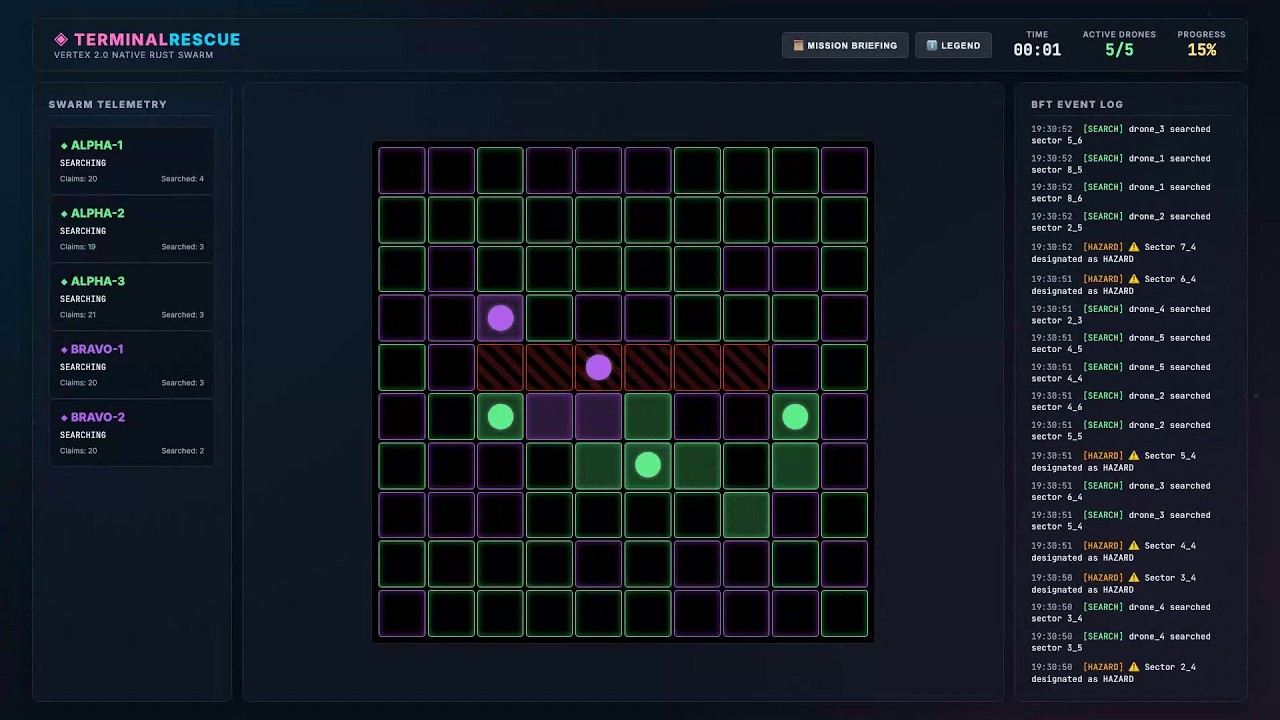
Search-and-rescue operations in disaster zones face a fundamental coordination challenge: when autonomous drone swarms rely on a centralized ROS master node, a single hardware failure brings the entire fleet to its knees. In environments with degraded communications — collapsed cell towers, electromagnetic interference, GPS blackouts — this centralized dependency is not just inconvenient; it's fatal for the people waiting to be found.
Terminal Rescue is a hybrid Rust/Python simulation of a leaderless search-and-rescue drone swarm that uses Tashi's FoxMQ decentralized MQTT broker for peer-to-peer coordination. There is no master node. No central database. No single point of failure.
Five independent drone agents — compiled as native Rust binaries for maximum throughput — divide a 10×10 disaster grid into search sectors through a consensus-backed bidding protocol. Each drone publishes heartbeats to FoxMQ, which uses Vertex's BFT (Byzantine Fault Tolerant) consensus to guarantee that every drone sees messages in the exact same order. This deterministic ordering is the foundation of the entire coordination protocol — it eliminates race conditions in sector claiming and provides mathematically provable coordination correctness.
A Python FastAPI server acts as Mission Control, delivering a real-time glassmorphism Web UI dashboard over WebSockets.
Terminal Rescue mathematically proves Mesh Survival and Decentralized Logic without relying on heavy 3D physics engines. By abstracting the physical environment into a live real-time dashboard, the entire focus of the architecture is on demonstrating FoxMQ's BFT messaging for verifiable, collision-proof drone coordination coupled with a beautiful and accessible Web UI.
The real proof is in the failure. The core feature is the Kill-Switch Stunt:
- Launch the Uvicorn web server and open the Mission Control web dashboard at
localhost:8000— it automatically connects to the FoxMQ broker and tracks the autonomous drones. - Click the remote KILL button next to any drone in the telemetry panel to destroy it mid-mission.
- The remaining drones detect the missed heartbeat, mark it as
OFFLINE, release its uncompleted sectors back to the pool, and autonomously re-bid to claim those orphaned sectors.
The grid search completes with zero orphaned sectors and zero human intervention. This demonstrates Mesh Survival — the fleet doesn't just "survive" a node dropout, it actively self-heals and redistributes workload in real time.
The mesh also showcases autonomous trajectory re-routing when presented with sudden geometric obstacles:
- Click anywhere on the sweeping grid during a live mission to drop an impassable HAZARD firewall.
- The Rust backend instantly broadcasts a massive
+10,000Euclidean cost penalty to those sectors. - The drones instinctively redraw their pathfinding vectors mid-flight, snaking perfectly around the danger zone without losing coordination.
Aligned with the hackathon's "Systems Over Demos" philosophy, we deliberately abstracted 3D aerodynamics into a 2D matrix to invest 100% of engineering time into bulletproof Vertex BFT coordination logic. The 2D grid proves the protocol is platform-agnostic — the same coordination algorithm works identically whether running on toy drones, industrial UAVs, or Mars rovers. What matters is the consensus math, not the physics engine.
- Leaderless: No central command. All nodes govern themselves based on shared consensus state.
- Zero Central Coordinator: All coordination happens through FoxMQ's consensus-ordered MQTT topics.
- BFT Consensus Ordering: FoxMQ/Vertex guarantees all drones process messages in identical order — no race conditions.
- Deterministic State Replication: Every drone's local state converges to the same global state via consensus.
- Heartbeat Failure Detection: Configurable timeout triggers autonomous workload re-allocation.
- Aversion-Weighted Pathfinding: Greedy nearest-neighbor with dynamic
+10,000cost penalties for real-time hazard avoidance. - S-Curve Inertia Physics: Frontend evaluates Euclidean jumps to compute rendering speeds via
cubic-beziermass acceleration with capped velocities. - Glassmorphism Web Dashboard: FastAPI + WebSocket-powered Mission Control with live telemetry, environmental scars (
.craterfrom offline nodes), and remote kill capabilities. - One-Command Demo:
make runlaunches FoxMQ, FastAPI, and 5 compiled Rust drones. One click for judges.
For hackathon judges, we've designed a friction-free setup using the bundled Makefile:
-
Set up a Python virtual environment (recommended to avoid polluting global state):
python3 -m venv venv source venv/bin/activate -
One-Command Setup:
make setup
(This automatically installs dependencies, sets execution permissions, prepares FoxMQ schema, and sets up FastAPI).
-
Launch the Simulation:
make run
(Then open
localhost:8000in your browser)
make setup  # Installs deps, modifies permissions, prepares FoxMQ
make run    # (alias `make demo`) Launches background drones and the Uvicorn web server
make kill   # Forcefully terminates any rogue background processes
make clean # Performs `make kill` and wipes python cache directoriesflowchart TD
D1["Drone (1)"] <--> broker["FoxMQ<br>BFT Broker<br>(Vertex)<br>MQTT 1883"]
D2["Drone (2)"] <--> broker
broker <--> D3["Drone (3)"]
broker <--> D4["Drone (4)"]
broker --- obs["Observer<br>(Mission Control)"]
- Rust — Native drone firmware & BFT pathfinding binaries
- Python 3.11+ / FastAPI — Mission Control telemetry server
- FoxMQ v0.3.1 — Tashi's Vertex BFT consensus MQTT broker
- paho-mqtt (MQTTv5) — Drone pub/sub messaging
- Vanilla JS/CSS — Glassmorphism Web UI (no frameworks)
- Playwright — Automated demo recording
Watch the full demo on YouTube
| Swarm Bootup | Grid Claiming |
|---|---|
 |
 |
| Mesh Stabilization | Mission Control Live |
|---|---|
 |
 |
| Kill-Switch Activation | Fault Detection (BFT) |
|---|---|
 |
 |
| Autonomous Recovery | Mission Complete |
|---|---|
 |
 |