
Your AI agent needs to read the production database. The connection string is the one thing you cannot hand it.
Give an agent a database URL and that credential now lives on a laptop, in a config file, in shell history, and in whatever the agent decides to echo back. Rotating it means finding every copy. And every query it runs is attributed to nobody.
db-mcp-gateway holds the credential instead. It is a self-hosted MCP server your team deploys once. Developers point their agent at one URL. The gateway authenticates them through the SSO you already run, checks each query against permissions reviewed by pull request, and commits an append-only audit row before any result goes back.
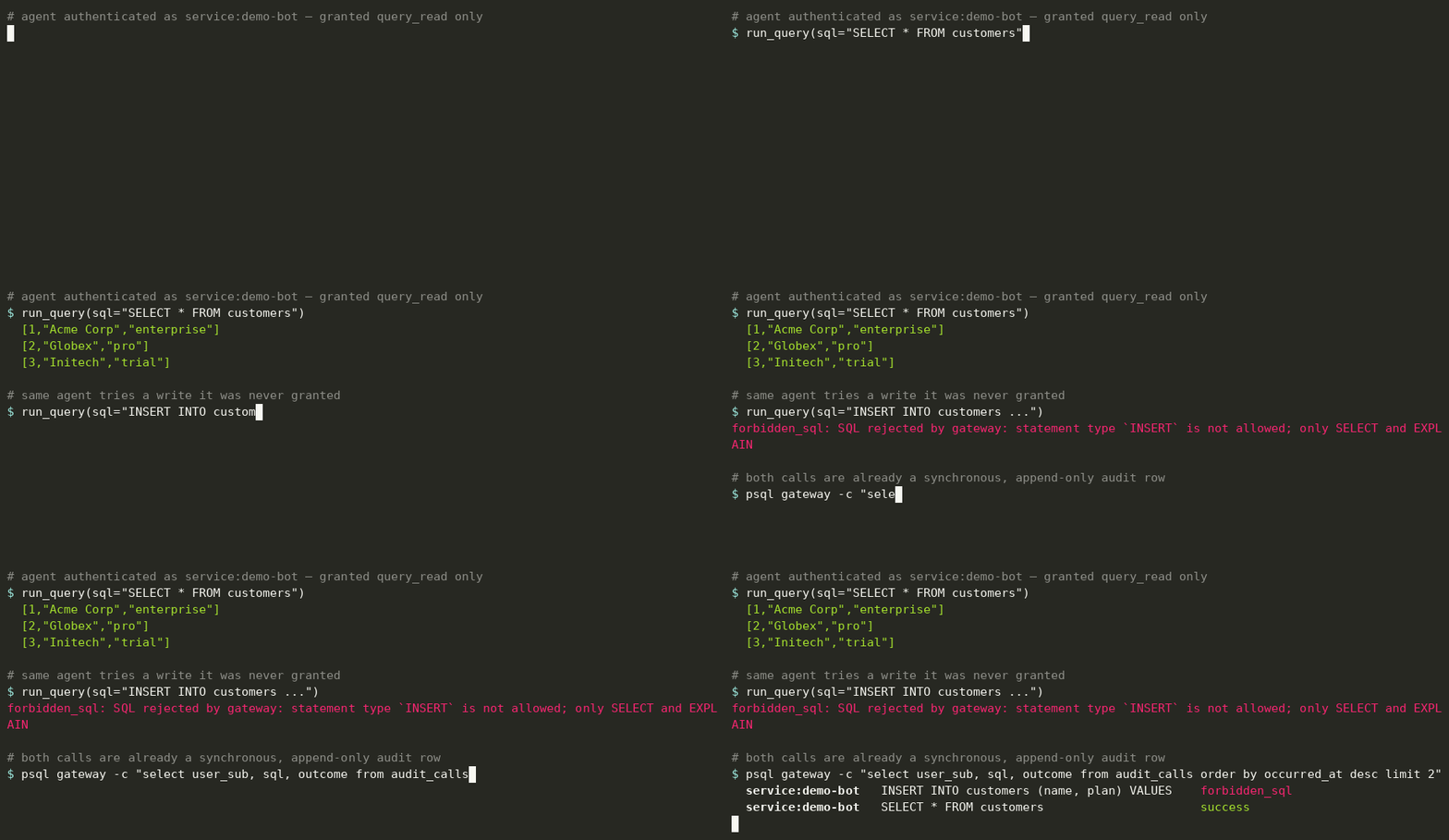
v1.5.0 — stable, in production use. One image, one YAML file, and one Postgres for the gateway's own state:
docker pull ghcr.io/developerz-ai/db-mcp-gateway:1.5.0Public on GHCR, no auth needed to pull. Multi-arch (linux/amd64,
linux/arm64), built reproducibly from a v* git tag. :latest tracks the
newest release; pin the version in production. Compatibility policy in
website/docs/deployment/releasing.md,
deployment in website/docs/deployment/quickstart.md.
Client side, that is the whole setup:
claude mcp add --transport http db-gateway --scope project https://db.internal.acme.comThe first call triggers SSO in a real browser — no embedded webview, no token
pasting. Walk through it end to end in
website/docs/usage/first-query.md, or use
another MCP client via
website/docs/usage/other-agents.md.
| Pillar | What it means |
|---|---|
| Credentials never leave the gateway | No DB URL on a laptop, ever. No tool returns one. No log line contains one. |
| Identity end-to-end | Every query traces SSO user → group → grant → audit row. |
| Config-as-code | Permissions live in YAML, reviewed by PR. No in-band admin UI, by design. |
"MySQL" means two unrelated things here, so both are stated once, in one table. Query targets are what an agent can read through the gateway. The permissions store is where the gateway keeps its own grant metadata — an agent never touches it.
| PostgreSQL | MongoDB | MySQL | MSSQL | |
|---|---|---|---|---|
| Query target — agents can query it | yes | yes | no — rejected at boot | no — rejected at boot |
| Permissions store — gateway's own state | yes | no, by design | resolver path only, no admin API | no |
A server.kind of mysql or mssql refuses to start rather than booting
clean and failing every query, so a wrong config is caught at deploy time and
not by a user. MySQL and MSSQL query adapters are on the roadmap.
Performance: we publish no benchmark numbers. We removed the ones we had because nobody had measured them — here is what happened and how to measure it yourself.
- MCP tool surface —
list_servers,list_databases,describe_schema,sample_table,run_query,explain,get_query_history. - OIDC SSO — Any OIDC-compliant identity provider (e.g. Okta, Google Workspace, Entra, Authentik, Keycloak). Browser-flow login from the agent.
- Read-only by default, writes opt-in per grant — per-database least-privilege roles; a
query_writegrant permits data writes (INSERT/UPDATE/DELETE), never schema changes. Statement timeouts and row caps enforced at the DB and gateway layer. - Permissions in YAML — group × server × database × action, with per-grant constraints (
require_reason,row_limit,statement_timeout_ms, allow/deny schemas, time windows). Reviewed by PR, with the full change history git already gives you. - Synchronous audit log — user, SQL, reason, row count, duration, outcome. The write commits before the response is sent; if it fails, the request fails. Retained in the gateway's Postgres with a configurable TTL and an hourly pruner, with optional
stdout/syslogstream sinks for feeding an existing log pipeline or SIEM. Archive to object storage and OTLP streaming are roadmap Phase 4, not shipped. - Boring deployment —
docker pull, one YAML file, and one Postgres for the gateway's own state. The databases your agents query are your existing ones; the local quickstart stands up a throwaway target too, so you can try it end to end without pointing at anything real. No agent runtime, no query builder, no credential vault to operate.
Complete feature documentation →
| If you are… | What you get |
|---|---|
| Platform / SRE | Agent database access without credential exposure, and one place to revoke it |
| A backend developer | Production queries for debugging with no password on your laptop, every one attributed to you |
| Data / analytics engineers | Agent-assisted access to supported targets through one interface, with resource limits already enforced |
| Security / compliance | Per-query SSO attribution, enforced reason logging, and an audit trail you did not have to build |
┌─────────┐    MCP/HTTPS    ┌──────────────┐    pg wire    ┌──────────┐
│ agent   │ ──────────────▶ │   gateway    │ ────────────▶ │ target   │
│ (Claude │   bearer: jwt   │              │  ro role per  │  DBs     │
│  Code)  │ ◀────────────── │  authz+audit │ ◀──────────── │          │
└─────────┘   tool result   └──────┬───────┘   result rows └──────────┘
                                   │
                                   ▼
                            ┌──────────────┐
                            │ state DB     │
                            │ (sessions +  │
                            │  audit log)  │
                            └──────────────┘
| If you're… | Read |
|---|---|
| Trying to understand what this is | website/docs/initial-idea/01-overview.md |
| A developer whose org already runs it | website/docs/usage/first-query.md (5-min walkthrough) → website/docs/usage/claude-code.md (reference) |
| A platform/SRE deploying it | website/docs/deployment/quickstart.md |
| Adding it to a non-Claude MCP client | website/docs/usage/other-agents.md |
| Cutting a release | website/docs/deployment/releasing.md |
| Wondering what it won't do | website/docs/initial-idea/10-non-goals.md |
| Tracking what's built vs planned | website/docs/initial-idea/11-roadmap.md |
| Asking about performance | website/docs/benchmarks.md |
| Comparing against alternatives | website/docs/comparison.md |
| Concern | Choice |
|---|---|
| Language | Rust (stable) |
| Async runtime | tokio |
| HTTP | axum |
| DB driver | sqlx |
| Config | serde + YAML, validated at boot |
| State store | Postgres (co-deployed) |
| Distribution | OCI image — ghcr.io/developerz-ai/db-mcp-gateway |
MIT. See LICENSE.