Repository navigation
arm64: dts: exynos: google: zuma-husky: S2MPG15 sub-PMIC with the GNSS supplies (disabled) - #211
Conversation


… the GNSS supplies, disabled

The Pixel 8 Pro's GNSS receiver is fed by three LDOs of the S2MPG15
sub-PMIC (Google's L9S_GNSS_CORE, L10S_GNSS_RF and L11S_GNSS_AUX), which
stock leaves always on. Add the sub-PMIC as pmic-2 under the ACPM node,
status "disabled", with only those three rails and stock's voltage
ranges, as the 7 Pro does for its S2MPG13. The ACPM channel the driver
uses (2, speedy 1) is the one Google's zuma device tree gives
s2mpg15mfd.

Disabled, so nothing changes at boot; the GNSS node that takes these
supplies comes separately. Built, not booted.

Signed-off-by: Lef <me@lefteros.com>

|
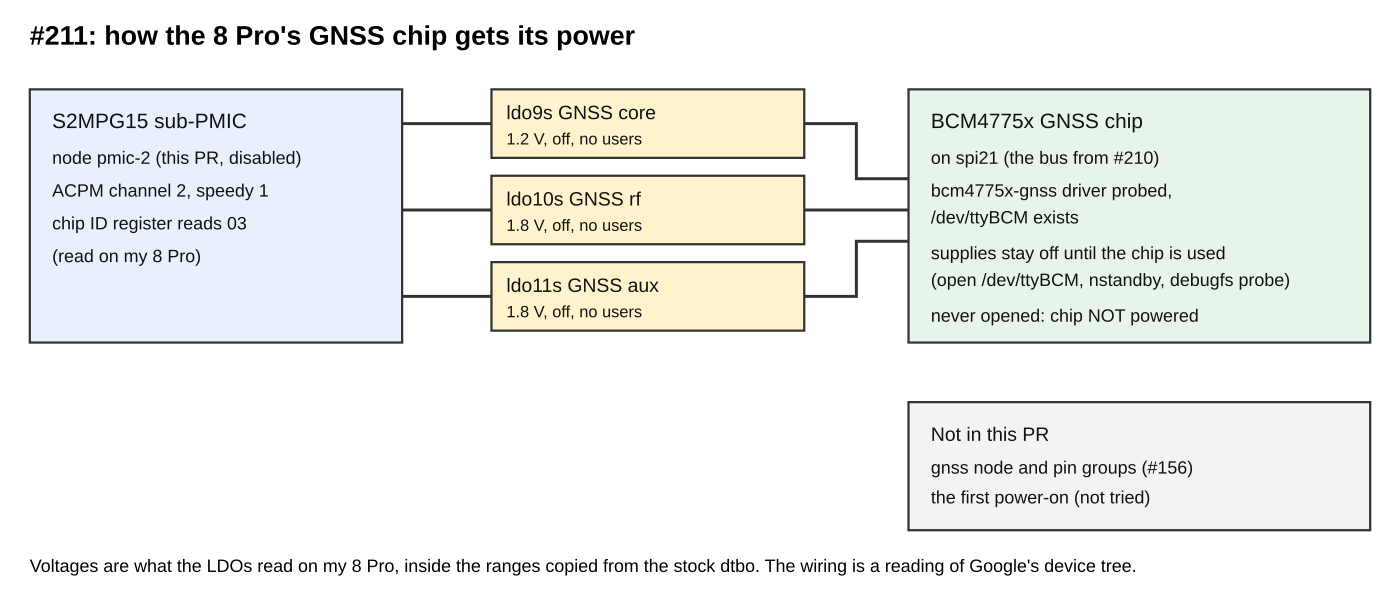
@derekross I booted the sub-PMIC node from this PR enabled on my 8 Pro, to check that the S2MPG15 really answers and that the three GNSS rails look the way I wrote them. They do. Here is what I did and what it does and doesn't show. What I booted: an older test kernel of mine (7.3-rc6), not built from this branch, with an older version of the same pmic-2 node, and an overlay that switches it on (in the PR it's disabled). The diagram below shows where these rails sit.
What I saw:
Why I blacklisted it: instead of letting sec_acpm load at boot I wanted the first look at the unused rails to be one I chose, in case the regulator core's late cleanup touched them first. It turned out they were off already (the bootloader leaves them off, stock Android's kernel is what keeps them on), so nothing was lost. On a separate boot I also loaded your bcm4775x driver with a gnss node on top. It probed on the new SPI device and created /dev/ttyBCM, but the supplies stayed off and I never opened the device, so the chip was never powered. I haven't tried a power-on yet. I'm waiting on the pin controllers in #156 for the pin groups before the gnss node can go in as its own PR. |

|
Thank you, @Somnius. I checked the node against Google's On your question: our kernel builds One optional follow-up: the S2MPG15 bindings still say "paired with Google's Tensor G4". A one-line change to "G3 and G4" would make them match. |

|
@derekross thanks again for checking the node against zuma-pmic.dtsi. It's ready as it is, so please merge it when you can. I'm leaving out the optional "G3 and G4" wording in the bindings to avoid another push for it, I can do it as a small separate change if you'd like. Next for GNSS I'll rebase my node onto the pin controllers that landed with #187. |
|
Thank you, @Somnius. I re-ran the checks on today's |


This adds the sub-PMIC of the Pixel 8 Pro as pmic-2 under the ACPM node, disabled, with only the three rails that feed the GNSS receiver: ldo9s, ldo10s and ldo11s (Google's L9S_GNSS_CORE, L10S_GNSS_RF and L11S_GNSS_AUX). It's the second step for GNSS on the 8 Pro after the USI3 bus: @derekross's bcm4775x binding wants three supplies, and @W4HO-ham's S2MPG15 regulators already have these LDOs.
The voltage ranges are stock's (0.725 to 1.3 V for the core, 1.6 to 1.95 V for the other two), copied from the stock dtbo, and they match what the 7 Pro's S2MPG13 node has for the same rails. Stock leaves all three always on. Nothing sets a voltage at probe, the GNSS driver will switch them. The ACPM channel the driver uses (2, speedy 1) is the one Google's zuma device tree gives s2mpg15mfd, I read it in their pmic dtsi, it isn't a guess.
The node is disabled, so a normal boot changes nothing. Tested: it builds with W=1 and checkpatch is clean, and I checked in the decompiled husky dtb that pmic-2 and the three ldo nodes are there and disabled. I couldn't run dtbs_check here (dtschema isn't installed), so I'm relying on the CI for that. I haven't booted it. This is the first board user of the S2MPG15 driver, so I want to try it on my phone in its own boot before enabling it, with a read of /sys/class/regulator first and nothing else.
@derekross, question for you: on my 7 Pro I load sec_acpm 30 seconds after boot from my own package, so the regulator core's unused-rail cleanup doesn't switch off rails that have constraints. That's a rule in my package today, not something in the kernel. Would you rather have that in the driver?