Repository navigation
Pixel 8 Pro idle power: steady 515 mA with the screen off (10 minute log, data inside) #217
Description

I took a 10 minute log of the 8 Pro doing nothing: screen off, battery only (cable out, ssh over Wi-Fi), nothing running, kernel ge98a7a38a3ef on the e1 stack, max170xx_battery current_now every 10 s.
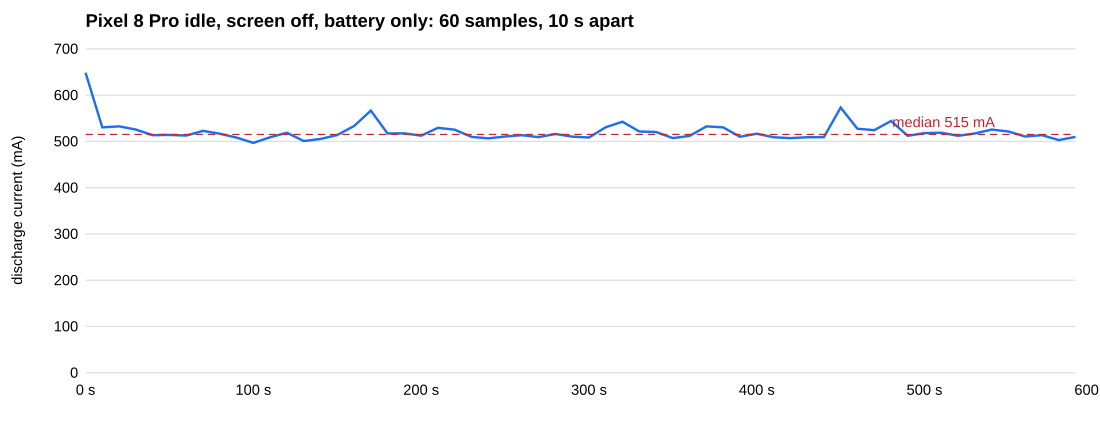
The gauge is uncalibrated, so treat absolute numbers as rough. It sits at a median of 515 mA (about 2.2 W at 4.25 V) and doesn't drift: the three thirds of the log are 517, 513 and 515 mA. The SoC cooled from 53 to 50 C, the battery is about 36 C. The first sample is high because the screen had just gone off. My own debugging service (it polls every 5 s) costs about 100 mA, it reads about 630 mA with it running, so I stopped it for this.
What I could see: about 834 interrupts/s in total. arch_timer is about 640/s of that (about 70/s per core if spread evenly, I didn't check the per-CPU split; that looks high for a sleeping phone; I don't know yet whether the tick isn't being stopped or something keeps arming timers), the I2C bus with the charger and gauge (10cb0000.i2c) is about 35/s, Wi-Fi 6/s, UFS 4/s, the gauge 1.4/s, and IPIs about 180/s. Only the fuel gauge's wakeup source registered events (it follows its own interrupts), no other wakeup source moved, and I never tried suspend. 9 cores are online, there's no cpuidle directory at all (WFI only), pm_genpd is empty, the same 46 clocks are enabled at the start and the end (only the CPU cluster rates moved), and the cmdline has clk_ignore_unused pd_ignore_unused. From an earlier run: CPUs 1-8 offline saved about 38 mA, Bluetooth and Wi-Fi about 20 mA, the AoC about nothing, and the minimum CPU clock made no difference, so most of the 515 mA is somewhere else.
For comparison the 7 Pro (cheetah) notes say about 434 mA awake and 312 mA in s2idle. I haven't changed anything to fix this, and I'm not going to reload the C2 and power-domain overlays that reboot-looped for me on 11-05. Next I want to compare those overlays with the 7 Pro idle and timer setup offline. Does anyone know what the bootloader leaves on (ISP, codec, camera domains)? @derekross @greenbrettmichael
Activity
Somnius commentedon Nov 8, 2026
Small correction to my own post: I wrote that there's no
cpuidledirectory at all. That was too loose./sys/devices/system/cpu/cpuidle/is there (governormenu), butcurrent_driverisnoneand there is nocpu0/cpuidle, so no idle states are registered, and as far as I can tell the cores just drop into plain WFI. Everything else in the post stands.I also read the timer counts again today on another boot, 60 s apart:
arch_timerwas about 766/s in total over the 9 CPUs this time (cpu0 about 235/s, cpu1 about 204/s, the other seven 31-95/s), with an ssh session open, so I don't think it compares with the 640/s of the idle log. The broadcast device is the softwarebc_hrtimerand the timer-broadcast IPI count is 0.Somnius commentedon Nov 15, 2026
An update on the idle floor, with numbers from yesterday and this morning. Hi @derekross and @greenbrettmichael, I'd like your view on what to try next, and @gitColinX, your overnight drain on derekross/omarchy-mobile#724 (comment) looks like the same kind of floor, though I can't tell from here.
All of this is my one 8 Pro, battery only (cable out), screen off, kernel
7.3.0-rc6-omamobile-push1-gbfe780ba73bf(published tip plus the AoC sound port and the S2MPG14 power-off change, a local build). A script on the phone logged the gauge'scurrent_nowevery 15 s, 4 to 5 minutes per step, medians:iw dev wlp1s0 set power_save onsaves about 30 mA. It is off by default here.So the floor is about 540 mA (about 2.1 W) and it isn't userspace, the CPUs or the radios. The gauge is still uncalibrated, so the absolute number is rough, the differences less so.
What I read but did not test:
ufs-exynos.cgives zuma no clock gating or hibern8, only zumapro gets them, and the phone has noclkgate_enablefile. Raven measured 125 mA there. I don't know what it is worth on this chip.screen_offreads 2 and the gs-decon interrupt counters did not move in 10 s), so that raven item is already in.Not done: suspend current, anything with the screen on.
I also booted a local kernel that only adds a read-only regmap for the S2MPG14 meter (no writes anywhere in it) and read it once over debugfs: the firmware answers, but the bootloader leaves the meter off. The enable bit in CTRL1 is 0, the channel enables and rail mux registers are all 0 and the power data reads 0. So getting per-rail power would need writes to turn it on, and I won't do that without a review. I didn't read the S2MPG15 one, its node is disabled in that image.
Two questions. Would you take a test of a husky DT with MIF at 1014 MHz, and of clock gating for zuma in ufs-exynos, as two separate boots on my unit with a revert set ready? And what do you think of a reviewed, attended step that enables the meter and reads per-rail power, since that looks like the only way to see where the rest goes?
Somnius commentedon Nov 15, 2026
Hi @derekross and @greenbrettmichael, following on from my numbers above (#217 (comment)): I'm going to start working on power optimization properly, and I'd like to do it with you rather than next to you. [[Urgent, don't forget to read the last paragraph]]
My thinking, in one sentence: omamobile works as a linux under the hood but it may require to work like android does in some parts with "Doze" and other techniques in order to consider battery longevity with user experience. Right now my 8 Pro draws about 540 mA with the screen off and runs warm to the touch, and nothing I can switch in userspace moves it, so I don't want to throw compute and battery away like that.
What I read, not tested: Doze, app standby buckets and the cached-app freezer are policies that keep the CPUs quiet so the kernel can idle or suspend deeply. The saving comes from the kernel states, so a Doze-like unit alone would give me about nothing today. The other phones agree (PinePhone Pro 1500 mW idle against 177 mW in real suspend, https://xnux.eu/log/081.html). So I plan two tracks in this order:
quickshell142 andvoxtype-osd-gtk130 of them, with the cable in), Wi-Fi power save on by default (30 mA, with a tile and the helper coming as local commits I haven't pushed), then a screen-off unit that freezes background app scopes with cgroup v2 and gives them idle CPU weight, and a skin-temperature throttle like stock's.On my unit the kernel has the energy model and schedutil on all three clusters and
CGROUP_FREEZER, but noUCLAMP_TASKand noteogovernor, which stock sets. Would you take those as kernel config changes? And would you want a screen-off freeze unit inomamobile-shell, or somewhere else, if it works? Nothing here is built yet beyond the Wi-Fi part, and I'll post the numbers as I get them.Edit, same day: one more thing I want to be upfront about, because it makes this a bigger job than a kernel and shell change.
A Doze-like system only works if what runs on the phone cooperates with it. Android restricts background work through its standby buckets (they limit jobs, alarms and network use the less an app is used) and through Doze, which defers them while the phone sits idle. omamobile has no such policy today, and apps and scripts written for a plugged-in laptop can poll, keep timers running, animate and wake the CPU with the screen off without anything telling them they are on a phone. In my 60 s read the two busiest tasks by context switches at screen off were
quickshell(the shell UI, started from/usr/share/omarchy/shell) andvoxtype-osd-gtk(from thevoxtype-binpackage). Both come with the base system, so it starts with the parts we ship ourselves.To be clear about today's numbers: my A/B showed that no userspace switch moves the 540 mA floor, so none of this saves battery until the kernel can idle and suspend. This is about being ready for that.
What I think this may mean, as a proposal and not as a decision:
cgroup.freezewhile the screen is off, idle CPU weight, little cores, with a short allow-list and maintenance windows so calls, alarms and notifications keep working).This is a large job and I don't want to guess at the contract alone. It needs a few agreed conventions, a way to measure an app's battery impact, and a place to show it to the user. @derekross and @greenbrettmichael, does this direction fit omamobile, and where should a wrapper and a notice live? @marselnenaj, would the Settings app be a place for a battery-impact page? And @gitColinX, since you are working on the suspend runbook, tell me if I'm missing something from that side. I'll keep posting measurements here, starting with the shell's own wakeups.
Second edit: I've written all of this up in its own issue, with the measurements and screenshots (the charts of what moved the floor and what didn't, the Wi-Fi power save runs, the busiest tasks at screen off), the profile idea and the questions about apps and scripts: derekross/omarchy-mobile#803 . I'd like help from the guys there, so please continue that part on #803. The kernel side (idle states, UFS clock gating, memory bus, power domains) stays here, and I'll keep posting those numbers on this thread.