
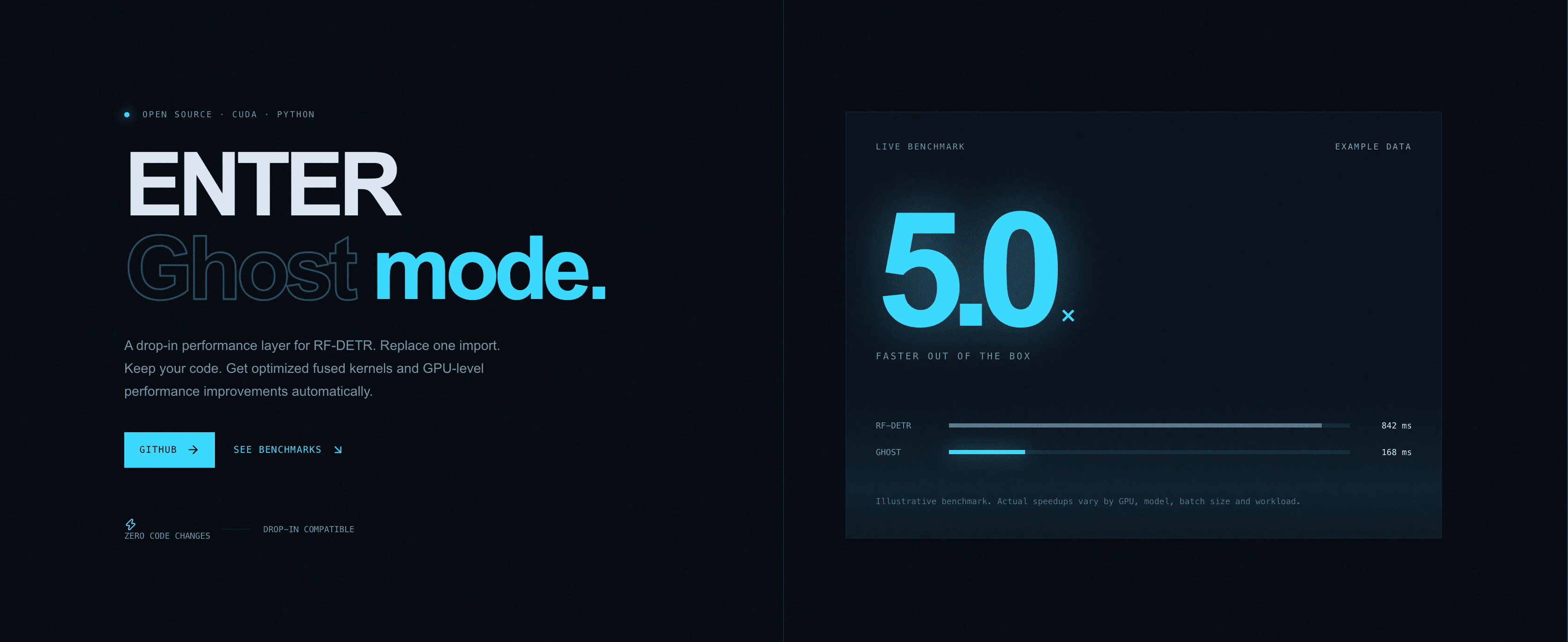
rfdetr-ghost is a drop-in performance optimization layer for RF-DETR.
The goal is simple: make RF-DETR significantly faster without requiring users to change their code or learn new APIs.
Users replace:
from rfdetr import ...with:
from rfdetr_ghost import ...Everything else stays the same — models, APIs, training/inference code, and workflow.
Under the hood, Ghost patches and replaces performance-critical paths with custom fused CUDA/Triton kernels and other GPU-level optimizations, targeting things like kernel launch overhead, memory movement, and inefficient intermediate operations.
One import change. Same API. Faster execution.
The project targets up to ~5× speedup (80% less execution time) on supported workloads, with actual gains depending on the GPU, model, batch size, and operation.
The deeper goal is to demonstrate that significant low-level GPU optimization can be packaged behind a familiar high-level API — allowing existing RF-DETR users to benefit from optimized kernels out of the box, with zero migration effort.
RF-DETR:
Python API → GPU
RF-DETR Ghost:
Same Python API → Ghost optimization layer → custom fused kernels → GPU
Ghost is inspired by the idea of being invisible to the application but highly visible in the benchmark.