

Deep LVPM is a PyTorch toolbox for multimodal representation learning and Deep Latent Variable Path Modelling.
Deep Latent Variable Path Modelling (DLVPM) is a method for path/structural equation modelling using deep neural networks. It connects different data types through sets of orthogonal deep latent variables (DLVs), and can also be used in a Siamese configuration to learn representations of a single data type. Full documentation is available at deep-lvpm.readthedocs.io, and the method is described in the Nature Machine Intelligence paper.
DLVPM is implemented directly in PyTorch. The high-level toolbox API (model.fit, model.evaluate, model.predict, etc.) is retained for convenience, but these methods use ordinary PyTorch commands internally (model.train(), forward passes, loss calculation, loss.backward(), optimizer.step(), model.eval(), and torch.no_grad()).
The current default branch is the native PyTorch version of the toolbox. Earlier versions remain available for reproducibility and comparison:
keras3: Keras 3 version of the toolbox, compatible with both TensorFlow and PyTorch backends.keras2: publication-era version associated with the original DLVPM paper, Integrating multimodal cancer data using deep latent variable path modelling.
| Method | Purpose |
|---|---|
| DLVPM | Deep latent variable path models for multimodal structural modelling |
| CLIP / SimCLR | Contrastive image-text, multimodal, and Siamese representation learning |
| VICReg | Variance-invariance-covariance regularized multimodal learning |
| LeJEPA | Latent joint embedding predictive architecture for multimodal views |
| DGCCA | Deep Generalised Canonical Correlation Analysis |
This package also contains implementations of Deep Generalised Canonical Correlation Analysis and multimodal adaptations of VICReg, LeJEPA, and CLIP/SimCLR. Each method can be used to connect multimodal datasets or to learn representations of a single data type.
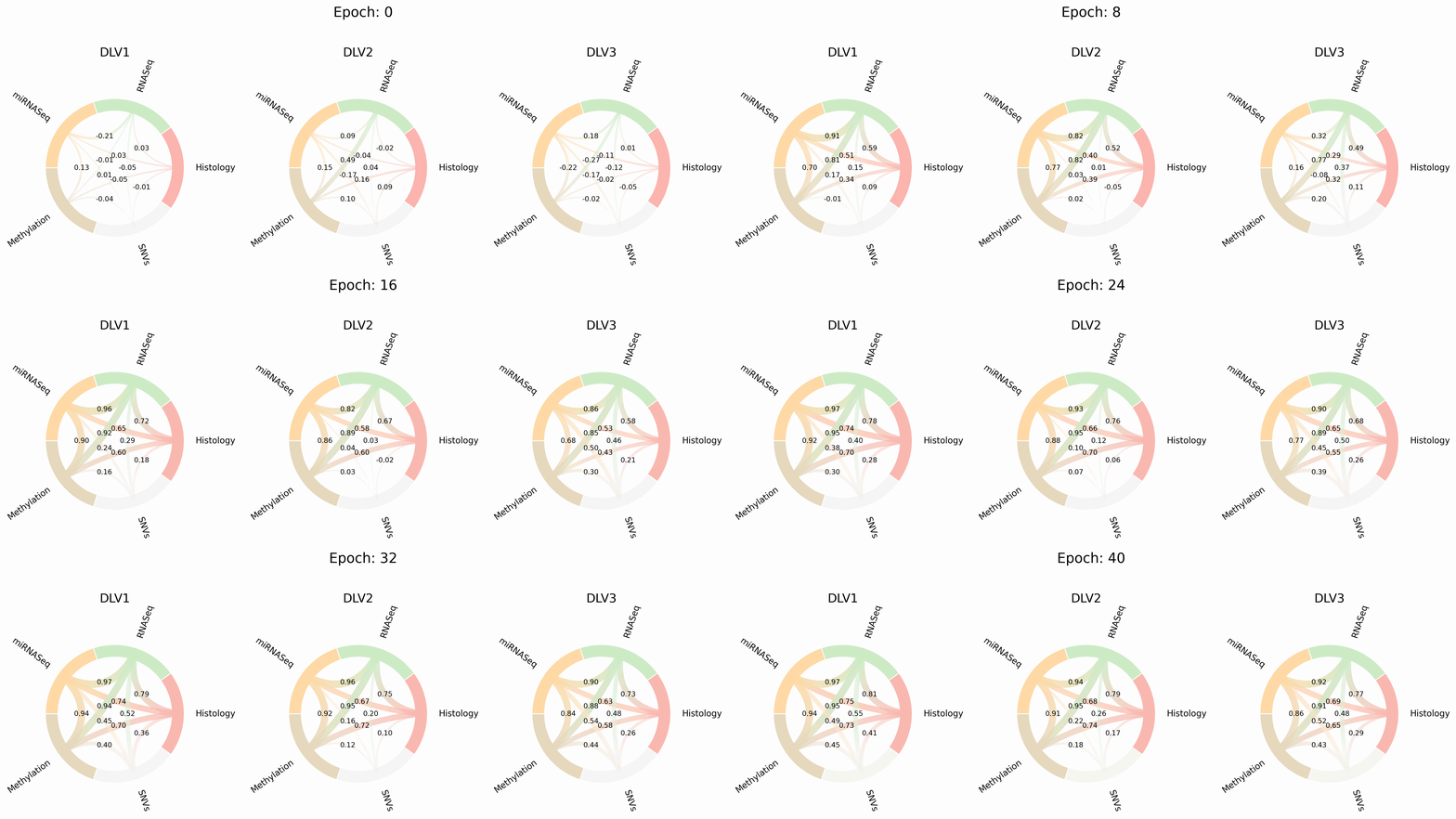
The animation above shows model training in progress on a three-factor DLVPM model linking omics and imaging data types from lung cancer patients. The dataset used for this example is included in the package.
Deep LVPM supports Python 3.11 and 3.12.
Create and activate a clean environment:
conda create -n dlvpm-torch python=3.11 -y
conda activate dlvpm-torch
Install the package from PyPI:
pip install deep-lvpmTo install directly from GitHub:
pip install "git+https://github.com/alexjamesing/Deep_LVPM.git#egg=deep-lvpm"For NVIDIA CUDA, install the CUDA-enabled PyTorch wheel for your platform first, then install Deep LVPM:
pip install torch torchvision torchaudio --index-url https://download.pytorch.org/whl/cu126
pip install deep-lvpm
For an editable local install:
git clone https://github.com/alexjamesing/Deep_LVPM.git
cd Deep_LVPM
pip install -e ".[tutorials,dev]"
Useful extras are:
deep-lvpm[tutorials]for the standard tutorials.deep-lvpm[coco]for the MS COCO image-text tutorial.deep-lvpm[survival]for the TCGA survival analysis dependencies.deep-lvpm[docs]for building the documentation.deep-lvpm[dev]for tests, package builds, and metadata checks.
Verify the install:
python -c "import torch, deep_lvpm; print('torch:', torch.__version__); print('cuda:', torch.cuda.is_available())"Apple Silicon uses standard PyTorch wheels with MPS support where available. CUDA-enabled PyTorch wheels should be installed from the PyTorch index for your platform and driver.
Turnkey tutorials ship with the toolbox and use native PyTorch. Launch them with:
python -m deep_lvpm.tutorial.tutorial_mnist- associate MNIST images with labels and visualise the latent space.python -m deep_lvpm.tutorial.tutorial_tcga- integrate five TCGA lung cancer modalities using residual encoders.python -m deep_lvpm.tutorial.tutorial_siamese- train a residual PyTorch Siamese encoder on CIFAR-10 and compare linear probes on final DLVPM factors and average-pooled convolutional features.python -m deep_lvpm.tutorial.tutorial_coco- train an image-text model on MS COCO and benchmark true five-caption retrieval for DLVPM/CLIP/VICReg.python -m deep_lvpm.tutorial.tutorial_tcga_survival- run the TCGA pan-cancer survival example with PyTorch encoders, integrated gradients, and PyTorch checkpoints.
All tutorials report the expanded StructuralModel.evaluate metrics (total_loss, cross_metric, mse_loss, and redundancy) so you can monitor both cross-view alignment and within-view redundancy.
If you use Deep LVPM, please cite:
Ing A, Andrades A, Cosenza MR, Korbel JO. Integrating multimodal cancer data using deep latent variable path modelling. Nature Machine Intelligence 7, 1053-1075 (2025). https://doi.org/10.1038/s42256-025-01052-4