







📖 Full documentation is available per language:
🇬🇧 English · 🇩🇪 Deutsch · 🇪🇸 Español · 🇫🇷 Français · 🇮🇹 Italiano · 🇭🇺 Magyar · 🇵🇱 Polski · 🇧🇷 Português (BR) · 🇸🇰 Slovenčina · 🇷🇺 Русский · 🇸🇦 العربية · 🇨🇳 简体中文
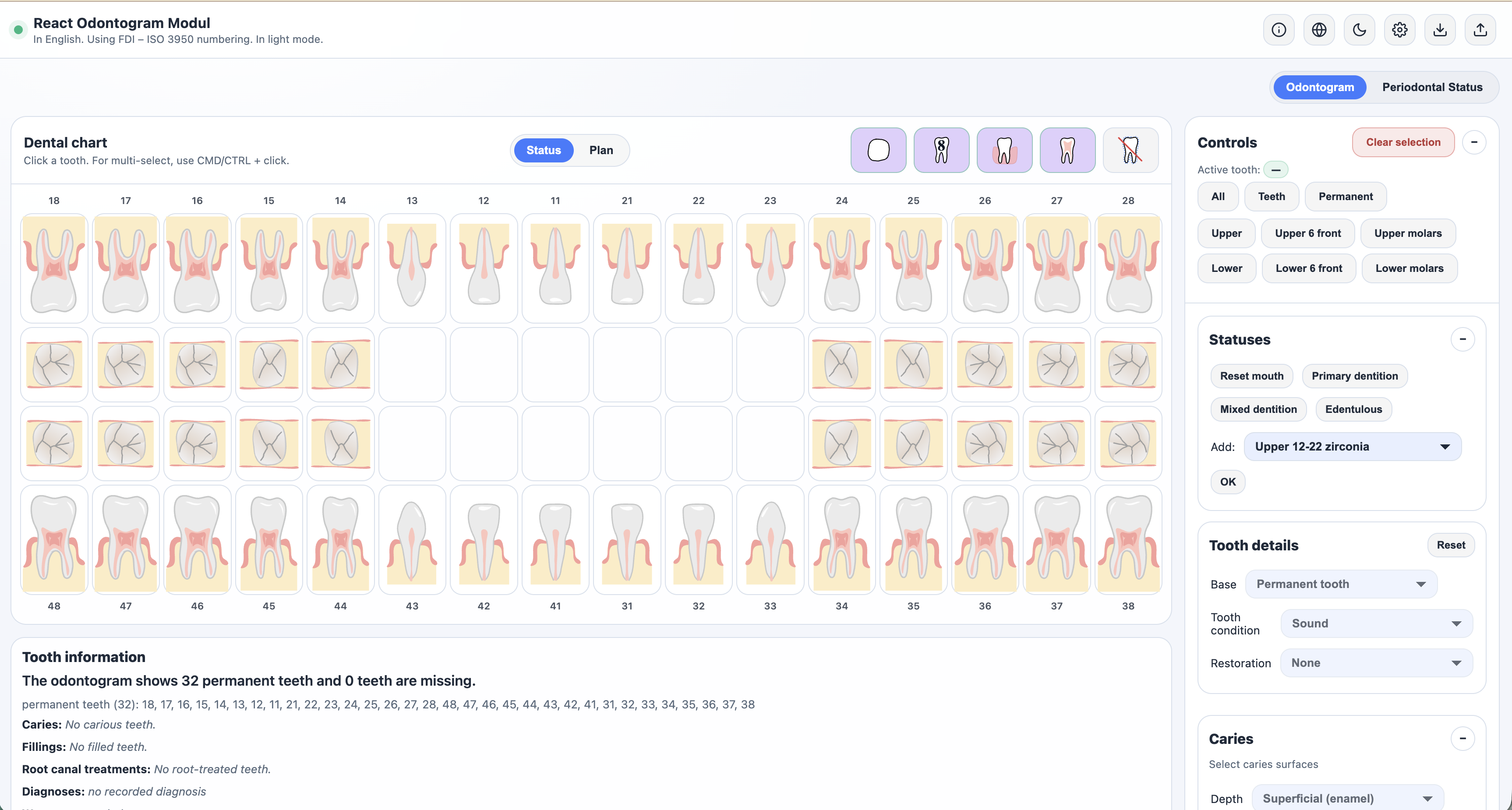
An interactive, SVG-based dental odontogram (dental chart) editor for React + TypeScript — with a full periodontal charting module, multi-surface caries/restorations, endodontic/prosthetic states, FDI/Universal/Palmer numbering, HL7 FHIR R4 export/import, optional ICDAS scoring, and a 12-language UI.
🔗 Live demo: https://react-advanced-odontogram.vercel.app/
📚 API docs: https://zoliqua.github.io/React-Advanced-Odontogram/
angular-advanced-odontogram on npm), is available — JSON and FHIR R4 exports round-trip between the two libraries.
npm install react-advanced-odontogram react react-domRequirements: React 18 or 19 (peer dependency); a bundler that supports the exports field and ESM (Vite, webpack 5, Next.js, Rollup, esbuild, Parcel). The package is ESM-only.
Render OdontogramShell and import the stylesheet once:
import { OdontogramShell } from "react-advanced-odontogram";
import "react-advanced-odontogram/style.css";

export function Chart() {
  return <OdontogramShell language="en" numberingSystem="FDI" darkMode={false} />;
}
The imperative state API, the standalone PerioChart component, the guided tour, and all public types are named exports from the same entry point (OdontogramShell is also the default export):
import {
  OdontogramShell,        // also the default export
  PerioChart,             // standalone periodontal chart
  getOdontogramSummary,
  exportStatus, importStatus,   // JSON state serialization / hydration
  exportFhir, exportSvg, exportImage,
  setReadOnly, startIntroTour,
} from "react-advanced-odontogram";
SSR: the component is client-only (reads the DOM on mount). In Next.js render it in a Client Component (
"use client") or via a client-only dynamic import. Assets are self-contained — tooth/icon SVGs are inlined into the bundle; there is no runtime asset fetch to configure. One instance per page in this release (engine state is a module-level singleton).
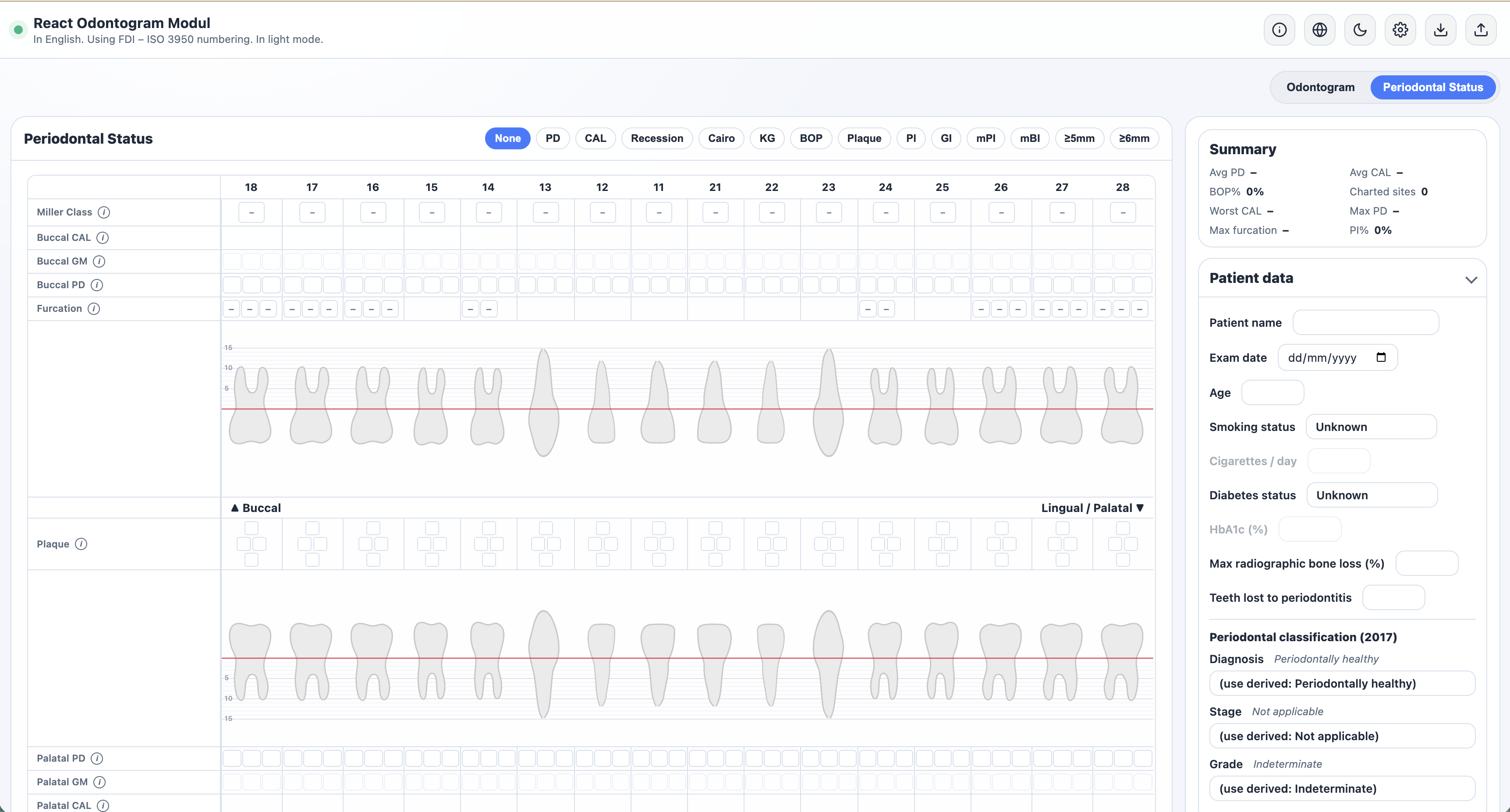
Per-site probing depth, gingival margin, bleeding on probing (+ suppuration) at the six standard sites, with derived CAL, recession and whole-mouth %BOP; a graphical full-mouth perio chart (CEJ line, mm guide grid, pocket/margin curve, anatomical diamond index tiles), 2017 staging/grading, and per-site FHIR export (LOINC periodontal panel 74029-0). Available as an Odontogram | Periodontal Status view toggle and as a separately-invocable PerioChart component. Periodontal data now round-trips through FHIR import too, not only through the JSON payload — suppuration is the one exception and stays JSON-only.
- 🦷 Permanent / primary / implant / missing teeth; substrate, restorations (crown/inlay/onlay/veneer/bridge × materials), removable & implant prosthetics
- 🔍 Multi-surface caries & fillings (ICDAS / CARS severity, root & radiographic caries), endo & AAE pulp diagnosis, apical diagnosis, peri-implant status, wear, discoloration, orthodontics
- 🩺 Full periodontal module (see above) + 2017 classification
- 🔗 HL7 FHIR R4 export/import; JSON export/import with migrations
- 🧬 Standards-based diagnosis coding — WHO ICD-10 always on, per-tooth & case/regional diagnoses, selectable national packs (BNO-10, US ICD-10-CM), an opt-in SNOMED CT overlay, and full FHIR
Conditionexport/import round-trip - 🩺 Diagnoses card, revised: every per-tooth diagnosis row shows the ICD-10 code first (
K04.0 Pulpitis) and rows are sorted by code. Each row has an exclude toggle (drops the diagnosis from the FHIR export but keeps it on the chart) and a delete (×) that removes the diagnosis and its finding on the tooth. Adding a diagnosis from the picker writes the underlying chart finding, so the glyph appears at once. - 🗂️ Case / regional diagnoses pop-up: the whole-mouth and regional diagnoses (jaw anomalies, cysts, salivary and mucosal conditions…) moved out of the periodontal sidebar into their own dialog, opened from the Diagnoses button beside the Odontogram / Periodontal-status toggle; its picker is code-first and code-sorted.
- 🇭🇺 BNO-10 pack: the Hungarian display strings are now the official NEAK BNO-10 titles, and the pack uses the standard ICD-10 system URI (BNO-X is identical to WHO ICD-10).
- ✅ HL7-validator-clean FHIR export: every Bundle entry carries a deterministic
idand an absolutefullUrl(nourn:uuidplaceholders), and the Bundle embeds the engine's own CodeSystem so its local codes resolve during validation; the same CodeSystem is published in the repository asfhir/CodeSystem-odontogram.json(passincludeCodeSystem: falsein the FHIR export options to omit it). - 🎯 ICD codes that follow the chart (data-driven specificity). Caries depth comes from the radiographic depth when it is charted (E1/E2 → enamel, D1–D3 → dentine) and falls back to the ICDAS severity (1–3 → enamel, 4–6 → dentine), refining WHO
K02toK02.0/K02.1and ICD-10-CMK02.9toK02.51/.52(pit-and-fissure) orK02.61/.62(smooth surface) by surface × depth. Chronic periodontitis takes its ICD-10-CM code from the 2017 stage and extent (K05.311–K05.329). One Condition per tooth, carrying the deepest involvement. - 🔄 Periodontal data round-trips through FHIR. The importer reads the LOINC 74029-0 periodontal panels back into each tooth — probing depth, gingival margin (reconstructed from CAL, so pseudopocket values survive), BOP, furcation, O'Leary plaque, the PI/GI and implant mPI/mBI indices and keratinized-gingiva width — plus the smoking-status and HbA1c evidence Observations. Conditions coded only in ICD-10-CM or SNOMED CT are recognised too, so a foreign bundle imports what it can.
- 🧬 SNOMED CT for the whole diagnosis catalog. 48 of the 50 slots now carry a verified SNOMED CT International concept (active, core module, matching FSN). Two stay deliberately unset because SNOMED International has no umbrella concept for them: jaw-size anomaly (K07.0) and dentofacial functional abnormalities (K07.5). The SNOMED overlay remains opt-in in Settings.
- 📦 A loadable FHIR terminology package. The repository's
fhir/folder is a FHIR NPM package (react-advanced-odontogram.fhir, FHIR 4.0.1) holding the engine CodeSystem plus generated ValueSets — one per clinical-axis value group, one for the finding types and an all-codes set. Point a validator at it with-ig ./fhir. - 🖼️ PNG / JPG / SVG chart export and a customizable, multilingual PDF report (jsPDF, lazy-loaded) — colour themes, a grouped dentition-summary table, a periodontal chart/description, and bundled Unicode fonts so every UI language (incl. Hungarian accents, Cyrillic, Arabic RTL and Chinese) renders correctly
- 🔢 FDI / Universal / Palmer numbering · 🌐 12 UI languages (HU/EN/DE/ES/IT/SK/PL/RU/PT-BR/AR/ZH/FR, Arabic RTL) · 🎨 theming via
--odon-*CSS variables · 🧩 plugin system · ⌨️ keyboard accessibility
Per-language guides are linked at the top of this file. Full API reference (TypeDoc):
📚 https://zoliqua.github.io/React-Advanced-Odontogram/
MIT © Zoltán Dul. If you use this software in research, please cite it — see CITATION.cff and the Zenodo record.