



Cobra2D is a Python package that extends COBRApy to automatically build time-resolved and/or multi-subsystem metabolic models from an existing model. It creates one context-specific submodel per time interval and subsystem, and connects these submodels with linker and/or transfer reactions. To account for the lengths of the time intervals and the sizes of the subsystems, it scales the stoichiometry of the linker and transfer reactions and the objective coefficients of each submodel. The bounds of all other reactions are not scaled. For details, see Linker and transfer reactions. Cobra2D also provides a weighted pFBA function that takes the lengths of the time intervals and the sizes of the subsystems into account.
- Define time intervals and subsystems (e.g. cell types, tissues or organs). Each combination of a time interval and a subsystem forms a phase.
- Set the lengths of the time intervals
- Set the sizes of the subsystems
- Connect the phases
- Define linker reactions (auxiliary reactions that connect consecutive time intervals and allow storage metabolites to be carried over from one time interval to the next)
- Define transfer reactions (auxiliary reactions that connect subsystems and allow metabolites to be exchanged between them)
- Add context-specific constraints to individual phases
- Construct a new model that contains all context-specific submodels, their constraints and the reactions connecting them
Cobra2D not only simplifies this process, but also makes it easy to save the defined settings and share them with others.
Define the sub_models (subsystems) and time periods, connect the phases, and apply the resulting constraints to a COBRApy model:
from cobra2d import Constraints
from cobra.io import load_model

model = load_model("textbook")

constraints = Constraints()
constraints.add_sub_models(["leaf", "root"], [2, 1])
constraints.add_time_slots(n_ranges=2, time=12)
constraints.add_linker_series("atp_c")
constraints.add_transfer_series("glc__D_e", ["leaf", "root"])

resolved_model = constraints.apply_to_model(model)
Constraints can also be saved as XML and shared:
constraints.save_as_xml("constraints.xml")
restored = Constraints.load_from_xml("constraints.xml")
See the constraints notebook for a complete introduction and linkage and phases for more advanced model construction.
The documentation includes notebooks for constraints, linkage and phases, and visualization. A sample XML configuration is available at docs/source/examples/data/conf.xml.
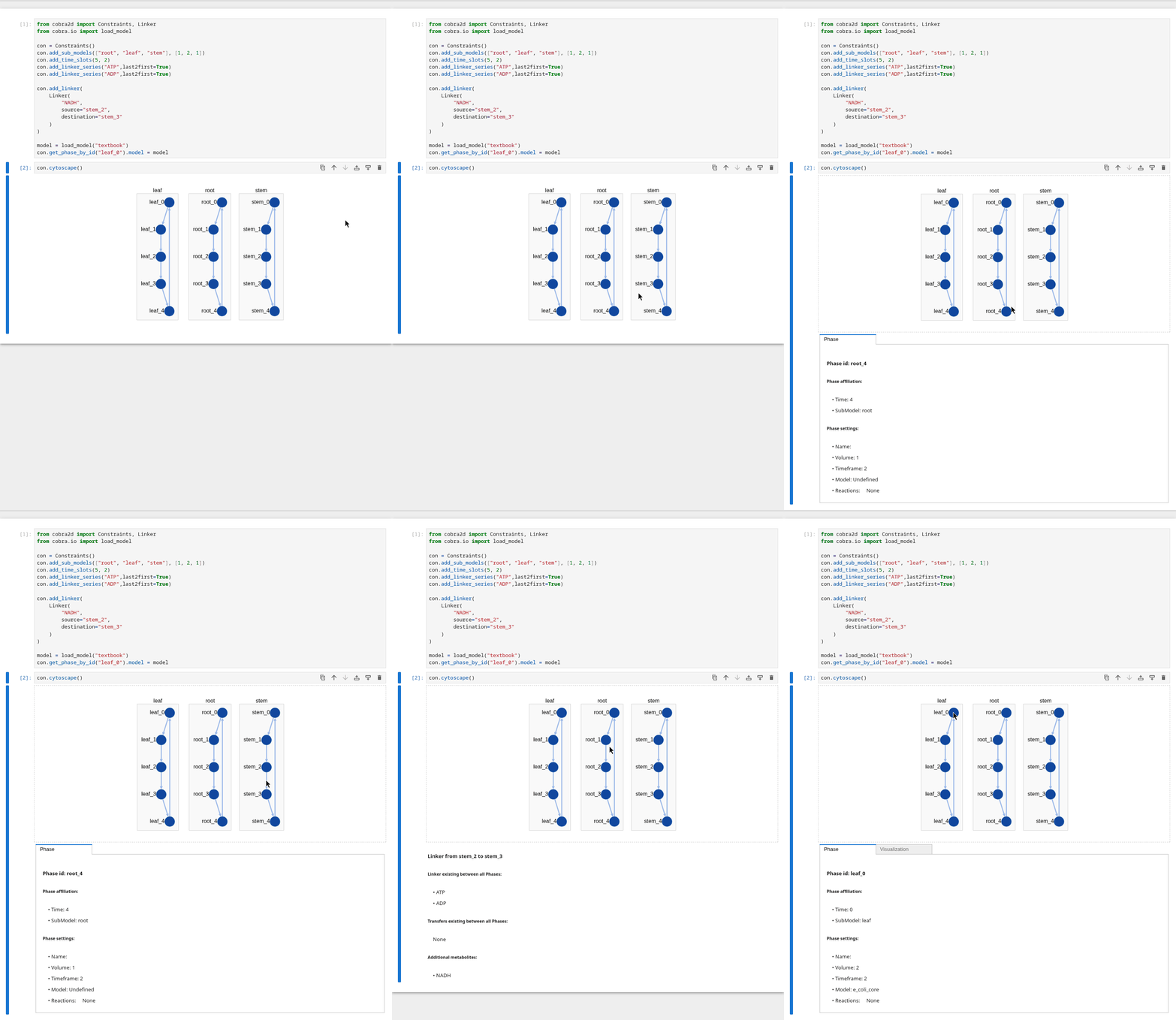
The defined settings can also be visualized, either as an interactive graph or as a static image.
After cloning the repository, the package can be installed into the current Python environment using pip:
git clone https://github.com/Toepfer-Lab/Cobra2D.git

cd Cobra2D

pip install .
The static GraphViz visualization (Constraints.create_graph) additionally requires the Graphviz system package. It is separate from the graphviz Python package and cannot be installed via pip; please refer to the documentation of graphviz.
Tests, linting, formatting and type checks all run through tox. The test matrix covers Python 3.9 to 3.13, but you do not need to build those interpreters yourself: we use the tox-uv plugin, which builds every environment with uv and can supply the required CPython versions.
Setting up the same environment we use takes one command. With uv installed:
uv tool install tox --with tox-uv
Alternatively, if you prefer to keep tox in an existing environment, pip install tox tox-uv works as well.
Depending on how uv was installed, the interpreters may have to be fetched once manually:
uv python install 3.9 3.10 3.11 3.12 3.13
From the repository root you can then run:
tox                  # the full matrix: format, lint, types, and tests on 3.9-3.13
tox -e py312         # tests on a single version
tox -e format,lint   # black (check only) and flake8
tox -e types         # mypy
tox -e py310-req     # tests against the pinned requirements.txt
tox -e py312 -- -k linker    # arguments after -- are passed through to pytest
A few notes on the setup:
tox -e formatonly reports diffs; it does not rewrite files. Runblack src/cobra2d/ tests/ --line-length=79to actually apply the formatting.py310-reqis the reproducibility check. It installs the pinnedrequirements.txtrather than resolving dependencies afresh. It is tied to Python 3.10 because the pins were generated withpip-compileunder that version. The remaining environments install fromsetup.cfgand therefore test against current releases of cobra and its dependencies.- Without tox-uv, tox falls back to
virtualenvand expects to findpython3.9,python3.10, … on yourPATH; environments for versions it cannot find will fail. Add--skip-missing-interpreters=trueif you deliberately want to run only the subset you have installed.