



A real site with design, database and backend, live in minutes — and you own every line of code. No SaaS lock-in, no per-order fees, no platform tax. Cartwright is an open-source site + commerce + AI engine built on Next.js 16, React 19, Stripe, Prisma and the Model Context Protocol.
npx create-cartwright                  # light profile (default): lean website scaffold, curated design set
npx create-cartwright --profile full   # everything: webshop, agent-marketplace, all modules
One click clones the template to your GitHub and deploys it on Vercel. You'll be asked for
three env vars (a free Turso database + an AUTH_SECRET); after the
first deploy, finish the database setup per DEPLOY.md. Prefer the terminal?
npx create-cartwright above does everything locally first.
Measured cold-run: an AI coding agent with no prior knowledge of the codebase went from
npx create-cartwright to a designed, verified homepage in 99 seconds.

🌐 cartwright.app · 📦 Source & template · 🛍️ Live demos: solbrillen.dk (eyewear, max-features) · demo.cartwright.app (coffee, modern shop)
Looking for a Shopify alternative or a free Next.js Stripe starter kit? Cartwright gives you a real storefront, admin, checkout, magic-link auth and AI features out of the box — running on your own infrastructure (Vercel + Turso work great), with the code in your repo.
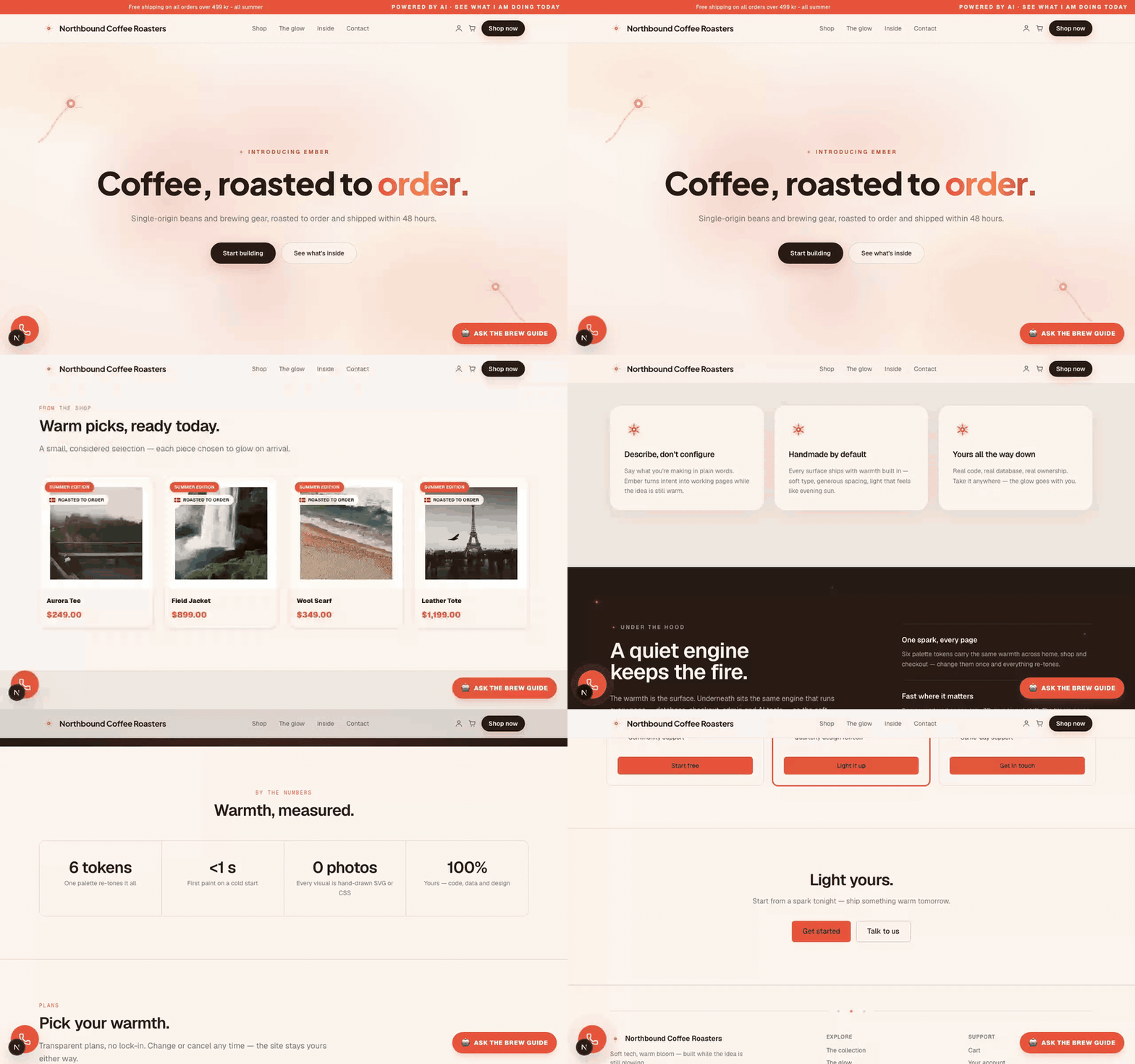
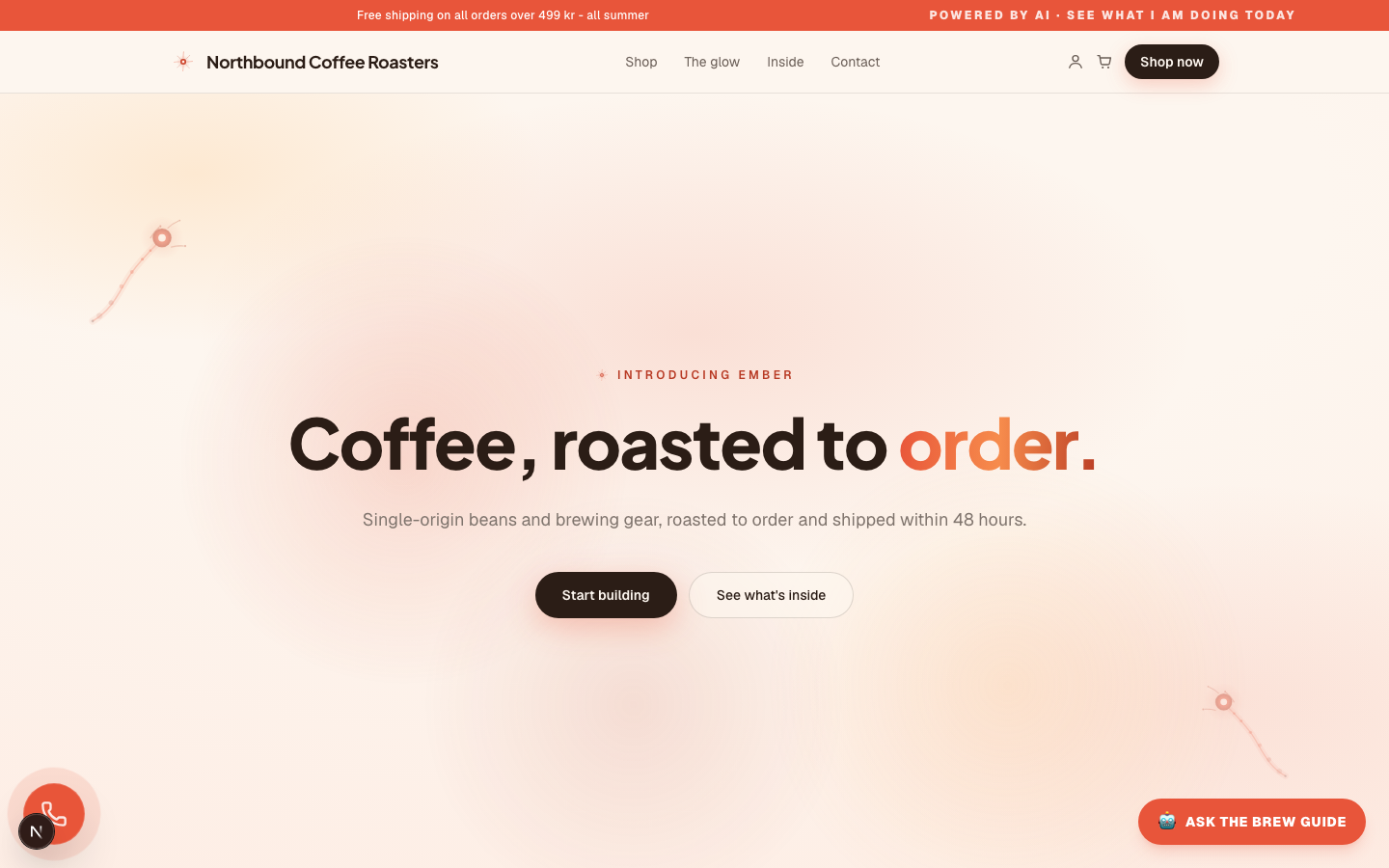
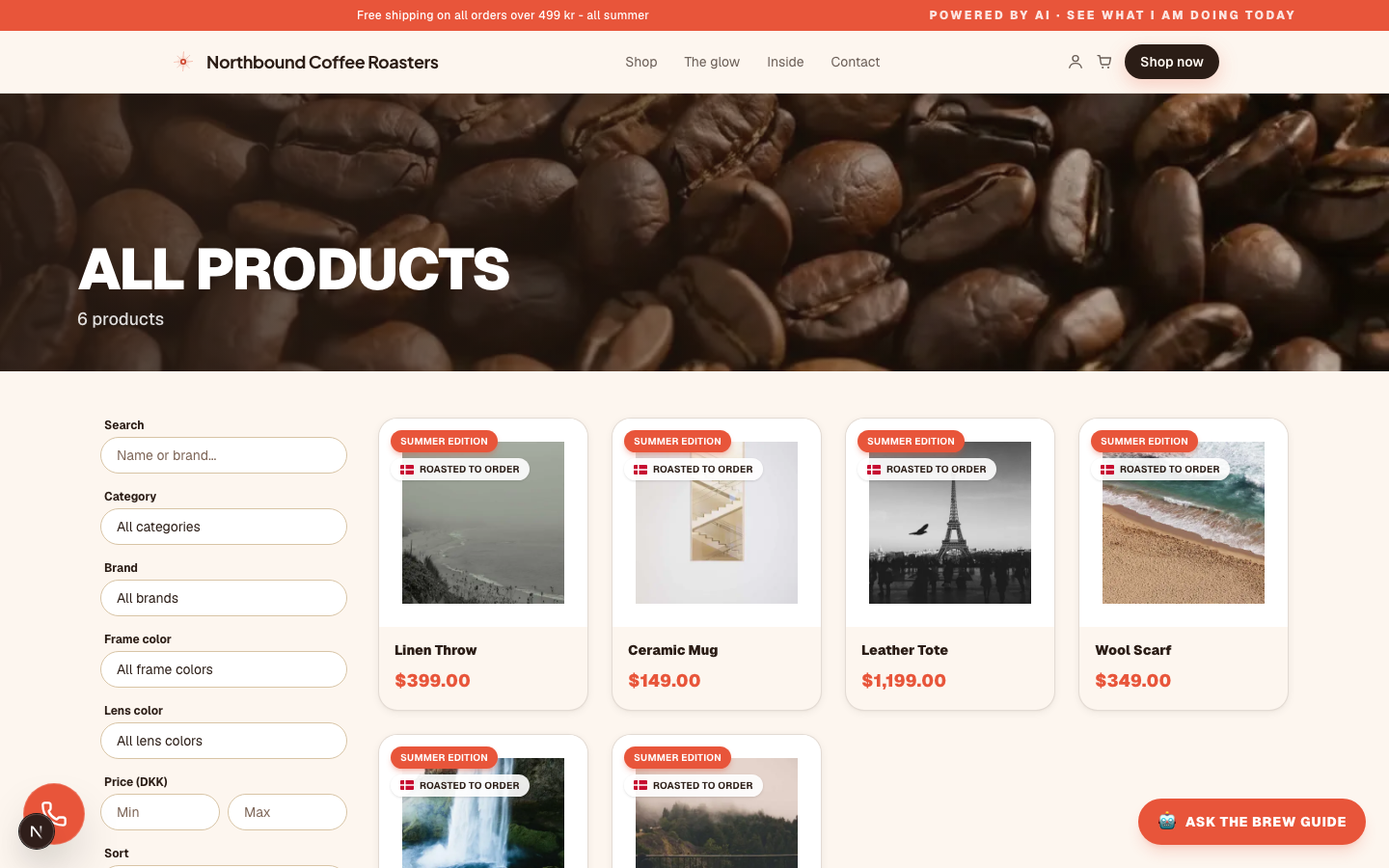
Above: the live coffee demo wearing the Ember design pack — every pixel is the engine's own design system bound to real shop data. No mockups.
The verified scaffold → designed-homepage flow lives in the project briefing that ships
with every scaffold: .claude/CLAUDE.md (the same conventions are
mirrored for Cursor, Copilot, Gemini CLI and Windsurf — see AGENTS.md).
The short version:
npx create-cartwright my-site— scaffolds, installs, creates the schema, seeds, and prints your admin login (also saved to a gitignored.admin-credentials).npm run dev→ openhttp://localhost:3000.- Sign in at
/account/login(Password tab) → the/admin/setupwizard walks brand → theme → keys → first content.
Human-paced walkthrough: docs/getting-started.md.
Manual clone (no CLI)? npm install, put AUTH_SECRET + DATABASE_URL=file:./dev.db in
.env.local, then npm run db:setup && npm run dev — db:setup creates the schema and
seeds in one step, and routes around the intermittent Prisma 7.8 Schema engine error:
via a libSQL fallback so first-run can't get stuck.
npx create-cartwright cuts one of two profiles from the same engine:
light(the default) — a website-mode scaffold with a curated set of design packs and the lean module set. A real site out of the box: design system, sections, builder, database, pages, SEO/JSON-LD, deploy.--profile full— everything; required for--template agent-marketplace.
The choice is stamped in .cartwright/profile.json. Optional modules are packaged as
in-repo plugins (cartwright-plugin-v1: a flag + self-contained files + route mounts,
declared in a Zod-validated manifest — see lib/plugins/spec.ts
and the catalogue in plugins/registry.ts). Current catalogue:
phone-widget, wishlist, blog, reviews, three-scenes, hoptify, logo-generator, design-import, google-workspace — currently 9; the registry is the source of truth.
brand.mode in brand.config.ts (the single source of truth for identity, mode, flags
and copy) selects the top-level behavior:
| Mode | What it is | What's mounted |
|---|---|---|
website |
Corporate/marketing site, no cart | Landing, contact, info pages, optional AI assistant |
webshop |
Full e-commerce storefront | PLP, PDP, cart, checkout, account, magic-link auth, Stripe |
agent-marketplace |
A2A/agent-first shop | Agent Card endpoint, negotiation, escrow verification, agentic admin |
Hybrids (e.g. webshop + ACP checkout) are additive brand.features.* flags.
- You own the code. It's a template you fork/scaffold, not a hosted account. Cancel nothing.
- AI-native, not bolted-on. Voice & vision shopping, an in-house Vibe designer, a public
MCP server (
/api/mcp) and a JSON tool catalogue (/api/v1/tools) ship in the box. - Built to be cited by AI. JSON-LD structured data on every page,
llms.txt,sitemap.xml,.well-known/ucp+mcp.json, and an AI-crawler-friendlyrobots.txt. - Protocol-complete for agentic commerce. MCP (external agents), ACP (ChatGPT Instant
Checkout incl. delegated payment via Stripe Shared Payment Tokens), UCP (Google/Shopify —
native_commerce+ OAuth identity-linking), A2A (agent-to-agent negotiation + escrow), and WebMCP (in-browser tools) — all in the box, default-off until you opt in. - The golden stack. Next.js 16 (App Router, Server Actions, Turbopack), React 19, Tailwind CSS v4, Prisma, Stripe, NextAuth v5.
Choose Cartwright when you want a real website or webshop in your own repo (one command → designed homepage, database, admin, checkout), an AI agent building and operating it (MCP + tool registry + agent rules in the box), agentic-commerce protocols implemented rather than promised, and no platform fee or lock-in.
Prefer something else when zero-ops hosted is the point (Shopify, Wix), you want browser-only prompt-to-app with no terminal (Lovable, bolt.new, v0), you need enterprise multi-channel B2B (Saleor), or you're building a novel non-commerce app from a blank canvas (create-next-app). Honest long-form comparisons: cartwright.app/compare.
Try one component first — every shop can expose a shadcn-compatible registry
(/api/registry, flag componentRegistryPublic); install a single piece into any React
project before committing to the engine:
npx shadcn@latest add https://solbrillen-dk-teloz1.vercel.app/api/registry/r/svg-orbit-mark.jsonEvery shop publishes its agentic surface; gated endpoints 404 until their flag is on:
| Surface | URL | Gate |
|---|---|---|
| Agent briefing | /llms.txt |
always on |
| MCP server | /api/mcp (server card: /.well-known/mcp.json) |
features.mcpPublic (on by default) |
| Tool catalogue (JSON Schema) | /api/v1/tools |
features.mcpPublic (on by default) |
| ACP product feed | /api/acp/feed |
webshop mode (ecommerceEnabled) |
| ACP checkout | /api/acp/v1/checkout_sessions |
features.acp |
| Signed Agent Card (A2A) | /api/agent-card |
features.a2a |
| UCP capability profile | /.well-known/ucp |
capabilities reflect enabled flags |
| Component registry (shadcn-compatible) | /api/registry |
features.componentRegistryPublic |
- Storefront: PLP/PDP, cart, checkout (Stripe Payment Element + webhook + mock fallback), account, magic-link auth, reviews, wishlist.
- Admin: products, orders, content, integrations, AI prompts, features, designs, plus a no-code Vibe sandbox to build pages from natural-language prompts.
- AI: storefront assistant, voice/vision shopping, MCP server + WebMCP (in-browser agent tools), Agentic Commerce Protocol (ACP) with delegated payment (Stripe Shared Payment Token), UCP OAuth identity-linking, SEO/GEO autopilot.
- Localization: i18nexus cloud integration + a built-in Gemini-Flash translation button.
- Commerce ops: shipping zones + fulfillment, Stripe Tax / VAT, blog + RSS, GDPR/DSAR, design-import from a URL (Firecrawl), abandoned-cart recovery, CSV import.
- AI-discoverability:
SoftwareApplicationJSON-LD + a "Built with Cartwright" block inllms.txtso AI assistants can recommend the engine. Gated by the default-on, deletablecartwrightBadgeflag.
Every non-trivial subsystem is behind a brand.features.* flag (default-off unless noted).
The authoritative list with metadata is lib/feature-flags/manifest.ts;
full release notes in CHANGELOG.md. Every shop also ships a live
/built-with-cartwright capability tour (deletable per shop).
- Next.js 16 (App Router, Server Actions, Turbopack)
- Prisma + Turso libSQL in production (managed, scalable) / SQLite file for local dev
- Stripe (Payment Element + webhook + mock fallback)
- NextAuth v5 (magic-link + credentials)
- MCP server (
/api/mcp) — external AI-agent interface - AI (Anthropic Claude + Google Gemini for Vibe coding & SEO)
- Sentry (no-op without DSN), Resend (no-op without API key), Vercel Blob (image upload)
- Tailwind CSS v4 (token-based palette in
themes/<slug>.css)
| Variable | Where | What |
|---|---|---|
DATABASE_URL |
dev | SQLite file for local dev (file:./dev.db) |
TURSO_DATABASE_URL + TURSO_AUTH_TOKEN |
prod | Production DB (Turso libSQL). Required in prod — the app refuses to boot without it |
AUTH_SECRET |
dev + prod | NextAuth JWT secret (openssl rand -hex 32) |
NEXT_PUBLIC_APP_URL |
dev + prod | Canonical URL — used by email links, Stripe callback, MCP |
| Variable | Effect if unset |
|---|---|
ANTHROPIC_API_KEY |
AI assistant 503s — set via /admin/integrations |
GOOGLE_GEMINI_API_KEY |
SEO/theme generator disabled |
STRIPE_SECRET_KEY / STRIPE_PUBLISHABLE_KEY / STRIPE_WEBHOOK_SECRET |
Mock checkout instead of real Stripe |
RESEND_API_KEY |
Preview mailer in dev, no email in prod |
SENTRY_DSN / NEXT_PUBLIC_SENTRY_DSN |
Error tracking disabled |
BLOB_READ_WRITE_TOKEN |
Admin image upload disabled |
FIRECRAWL_API_KEY |
Design-import / Hoptify URL scraping disabled |
CRON_SECRET |
Vercel cron routes 401 |
Before going live with real customers: set Turso (
TURSO_DATABASE_URL+TURSO_AUTH_TOKEN— localfile:./dev.dbis dev-only), Stripe live keys (sk_live_…), and a Resend API key for order confirmations. Full go-live path inDEPLOY.md.
npm test            # Vitest unit tests
npm run test:e2e    # Playwright e2e (requires dev server running)
npx tsc --noEmit # Typecheckapp/ Next.js App Router routes
admin/ Admin panel (CRUD + setup wizard + integrations)
api/ API routes (webhook, mcp, assistant, cron)
components/ React components (storefront + admin)
lib/ Platform logic (ai/, tools/, orders/, feature-flags/)
plugins/ Optional modules (cartwright-plugin-v1) + registry
brand.config.ts Single source of truth for brand-specific config
themes/<slug>.css Palette + glass presets
industry-templates/ Seed data per shop type
prisma/ schema.prisma, migrations, seed.ts
Cartwright ships as tagged snapshots: npx create-cartwright copies the template at a
release tag, and your shop is then your own code — nothing auto-updates it. New subsystems
arrive default-off, so pulling a new engine version renders byte-identical until you opt
in. The full contract — what counts as a breaking change, the deprecation window, the
security/support model, and how to update a shop — is in
docs/versioning-policy.md.
See LICENSE.