Explore EMPIAR — EMBL-EBI's public archive of raw cryo-EM / cryo-ET image data (~3,000 datasets, ~8.9 PiB) — from Python, without downloading anything.
EMPIAR is served over EBI's public HTTPS at ~1.5 MB/s per connection. scigantic_empiar parallelises HTTP range reads (8-way ≈ 5–10 MB/s) so you can pull a single frame from a many-GB entry in seconds, decode the MRC, and render the micrograph + its power spectrum — nothing is copied to disk.
import scigantic_empiar as se

se.preview(10406)                      # render the micrograph below, in seconds
se.EmpiarClient().summary(10406)       # title, pixel size, method, DOI, EMDB/PDB cross-refs
se.EmpiarCatalog().search("ribosome")  # search the whole archive by metadata (instant)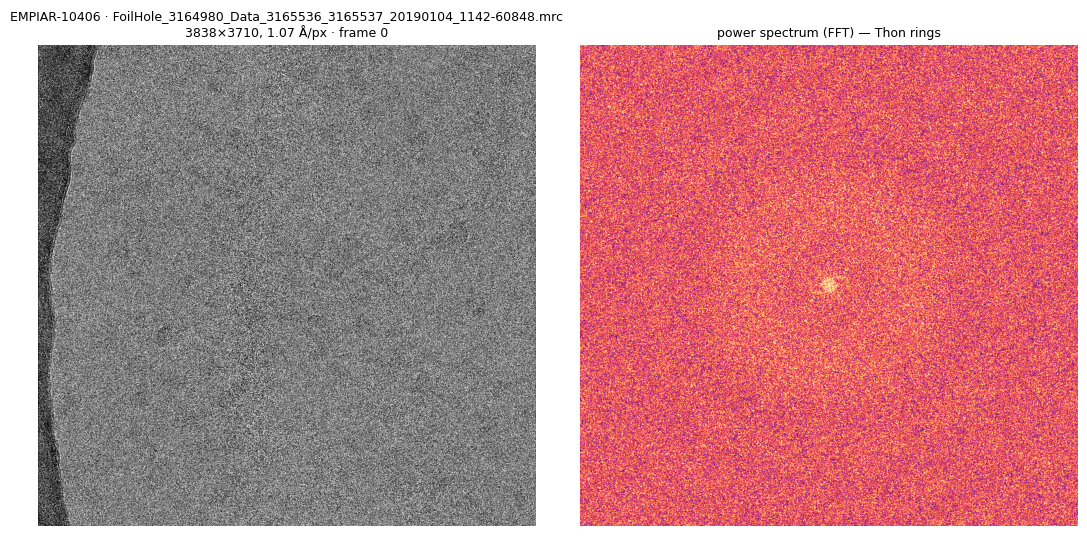
One frame of EMPIAR-10406 (a 70S-ribosome dataset) pulled straight from EBI over parallel range reads — the carbon-foil edge, ice, and particles are visible at left; the FFT is at right. Nothing was downloaded to disk.
pip install "scigantic-empiar[viz]"Core (numpy, requests) is enough for the readers; [viz] adds matplotlib / pandas / pillow for preview() and the catalog gallery.
preview(id) |
micrograph / tomogram-slice + power spectrum, rendered from a lazy parallel-range read |
read_mrc_frame(id) / read_mrc_average(id) |
one frame / a mean of frames as a NumPy array + header |
thumbnail(id) |
small preview array (a few-MB central-strip read) — used to build catalogs |
find_mrc(id) |
resolve an entry's first MRC, recursing the (often nested) data/ layout |
pread(url, off, len) |
the 8-way parallel HTTP range reader under it all |
EmpiarClient |
per-entry metadata from EMPIAR's REST API (cached) |
EmpiarCatalog |
search + a visual thumbnail gallery across all entries (from a prebuilt index) |
add_to_fast_workspace(id) |
mirror an entry to S3 for full-speed reprocessing (RELION/EMAN2) |
EBI throttles per connection (~1.5 MB/s) and past ~8 concurrent connections. pread splits a read into ~8 concurrent range requests, which aggregates to ~5–10 MB/s — enough to look at any entry interactively. For heavy reprocessing of a whole multi-hundred-GB dataset, mirror it to fast storage first (add_to_fast_workspace); streaming a full entry at 1.5 MB/s isn't practical.
The job splits in two: parse MRC, and read bytes from a remote file. Both have existing libraries; neither covers the specific case here.
mrcfile(CCP-EM) is the standard MRC reader. Its lazy mode is a numpymemmap, which needs a local filesystem path — it does not issue HTTP range requests.scigantic_empiarparses the 1024-byte header directly (parse_mrc_header) to seek to one frame of a remote file without a local copy.fsspecHTTPFileSystemturns byte reads into HTTP range requests and can fetch many ranges concurrently (cat_ranges).preadis a small equivalent, kept dependency-free and tuned to EBI's ~8-connection throttle; moving the transport ontofsspecis a reasonable later change.copick(CZI, Protein Science 2026) is the closest cryo-EM analog: an fsspec-backed, server-less dataset API with lazy reads. It assumes data stored as OME-Zarr (chunked, multiscale). EMPIAR entries are raw MRC/TIFF, so copick needs a per-entry zarr conversion first — the conversion that MRC's flat layout letsscigantic_empiarskip.
- MRC/MRCS (movies, micrographs, tomograms, particle stacks) and some TIFF. Files often nest a couple subdir levels down;
find_mrchandles that. - Entry ids are opaque numbers — discover datasets by metadata (
EmpiarCatalog.search, or the EMPIAR website), not by listing the tree. - Inside a Scigantic cryo-EM notebook this is preinstalled and the archive is also FUSE-mounted at
$SCIGANTIC_MOUNT_PATH; standalone, it streams straight from EBI.
MIT.