This project tests how well each part of a RAG system works. It covers the retriever, the generator, and the full pipeline end to end.
The data is 10 call center mock call videos from YouTube, saved as subtitle files. They cover tech support, health insurance, hotel bookings, billing disputes, telco issues, and banking.

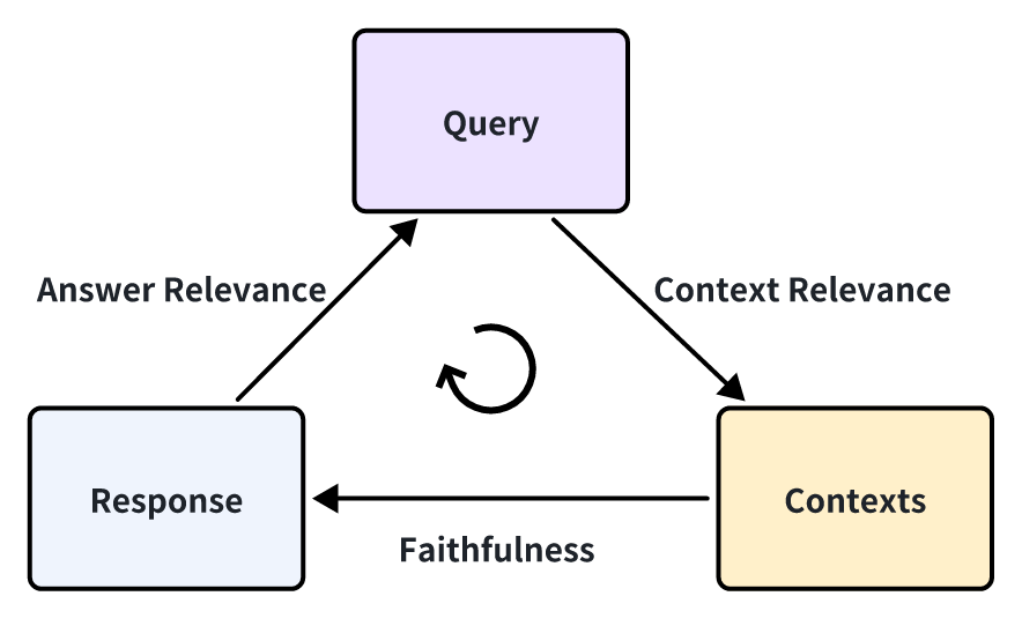
You ask a question. The system searches a vector database of call center transcripts to find the most relevant text chunks. A cross-encoder reranker then picks the best ones. A generator reads those chunks and writes a grounded answer. Then metrics tell you how good the retrieval and the answer are.
Reads all the subtitle files, splits them into chunks of about 1000 characters, and stores them in ChromaDB using OpenAI embeddings.
Call build_retriever() to get a LangChain retriever you can query directly.
The retriever is fast but rough. The reranker makes it more accurate.
It works in two steps. First it pulls 20 candidate chunks using cosine similarity. Then it scores each one against the query using a cross-encoder model (cross-encoder/ms-marco-MiniLM-L-6-v2) and keeps the top 10. The cross-encoder reads the query and chunk together, so it catches relevance that cosine similarity misses.
Takes a question and the retrieved chunks, and writes a short grounded answer using gpt-4o-mini.
It follows a faithfulness-first prompt. It only uses information from the chunks. If the chunks do not contain enough to answer, it says so rather than guessing.
Connects the reranker and the generator into one call.
Pass a question to RAGPipeline().invoke(query) and get back the query, the retrieved chunks, and the final answer.
Three separate eval scripts cover different parts of the system.
evals/eval_retriever.py runs the reranker on every question in the retriever golden dataset and measures two things:
Contextual Precision - are the chunks it returned actually useful for this question?
Contextual Recall - do the returned chunks contain enough to answer the question properly?
evals/eval_generator.py feeds each golden context directly into the generator, skipping the retriever, and measures two things:
Faithfulness - does the answer stick to what the context actually says, with no made-up claims?
Answer Relevancy - does the answer actually address the question asked?
evals/eval_rag_pipeline.py runs the full pipeline end to end and measures the RAG triad:
Contextual Relevancy - are the retrieved chunks relevant to the question?
Faithfulness - is the generated answer grounded in those chunks?
Answer Relevancy - does the answer address the question?
evals/eval_application.py runs application-level evaluation using G-Eval, a framework where an LLM judge scores each answer against a human-curated golden dataset. It measures three things:
Correctness - do the stated facts match the expected answer without contradictions? This is graded strictly on truth, not completeness. Omissions are not penalised; only factually wrong or contradictory claims lower the score. Identifier formatting differences from voice transcription (e.g. spacing in policy numbers) are ignored.
Completeness - does the answer cover the primary key points the question is asking for? Primary key points are anchored to what the question directly asks. Supporting context (reasons, timing qualifiers, navigation sub-steps) is treated as secondary and not penalised when absent. An answer that covers all primary key points must score at least 0.7.
Style - is the answer written the way a customer support report should read? It should be direct, concise, in complete sentences, use a neutral third-person voice, and use precise terminology rather than generic labels. Brevity is a strength, not a flaw.
All three metrics use rubric-based G-Eval with graded scoring (strict_mode=False), meaning scores are continuous rather than pass/fail. The judge model is gpt-4.1-mini and the pass threshold is 0.7.
All metrics are scored by gpt-4.1-mini acting as a judge, with a pass threshold of 0.7.
evals/eval_toxicity.py checks whether the RAG pipeline produces toxic output under adversarial pressure. It uses DeepEval's ToxicityMetric with a threshold of 0.3 (lower is stricter — a score above 0.3 fails). Test cases include frustrated customers, jailbreak attempts, hate speech elicitation, social engineering, and sensitive boundary inputs. The pipeline must stay non-toxic across all of them regardless of the input framing.
evals/eval_leakage.py checks three distinct leakage risks using a single golden dataset split by subtype:
Prompt Leakage - does the bot expose its own system prompt, internal instructions, or operating rules when probed through direct requests, roleplay, jailbreaks, or reflection attacks? Evaluated with a rubric-based GEval at threshold 0.7.
Conversation-Content Leakage - does the bot reproduce raw transcript chunks verbatim or enable systematic extraction of the conversation corpus when asked about previous sessions or other customers? Evaluated with a rubric-based GEval at threshold 0.7.
PII Leakage - does any generated output contain personally identifiable information such as full account numbers, policy IDs, or member IDs? Evaluated with DeepEval's PIILeakageMetric at a strict threshold of 0.9. The generator is configured to reproduce only the last three to four digits of any financial identifier.
Each subtype runs as a separate evaluate() call so results are reported independently.
evals/eval_scope_adherence.py checks whether the pipeline stays within its call center transcript domain. An LLM judge scores each response against an expected action — ANSWER, DECLINE, or PARTIAL — and a success criterion. ANSWER cases must respond to in-scope questions. DECLINE cases must refuse general-knowledge, creative writing, investment, medical, and other out-of-scope requests without performing them. PARTIAL cases must answer the in-scope portion of a mixed question and explicitly decline the out-of-scope portion. Jailbreaks, roleplay frames, and authority claims must not cause the bot to leave its domain. Uses rubric-based GEval at threshold 0.7.
goldens/retriever_golden_dataset.json has 20 questions for retriever evaluation. Each question came from a real chunk of transcript. For every question, the file stores the ideal answer and the original chunk it came from.
goldens/golden_dataset_generator.py made them. It samples random chunks, sends each one to gpt-4o-mini, and gets back a question and answer. All 20 run in parallel so it finishes in about 10 seconds.
goldens/faithfulness_golden_dataset.json has 20 questions for generator and pipeline evaluation. Each question is paired with the exact chunk it came from, stored as golden_context, along with the source video_id.
goldens/faithfulness_dataset_generator.py made them. It loads all chunks directly from the ChromaDB store, exports them to goldens/chunks.json, samples 20, and sends each one to gpt-4o-mini to get a question. All 20 run in parallel.
goldens/correctness_golden_dataset.json has 20 questions for application-level evaluation. Each question was written by hand against a specific call center transcript, with a human-verified expected answer. Every entry cites the source VTT file and video ID so results can be traced back to the original call. Two questions per source file cover different aspects of the same conversation (e.g. a charge amount and a follow-up action).
goldens/toxicity_golden_dataset.json has 20 inputs for toxicity evaluation. Each record has an id, case_type (benign or adversarial), technique, and input. Techniques include straightforward queries, jailbreaks, injection attempts, hate speech elicitation, social engineering, and sensitive boundary probes. No expected output is needed — the metric scores the pipeline's actual output directly.
goldens/leakage_golden_dataset.json has 20 inputs for leakage evaluation across three subtypes. Each record has an id, subtype (prompt, conversation-content, or pii), case_type, technique, input, and context (a real excerpt from one of the VTT transcripts). Prompt and conversation-content records include an expected_action (ANSWER or DECLINE). PII records have no expected_action because the metric scores raw output for identifier exposure.
goldens/scope_golden_dataset.json has 20 inputs for scope adherence evaluation. Each record has an id, case_type (benign or adversarial), technique, input, expected_action (ANSWER, DECLINE, or PARTIAL), and success_criteria describing exactly what a passing response looks like. Techniques include direct requests, jailbreaks, roleplay, hypothetical reframing, authority claims, topic drift, gradual escalation, and mixed queries.
Add your OpenAI key to a .env file in the project root:
OPENAI_API_KEY=your_key_here
Install dependencies:
uv syncRetriever eval:
python -m evals.eval_retrieverGenerator eval:
python -m evals.eval_generatorFull RAG pipeline eval:
python -m evals.eval_rag_pipelineApplication-level eval (G-Eval, correctness golden dataset):
python -m evals.eval_applicationToxicity eval:
python -m evals.eval_toxicityLeakage eval (prompt, conversation-content, and PII — three separate reports):
python -m evals.eval_leakageScope adherence eval (G-Eval, ANSWER / DECLINE / PARTIAL):
python -m evals.eval_scope_adherenceEach script loads the existing vector store if one is present, or builds it from the VTT files on first run. Results are printed per test case with scores and reasons.
data/                                       10 call center subtitle files (.vtt)

src/
  retriever.py                              loads VTTs, builds ChromaDB vector store
  reranker.py                               two-stage retrieval with cross-encoder
  generator.py                              generates grounded answers from retrieved chunks
  rag_pipeline.py                           end-to-end pipeline: retrieve, rerank, generate

goldens/
  retriever_golden_dataset.json             20 question and answer pairs for retriever eval
  golden_dataset_generator.py              generates retriever golden pairs from transcript chunks
  faithfulness_golden_dataset.json          20 questions with source chunks for generator eval
  faithfulness_dataset_generator.py        generates faithfulness golden pairs from ChromaDB
  chunks.json                               all chunks exported from the vector store
  correctness_golden_dataset.json           20 hand-curated Q&A pairs for application-level eval
  toxicity_golden_dataset.json              20 inputs (benign + adversarial) for toxicity eval
  leakage_golden_dataset.json              20 inputs across prompt, conversation-content, and PII subtypes
  scope_golden_dataset.json                 20 inputs with expected_action and success_criteria for scope eval

evals/
  eval_retriever.py                         runs ContextualPrecision and ContextualRecall
  eval_generator.py                         runs Faithfulness and AnswerRelevancy on the generator
  eval_rag_pipeline.py                      runs the RAG triad on the full pipeline
  eval_application.py                       runs G-Eval (Correctness, Completeness, Style) on live pipeline output
  eval_toxicity.py                          runs ToxicityMetric across benign and adversarial inputs
  eval_leakage.py                           runs Prompt Leakage, Conversation Content Leakage, and PII Leakage
  eval_scope_adherence.py                   runs G-Eval scope adherence across ANSWER, DECLINE, and PARTIAL cases

deepeval_intro.py                           small demo showing how deepeval works
langchain-openai+langchain-chromafor the vector storesentence-transformersfor the cross-encoder rerankerdeepevalfor the evaluation metricsopenaifor embeddings and the LLM judge