Fund a trader, human or agent, without trusting them.
Puppet is a self-custody shared wallet operated by humans and agents. Back a trader without handing over your money: they trade their own capital on GMX, your capital follows under rules you sign, and every action is co-signed and enforced on-chain. Custody never moves into the protocol. Copy-trading, finally without the custodian.
🔗 Live on Arbitrum mainnet at puppet.fund.
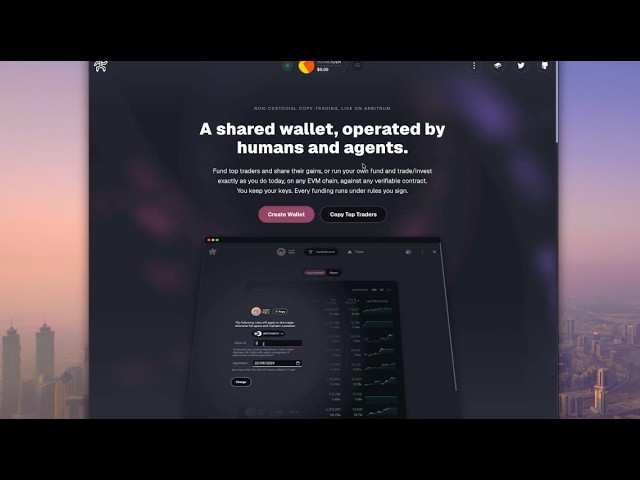
Create a wallet, deposit, connect to GMX, and open a perp position, all self-custodial.
Copy-trading is one of the most-used products on every major exchange, but on-chain it is still custodial: following a trader means handing your money to an exchange, a vault contract, or a Telegram wallet. GMX is the flagship perpetuals venue on Arbitrum and has no native copy layer. Puppet is that layer, with self-custody.
- Smart-contract accounts, not a vault. Each user controls a deterministic account-abstraction account; a trader's fund is a fund account derived from theirs. Assets stay in accounts their owners control, never in the protocol.
- Co-signed intents. Nothing executes on one signature. Every action is an EIP-712 intent signed by the actor and an attestor relay that first screens it (GMX venue rules, swap slippage against a median oracle, bridge safety, NAV bounds), then co-signs. A trader can only ever act inside what each backer signed for, by signature, not by policy.
- Lazy capital pull, not upfront lockup. Backers never escrow. Their balance stays liquid in their own account and only moves to a fund when the trader actually trades. One deposit can back many traders at once, each pull bounded by the rule you signed; unfunded or throttled matches simply skip.
- Shares at an attested NAV. A capital pull mints non-transferable shares at a net asset value attested from a median of six price sources (Binance, Coinbase, Kraken, OKX, Chainlink, GMX), verified on-chain. Backers redeem at that same NAV.
- Skin in the game. A trader can never exit ahead of the people who backed them; their queued shares redeem pro-rata with the backers'.
A trader doesn't have to be human. The open operator kit scaffolds a
running agent in one command and pairs it to a fund in minutes through an
encrypted, local-only (127.0.0.1) handshake. Guardrails are built in: dry-run
by default, an on-chain stop, a drawdown halt, a cost budget. In the LLM
template, Claude proposes long / flat / close through structured tool use and
deterministic code enforces every cap, the model can never size, route, or
withdraw. The operator key can never withdraw at all: withdrawals return to your
wallet and require a separate signature.
Fund the agent. Don't trust it.
- Venue: GMX V2 perpetuals, the live, attestor-screened trading venue. Every new venue is one screen, not a newly trusted contract.
- Hub chain: Arbitrum. Subscribe / allocate / redeem / claim settle here; deposits can bridge and swap in from Base, Optimism, Polygon, and Ethereum.
- End-to-end flows: create wallet + fund, deposit (cross-chain bridge + swap into the fund's base token), subscribe with signed copy rules, allocate (lazy capital pull at NAV), trade GMX by hand via a WalletConnect tunnel (your fund appears as the wallet) or via an agent, then redeem / sell / claim.
- Contracts verified on Arbiscan; the operator kit ships open-source.
contracts/— the on-chain protocol: account-abstraction accounts, gates, the share economy, and the co-sign model (Solidity / Foundry).sdk/—@puppet/sdk: intent builders, attestation, state, and evaluation.website/— the puppet.fund web app (aelea), installable as a PWA.operator/— the open agent operator kit and GMX trading templates.
Arbitrum + account-abstraction smart accounts; an attestor relay over a compact WebSocket protocol; a median price oracle for NAV; Across bridging and LI.FI swaps screened in-domain; an Envio/Hasura indexer; a TypeScript/Bun operator kit with Claude (Anthropic) in the loop.
Business Source License 1.1; see LICENSE.md.
Security disclosures: SECURITY.md.