

Dynamic Link equivalent for DaVinci Resolve to After Effects & REAPER
A native DaVinci Resolve Workflow Integration Plugin that bridges DaVinci Resolve with Adobe After Effects and REAPER, providing a Dynamic Link-like workflow for VFX, motion graphics, and audio post-production.








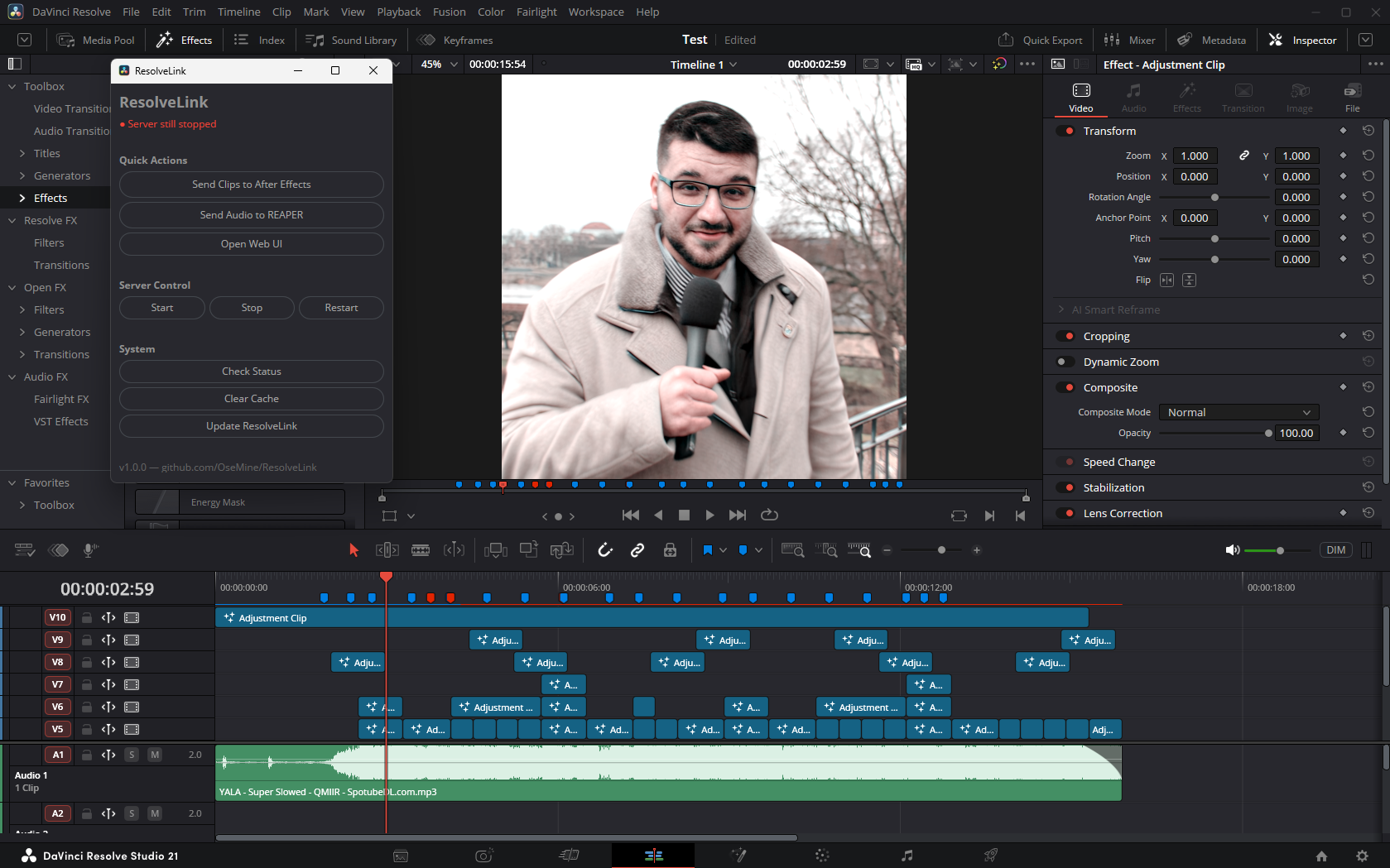
DaVinci Resolve
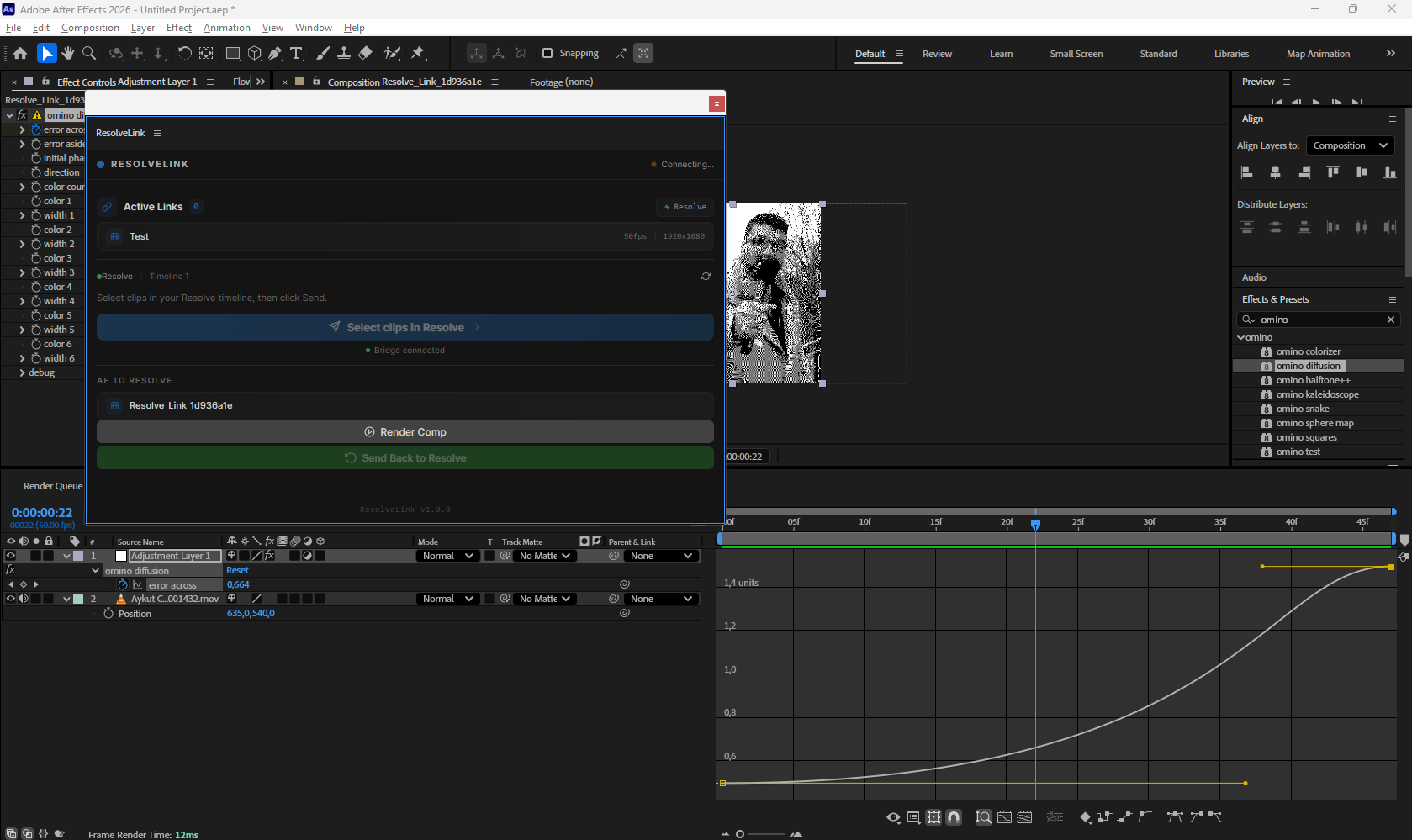
After Effects
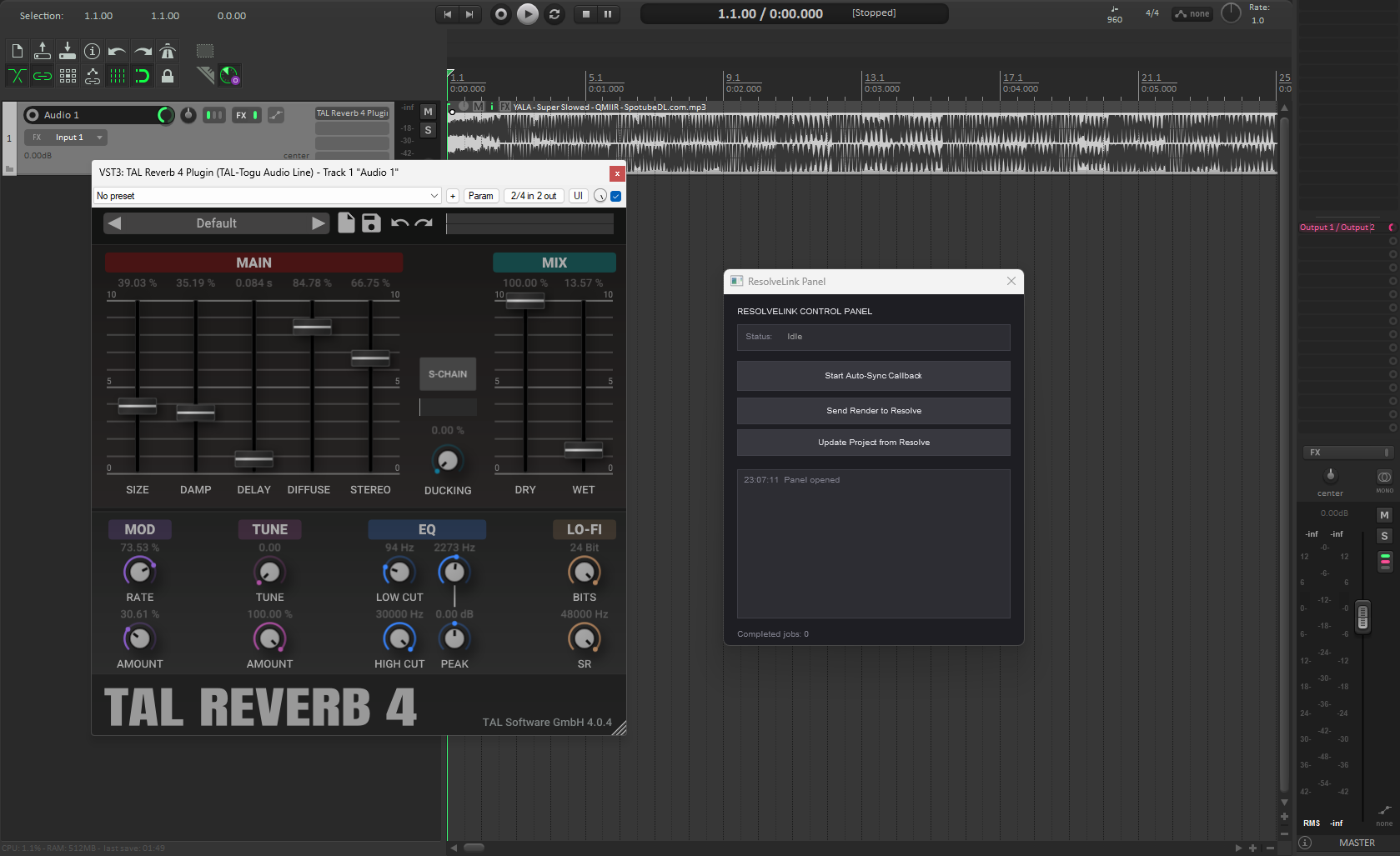
REAPER
DaVinci Resolve lacks Adobe's Dynamic Link. When VFX work needs to happen in After Effects or audio needs to be mixed in REAPER, editors must manually export clips, open the target application, import footage, match timecodes, render, and re-import back. This breaks creative flow and wastes hours.
ResolveLink automates the entire round-trip. Select clips in Resolve, click one button, and a synchronized After Effects composition is created instantly. When AE work is rendered, the result automatically syncs back to the Resolve timeline as a compound clip. For audio, send clips directly to REAPER for mixing — the same round-trip workflow applies.
 ┌──────────────────┐      ┌──────────────────┐      ┌──────────────────┐
 │  DaVinci Resolve  │ ───> │  ResolveLink       │ ───> │  After Effects   │
 │                   │      │  Bridge Server    │      │                  │
 │  Select Clips     │      │  - REST API       │      │  CEP Extension   │
 │  Click "Send"     │      │  - File Watcher   │      │  Auto Comp       │
 │  Auto Re-import   │ <─── │  - WebSocket      │ <─── │  Render & Export │
 └──────────────────┘      └────────┬─────────┘      └──────────────────┘
                                    │
                                    │
                           ┌────────▼─────────┐
                           │                   │
                           │    REAPER DAW     │
                           │                   │
                           │  Panel UI         │
                           │  File-based IPC   │
                           │  Render & Export  │
                           └──────────────────┘
- One-Click Send — Select clips in the Resolve timeline, send directly to After Effects
- Auto Composition — Creates perfectly synchronized AE compositions with correct resolution, framerate, and timecodes
- Auto Workflow — If AE is running, jobs are queued for the CEP extension; if not, AE is launched with the script automatically
- File Watcher — Monitors render output folders and syncs completed renders back to Resolve automatically
- Compound Clip Import — Rendered output is automatically imported back into Resolve as a compound clip (V2 render over V1 originals)
- CEP Extension — Panel inside After Effects that polls for jobs, executes scripts, and handles rendering
- Unified Panel — Single GFX UI window with all controls (no dependencies required)
- Background Callback — Toggle ON/OFF to auto-import audio from Resolve into REAPER
- Send Render to Resolve — One-click render and import audio back into DaVinci
- Update Project — Sync REAPER items to match Resolve timeline (position, length, track)
- File-based IPC — No network dependency between REAPER scripts and server
- Auto-Save — Projects saved automatically to
exports/reaper-projects/ - ReaPack Repository — Install scripts via ReaPack package manager
- Desktop App — Electron UI for server management, project browser, and status
- Real-time Status — Live status indicators via WebSocket
- Setup Wizard — Auto-detect Python and AE paths, first-run configuration
- Dark UI — Matches DaVinci Resolve's professional dark theme exactly
- Cross-Platform — Windows, macOS, and Linux support
- GitHub Releases — Tagged releases with auto-generated installers
iex (iwr -UseBasicParsing "https://raw.githubusercontent.com/OseMine/ResolveLink/main/install.ps1").Contentcurl -fsSL https://raw.githubusercontent.com/OseMine/ResolveLink/main/install.sh | bash- Download
install.luafrom the latest release - Open DaVinci Resolve
- Go to Workspace > Console (or press Alt+F9)
- Paste the contents of
install.luaand press Enter
That's it. The script will:
- Detect your OS and check for Git + Node.js
- Download the correct release version automatically
- Run the full setup (deps, build, extensions, .env)
- Deploy Resolve scripts and start the server
- In REAPER, go to Options > Show REAPER resource path
- Open
Scripts/ReaPack/Packages/ - Add this URL in ReaPack > Edit repositories:
https://raw.githubusercontent.com/OseMine/ResolveLink/main/index.xml - Click OK, then ReaPack > Synchronize packages
- Install from ReaPack > Browse packages > ResolveLink
| Script | Description |
|---|---|
| ResolveLink Panel | Unified control panel (all-in-one) |
| ResolveLink Callback | Background worker for auto-import |
| ResolveLink Send to Resolve | Render and import to DaVinci |
| ResolveLink Update Project | Sync REAPER to DaVinci timeline |
| ResolveLink Logger | Toggleable console logger for debugging |
| OS | Path |
|---|---|
| Windows | %LOCALAPPDATA%\ResolveLink |
| macOS | ~/Applications/ResolveLink |
| Linux | ~/.local/share/ResolveLink |
On first run, the setup wizard auto-detects Python and After Effects paths and generates a .env file. You can re-run it anytime:
.\scripts\setup.ps1 -ForceAll configuration is driven by .env:
| Variable | Default | Description |
|---|---|---|
PORT |
3030 |
Server port |
HOST |
127.0.0.1 |
Bind address |
EXPORT_DIR |
./exports |
Where renders are saved |
TEMP_DIR |
./temp |
Generated scripts location |
PYTHON_PATH |
python |
Python executable |
AE_PATH_WIN |
(auto-detected) | After Effects install path |
AE_PATH_MAC |
(auto-detected) | After Effects install path |
REAPER_PATH_WIN |
(auto-detected) | REAPER install path (Windows) |
REAPER_PATH_MAC |
(auto-detected) | REAPER install path (macOS) |
RESOLVE_SCRIPTING_PATH |
(auto-detected) | Resolve scripting modules |
WATCHER_ENABLED |
true |
Enable file watcher |
WATCH_FOLDERS |
(none) | Extra folders to watch (comma-separated) |
LOG_LEVEL |
info |
Log level (debug/info/warn/error) |
See .env.example for all options.
| Layer | Technology |
|---|---|
| Frontend UI | React 18, TypeScript, Tailwind CSS, Lucide Icons |
| Desktop Shell | Electron 28 |
| Backend Server | Node.js, Express, Chokidar, WebSocket (ws), Zod, dotenv |
| Resolve Bridge | Python 3.10+ (DaVinciResolveScript API), Node.js child_process wrapper |
| Adobe Automation | CEP Extension (HTML/JS panel), ExtendScript (.jsx), base64-encoded payloads |
| REAPER Automation | Pure GFX panel, Lua scripts, file-based IPC |
| Validation | Zod schema validation on all POST/PUT endpoints |
| Testing | Vitest (unit + integration) |
resolvelink/
├── install.lua                 # One-step installer (paste into Resolve Console)
├── scripts/                    # Management scripts
│   ├── setup.ps1 / setup.sh   # Unified installer/updater
│   ├── start.ps1 / start.sh   # Start server
│   ├── stop.ps1 / stop.sh     # Stop server
│   ├── status.ps1 / status.sh # Check status
│   └── deploy-*.ps1           # Deploy extensions
│
├── packages/                   # Monorepo packages
│   ├── server/                 # Backend
│   │   ├── src/
│   │   │   ├── index.js               # Express + WebSocket + Chokidar + Job queue
│   │   │   ├── config.json            # Default config
│   │   │   ├── logger.js              # Structured logger
│   │   │   ├── perf.js                # Request performance middleware
│   │   │   ├── middleware/            # Zod validation middleware
│   │   │   ├── routes/                # REST API route handlers
│   │   │   ├── integrations/          # External tool integrations
│   │   │   │   ├── ae/                # After Effects (spawn, JSX generators)
│   │   │   │   └── reaper/            # REAPER service
│   │   │   └── services/              # Core services
│   │   ├── resolve-bridge.py          # Python DaVinci Resolve scripting bridge
│   │   └── package.json
│   │
│   ├── ui/                     # Frontend (React + Vite + TypeScript)
│   │   ├── src/
│   │   │   ├── components/            # React components
│   │   │   └── lib/                   # API client, hooks, utilities
│   │   └── package.json
│   │
│   └── shared/                 # Shared types and utilities
│       └── package.json
│
├── extension/                  # CEP Extension (inside After Effects)
│   ├── CSXS/manifest.xml
│   ├── client/                # Panel UI (HTML/JS/CSS)
│   └── host/host.jsx          # ExtendScript host functions
│
├── resolve-scripts/            # DaVinci Resolve scripts
│   ├── ResolveLink.lua         # Main launcher
│   ├── send-to-ae.py          # Clip send dialog (tkinter)
│   └── send-to-reaper.py      # Audio clip send dialog (tkinter)
│
├── reaper-scripts/                 # REAPER scripts
│   ├── resolve-link-panel.lua      # Unified GFX control panel (v2.2.0)
│   ├── resolve-link-logger.lua     # Toggleable console logger (shared)
│   ├── render-lib.lua              # Shared render config + import logic
│   ├── json.lua                    # Shared JSON decoder module
│   ├── reaper-callback.lua         # Background worker (file-based IPC)
│   ├── send-to-resolve.lua         # Render and import to DaVinci
│   └── update-project.lua          # Sync REAPER to DaVinci timeline
│
├── adobe/                      # ExtendScript library
│   └── import_pipeline.jsx    # Standalone AE composition importer
│
├── test/                       # Test suite
├── docs/                       # Documentation
├── assets/                     # Images and icons
├── exports/                    # Render output (watched)
├── temp/                       # Generated scripts and payloads
├── index.xml                   # ReaPack repository
├── RELEASE.md                  # Release notes
├── vitest.config.js            # Test config
├── electron.js                 # Electron main process
├── .env.example                # Configuration template
├── package.json
└── README.md
| Document | Description |
|---|---|
| Architecture | System design, data flow, component interaction |
| API Reference | REST endpoints, WebSocket protocol, data types |
| Setup Guide | Installation, configuration, troubleshooting |
| Workflow Guide | Step-by-step user workflow |
| Release Notes | Version history and changelog |
- Node.js 18+
- Python 3.10+ (for Resolve scripting bridge)
- DaVinci Resolve 19+ (scripting API supported in free and Studio)
- Adobe After Effects 2022+ (for CEP)
- REAPER 6+ (optional, for audio post-production workflow)
| Command | Description |
|---|---|
npm run dev |
Start server + Vite dev server concurrently |
npm run server |
Start only the backend server |
npm run ui |
Start only the Vite dev server |
npm run build |
Build the frontend for production |
npm start |
Start the Electron app |
npm test |
Run all tests (vitest) |
npm run test:watch |
Run tests in watch mode |
npm run install:all |
Install all workspace dependencies |
- Selection — Editor selects clips in the Resolve timeline
- Send — Clicks "Send Selection to After Effects"
- Translate — Plugin reads clip metadata via the Python scripting bridge
- Generate — Server creates
.jsx+.json, queues job for CEP extension - Execute — CEP extension inside AE picks up the job, creates synchronized composition
- Edit — VFX artist works in After Effects
- Render — Artist renders (via CEP panel, plugin, or manually)
- Detect — File watcher detects the new render in exports/
- Import — Render is automatically imported back into Resolve as a compound clip
- Sync — UI shows updated link status via WebSocket
- Selection — Editor clicks "Send Audio to REAPER" in the Resolve launcher
- Dialog — Tkinter dialog shows available audio clips for selection
- Generate — Server generates Lua import script + JSON payload + render config
- IPC — Server writes job file to
exports/reaper-jobs/ - Execute — Panel's callback picks up job, imports audio into REAPER
- Mix — Audio engineer mixes in REAPER
- Save — Project auto-saved to
exports/reaper-projects/ - Render — Engineer renders to configured export directory
- Import — Panel sends rendered audio to server, imports into Resolve
- Sync — Audio track added to Resolve timeline, old clips muted
| Shortcut | Action |
|---|---|
Ctrl+Shift+R |
Refresh selection from Resolve |
Ctrl+Enter |
Send selected clips to AE |
Ctrl+T |
Toggle tools panel |
Ctrl+, |
Open setup wizard |
MIT
Built for editors who refuse to break their creative flow.