Realtime highly decentralised chat app with extension protocol support.
🌐 Live Demo: https://dweb.link/ipfs/bafybeiesr6wwz5boxhw3fwn5pdj2bgccsikci2ssklwdp6lao23vfsafmm

Showcasing libp2p's superpowers in establishing ubiquitous peer-to-peer connectivity in modern programming languages (Go, Rust, TypeScript) and runtimes (Web, native binary).
On top of this strong foundation, it layers a GossipSub: A Secure PubSub Protocol for Unstructured Decentralised P2P Overlays. By analogy, an event broker with distributed brokering, or a distributed PubSub protocol.
This is the gossip event protocol that powers Filecoin and Post-Merge Ethereum.
Some of the cool and cutting-edge transport protocols used by this app are:
- WebTransport
- WebRTC
- WebRTC-direct
- QUIC
- TCP
| Package | Description | WebTransport | WebRTC | WebRTC-direct | QUIC | TCP |
|---|---|---|---|---|---|---|
js-peer |
Browser Chat Peer in TypeScript | ✅ | ✅ | ✅ | ❌ | ❌ |
node-js-peer |
Node.js Chat Peer in TypeScript | ✅ | ✅ | ✅ | ✅ | ✅ |
go-peer |
Chat peer implemented in Go | ✅ | ❌ | ✅ | ✅ | ✅ |
rust-peer |
Chat peer implemented in Rust | ❌ | ❌ | ✅ | ✅ | ✅ |
nim-peer |
Chat peer implemented in Nim | ❌ | ❌ | ❌ | ❌ | ✅ |
✅ - Protocol supported ❌ - Protocol not supported
- Uses the GossipSub PubSub protocol for decentralised messaging
The Universal Connectivity Extension Protocol enables peer-to-peer apps to discover and interact with extensions running on other peers. Apps can dynamically discover available functionality from connected peers and execute commands without knowing about extensions beforehand.
- Discovery: Peers advertise extensions via libp2p identify protocol with custom protocol IDs:
/uc/extension/{extensionId}/{version} - Manifest Exchange: Peers request extension manifests containing metadata, commands, and UI URLs
- Command Execution: Execute commands on remote extensions via protobuf-encoded messages over direct streams
- User Installation: Users can install extensions from peers and access their functionality through the chat interface
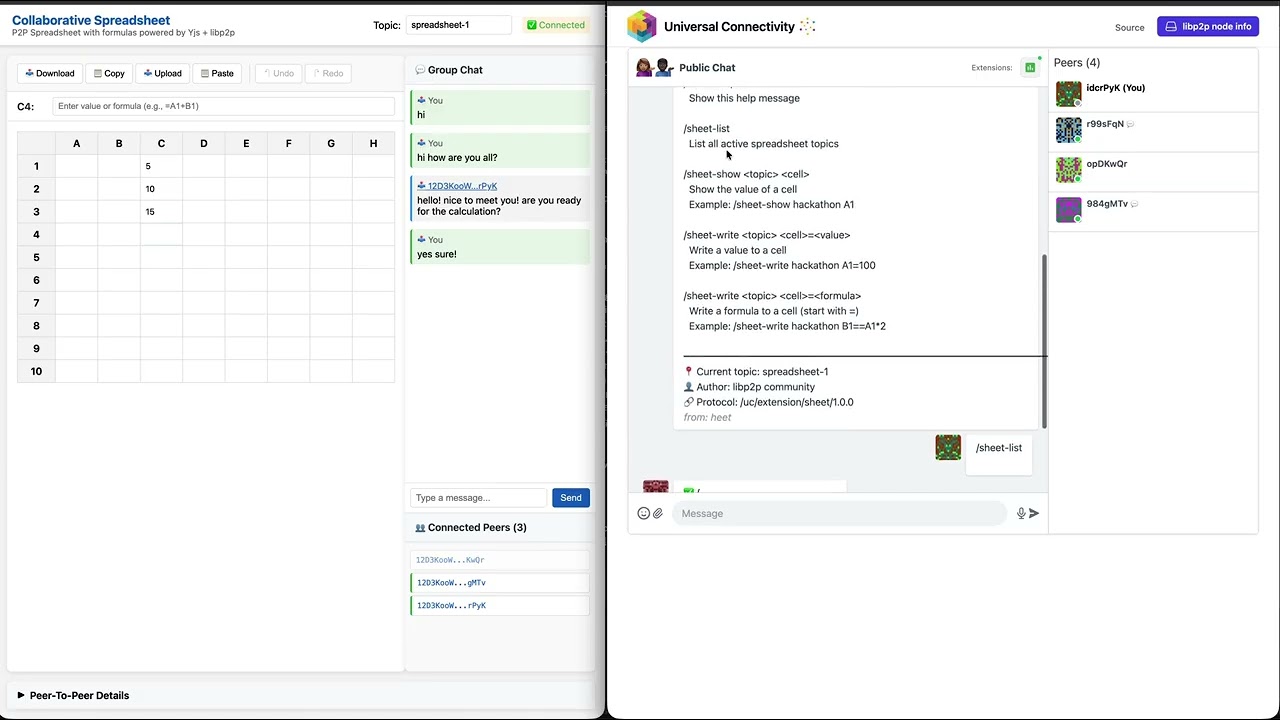
Watch the demo showing a collaborative spreadsheet extension in action
See the spreadsheet example for a complete implementation of UCEP. This example shows:
- Extension service setup with topology tracking
- Manifest and command request handling
- Integration with a Yjs collaborative spreadsheet
- Direct stream communication using pbStream
Any app can implement UCEP! Examples:
- Todo apps: Share and sync tasks across peers
- File sharing: Discover and request files from peers
- Games: Find and join multiplayer sessions
- Collaborative tools: Real-time document editing, whiteboards
The protocol is transport-agnostic and works over any libp2p connection (WebRTC, WebTransport, QUIC, TCP).
There are two ways to connect to a peer:
- With a PeerID using peer routing (adds a step to resolve the multiaddr for the PeerID), using the IPFS/Libp2p DHT, e.g.
12D3KooWLMySi3eEWscUnKmMCYRSXL3obYJ4KNimpShJK6shUy2M - With a multiaddr directly (skips the peer routing step), e.g.
/ip4/127.0.0.1/udp/64434/webrtc/certhash/uEiA_tkndZQWf7jyFqgCiwH_CqsS7FTWFTb6Px8MPxxT9gQ/p2p/12D3KooWLMySi3eEWscUnKmMCYRSXL3obYJ4KNimpShJK6shUy2M
Load the UI, and enter the multiaddr into the UI. Ensure that it includes the peerID, e.g./ip4/192.168.178.21/udp/61838/quic-v1/webtransport/certhash/uEiCQCALYac4V3LJ2ourLdauXOswIXpIuJ_JNT-8Wavmxyw/certhash/uEiCdYghq5FlXGkVONQXT07CteA16BDyMPI23-0GjA9Ej_w/p2p/12D3KooWF7ovRNBKPxERf6GtUbFdiqJsQviKUb7Z8a2Uuuo6MrDX
Run npm install:
cd js-peer
npm i
Start the dev server:
npm run dev
cd node-js-peer
npm i
npm start
cd rust-peer
cargo run

To start the Rust Peer with an argument, you can use the following command:
cargo run -- --gossipsub-peer-discovery dev-dcontact._peer-discovery._p2p._pubsub
This will automatically connect you to the bootstrap nodes running on bootstrap.libp2p.io.
To explore more advanced configurations if you e.g. want to set up our own network, try:
cargo run -- --help
cd go-peer
go run .
cd nim-peer
nimble build

# Wait for connections in tcp/9093
./nim_peer

# Connect to another node (e.g. in localhost tcp/9092)
./nim_peer --connect /ip4/127.0.0.1/tcp/9092/p2p/12D3KooSomePeerId