

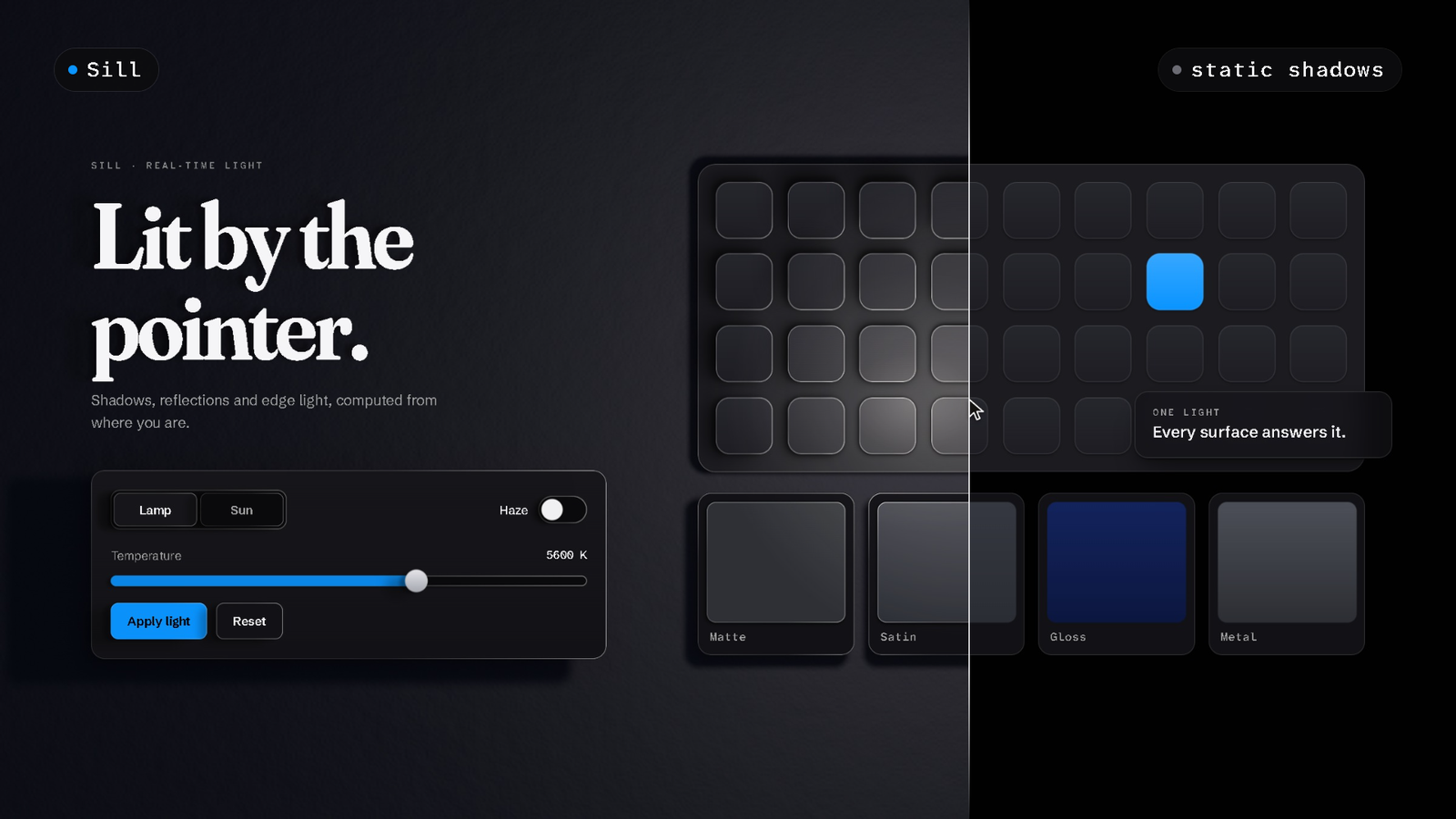
A 4.7-second loop from the live page, captured frame by frame. It shows a still frame if you prefer reduced motion. Try it live.
Real-time light for interfaces. The pointer is the light: cards, controls and type cast shadows projected from it, catch highlights where a real surface would, and light up on the edge facing it.
Your interface stays real HTML. Text, buttons, focus and screen readers work exactly as before. Sill lights them.
Mark up what should take the light:
<article class="card" data-lit data-material="satin" data-depth="16">
  <h2 data-lit="type" data-depth="10">Lit by the pointer.</h2>
  <button data-lit data-material="gloss" data-depth="6">Apply</button>
</article>
With a bundler (Vite, webpack, esbuild):
npm install @designesy/sillimport '@designesy/sill/sill.css';
import { Sill } from '@designesy/sill';
new Sill({ params: { mode: 'lamp', temperature: 5600 } });Without a build step, straight from a CDN:
<link rel="stylesheet" href="https://cdn.jsdelivr.net/npm/@designesy/sill@0.1.2/src/sill.css">
<script type="module">
  import { Sill } from 'https://cdn.jsdelivr.net/npm/@designesy/sill@0.1.2/src/sill.js';
  new Sill({ params: { mode: 'lamp', temperature: 5600 } });
</script>- Cast shadows. One WebGL2 pass treats every lit card as a rounded rectangle at a known height and projects it from the light. The penumbra grows with elevation, so a button's shadow is crisp and a floating card's is soft. Overlapping shadows never darken twice.
- Surfaces that answer the light. Each lit element gets a light layer beneath its content: a soft wash, a highlight placed where the light would reflect toward your eye, and edge light worked out for each side.
- Lit type.
data-lit="type"makes a heading stand off the page and cast shadows from the pointer, with a thin rim on the side facing the light. - Materials. Matte, satin, gloss, metal, fabric, wood, stone and glass each reflect the same light differently.
- Lamp or sun. A lamp at the pointer, or a sun the pointer moves across the sky, with optional skylight mullions and haze.
- Product stages. Small signed-distance-field scenes lit by the same light
(
@designesy/sill/stage.js).
- Text never sits under the light. The light layer paints between a surface and its content, so brightness changes never cover text.
- Contrast is capped. Wash and highlight over a face that carries text never
exceed a theme ceiling (
--sill-lift-max), whatever the sliders say. Faces with no text may take more light. Both are covered by tests. - Reduced motion parks the light. Under
prefers-reduced-motion, the light does not follow the pointer; a keyboard-operable position pad moves it on purpose. prefers-contrast: morelowers wash, highlight and rim.- No WebGL? The page keeps its own token shadows.
enabled: falseturns the light off completely. - Touch moves the light to the point of contact. There is no fake hover.
Nothing renders while the pointer is still. In our measurements Sill held 60 fps
with the light moving and the page scrolling, with 0.29 to 0.39 ms of its own
script per frame, on one machine with an integrated GPU. Conditions and limits are in
docs/PERFORMANCE.md. Five tiers (auto, high,
balanced, low, static) trade resolution for headroom, and auto steps down
on sustained missed frames.
import { Sill, PRESETS, MATERIALS } from '@designesy/sill';

const sill = new Sill({ root: document.body, params: { mode: 'sun' } });
sill.set({ intensity: 1.2, shadowLength: 1.6 });
sill.preset('golden');         // morning | noon | golden | lamp
sill.moveTo(640, 220, true);   // place the light; true skips easing
sill.subscribe((s) => console.log(s.params));
sill.scan();                   // after adding [data-lit] elements
sill.destroy();| Param | Range | Controls |
|---|---|---|
mode |
lamp, sun |
light source |
follow |
boolean | pointer tracking (off under reduced motion) |
intensity |
0 to 1.6 | key strength |
temperature |
2200 to 7500 K | key colour |
shadowLength |
0.4 to 2.6 | lamp height or sun elevation |
softness |
0 to 1 | light size, so penumbra width |
falloff |
0.2 to 2 | lamp inverse-square strength |
depth |
0 to 2.5 | multiplies every elevation |
material |
0 to 2 | highlight, rim and wash response |
ambient |
0.1 to 1 | sky fill |
rays |
0 to 1 | haze visibility |
shadow |
0 to 1 | cast shadow strength |
aperture |
boolean | sun skylight mullions |
smoothing |
ms | pointer easing |
tier |
auto, high, balanced, low, static |
performance tier |
enabled |
boolean | the off switch |
| Attribute | Meaning |
|---|---|
data-lit |
light this element |
data-lit="type" |
lit type: glyph shadows and rim |
data-material |
matte, satin, gloss, metal, fabric, wood, stone, glass |
data-depth |
elevation in px above its parent surface |
data-opacity |
how much light it blocks (glass, 0 to 1) |
data-cast |
floor (WebGL) or css (box-shadow onto its parent); inferred by default |
Themes own the numbers through CSS tokens: --sill-floor, --sill-sky,
--sill-shade, --sill-key, --sill-amb, --sill-wash, --sill-spec,
--sill-rim, --sill-cast, --sill-lift-max, --sill-lift-max-bare and more.
See docs/ARCHITECTURE.md.
A ready-made control panel ships as @designesy/sill/panel.js with
@designesy/sill/panel.css.
| Sill | vanilla-tilt.js | Shadow palette generators | Cursor-glow cards | |
|---|---|---|---|---|
| Light source follows the pointer | yes | glare overlay | no, static light | glow only |
| Shadows move with the light | yes | no | no | no |
| Penumbra grows with elevation | yes | no | yes, fixed per elevation | no |
| Highlights at the reflection point | yes | no | no | no |
| Text contrast guard | yes | no | not applicable | no |
| Interface stays real HTML | yes | yes | yes | yes |
vanilla-tilt tilts elements in 3D and is lovely at it. Shadow palette generators, such as Josh W. Comeau's, produce consistent static shadows from one implied light. Sill adds the light itself, moving, with physically derived shadows and an accessibility floor.
Live at le-vai.github.io/sill: the specimen, the furniture landing page, and the wordmark. To run them locally:
python -m http.server 4731Then open http://localhost:4731/.
The floor shadows and product stages need WebGL2. The surface layer uses CSS
masks and color-mix(). All three demos render the same in Chrome 154 and
Firefox 152 on Windows, with no console errors. Safari is not yet tested, and
performance has only been measured in Chrome.
MIT © 2026 LE-VAI. Part of the Designesy stack.