





A multi-agent operating system for enterprise executives. EOCoS ingests meetings, emails, documents, calendars, and project management tools, builds an organizational knowledge graph, and proactively coordinates enterprise operations — surfacing decisions, commitments, risks, and next actions with 100% verifiable source citations.
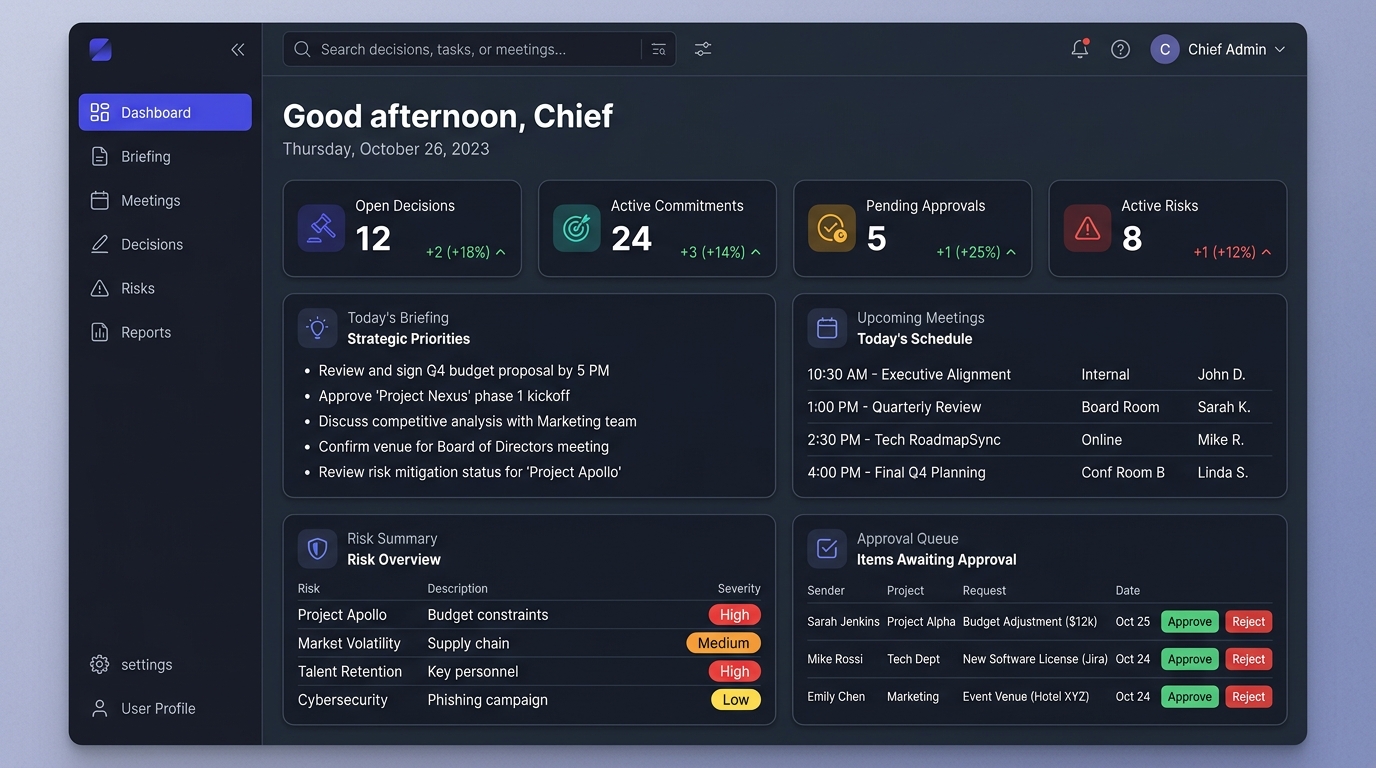
- Verifiable Decision & Commitment Ledger: Append-only system of record for every organizational decision and commitment. Every item references an exact timestamp and source transcript offset.
- Cognitive Multi-Agent Architecture: 6 specialized LangGraph agents running with reflection loops, RAG vector retrieval, and long-term memory.
- Enterprise-Grade Safety & Guardrails: Prompt injection defense (11 heuristic patterns), automated PII detection & redaction, LLM circuit breakers, and tenant token rate limiting.
- Human-in-the-Loop Approval Inbox: No external side effects (emails, calendar bookings, Jira updates) execute without explicit executive authorization.
- Organizational Knowledge Graph: Interactive ReactFlow visualization mapping connections across People, Teams, Goals, Projects, Decisions, and Commitments.
- Real-Time Live Meeting Processing: WebSocket-based transcript ingestion with near-real-time extraction chips and agent progress telemetry.
- Voice Executive Assistant: Deepgram STT + intent classification + TTS voice briefing read-back.
- Multi-Tenant Row-Level Security (RLS): PostgreSQL native RLS policies isolating every query by tenant ID.
graph TB
    subgraph Clients["Executive Client Layer"]
        NextJS["Next.js 14 Web App<br/>(Material-inspired Dark Mode)"]
        VoiceApp["Voice Client<br/>(WebRTC / Deepgram STT)"]
        PWA["PWA Mobile Client"]
    end

    subgraph APILayer["API Gateway & Ingestion"]
        FastAPI["FastAPI Gateway (Port 8000)<br/>REST + WebSocket + SSE"]
        AuthRLS["AuthN / RBAC / Postgres RLS"]
        Connectors["Enterprise Connectors<br/>(MS Graph, Google, Slack, Jira)"]
    end

    subgraph AgentMesh["LangGraph Multi-Agent Mesh"]
        MeetingAgent["Meeting Intelligence Agent"]
        PlanningAgent["Planning Agent"]
        CommAgent["Communication Agent"]
        SchedAgent["Scheduling Agent"]
        RiskAgent["Risk Agent"]
        BriefingAgent["Executive Briefing Agent"]
    end

    subgraph AgentInfra["Agent Infrastructure & Safety"]
        CircuitBreaker["Circuit Breaker & Fallback Chain"]
        SemCache["Semantic LLM Cache"]
        Guardrails["Input/Output Guardrails & PII Redaction"]
        RateLimiter["Token Budget Rate Limiter"]
        MemoryMgr["Agent Memory Manager (pgvector)"]
        ShadowEval["Online Shadow Eval (LLM-as-Judge)"]
    end

    subgraph StateAndStorage["Data & Event Persistence"]
        Postgres[("PostgreSQL 16 + pgvector<br/>System of Record & Embeddings")]
        RedisStream[("Redis 7<br/>Streams Event Bus & Cache")]
        MinIO[("MinIO / S3<br/>Raw Audio & Documents")]
        Temporal[("Temporal Engine<br/>Durable Workflow Orchestration")]
    end

    Clients --> FastAPI
    FastAPI --> AuthRLS
    FastAPI --> Connectors
    FastAPI --> Temporal
    Temporal --> AgentMesh
    AgentMesh --> AgentInfra
    AgentMesh --> Postgres
    AgentMesh --> RedisStream
    AgentMesh --> MinIO
| Agent | Core Responsibility | Input Sources | Output Deliverables |
|---|---|---|---|
| 🎙️ Meeting Intelligence | Ingests live/recorded transcripts, extracts decisions, action items, and open questions with speaker attribution and exact timestamps | Audio, VTT/SRT transcripts, calendar metadata | decisions[], commitments[], citation offsets |
| 🎯 Planning Agent | Decomposes strategic goals into projects and milestones; preserves traceability from executive OKRs to team tasks | Org goals, existing project registry | projects[], milestones[], goal-linkage edges |
| ✉️ Communication Agent | Synthesizes contextual follow-up emails, Slack messages, and executive summaries referencing verified decisions | Decision register, thread context, tone profile | Draft messages (routed to Human Approval Inbox) |
| 📅 Scheduling Agent | Resolves complex executive calendar conflicts, proposes multi-stakeholder meeting slots respecting constraints | Calendar APIs, attendee constraints, timezone matrices | Proposed meeting slots, conflict resolutions |
| Continuously scans for stalled initiatives, missed commitments, conflicting decisions, and project blockers | Register history, timestamp deltas, graph dependencies | risks[] with severity ranking + evidence citations |
|
| 📰 Executive Briefing | Generates daily and weekly personalized executive briefings ranked by strategic priority | All registers, goal weights, calendar events | Structured daily briefing document with citation chips |
The agent orchestration mesh includes 12 production-grade patterns:
backend/agents/common/
├── circuit_breaker.py   # Prevents cascade failures (5 errors -> OPEN -> 60s fallback)
├── cost_tracker.py      # Real-time token usage and cost accounting per tenant/model
├── guardrails.py        # 11-pattern heuristic prompt injection defense & output validation
├── llm.py               # Tiered model resolver (Tier 1: GPT-4o / Tier 2: GPT-4o-mini)
├── memory.py            # Long-term semantic memory with exponential time decay
├── metrics.py           # Per-agent latency, accuracy, and throughput telemetry
├── online_eval.py       # Shadow 5% LLM-as-judge evaluation pipeline
├── pii.py               # Automated PII detection (SSN, credit cards, emails, phones)
├── progress.py          # Real-time SSE progress event emitter for UI steppers
├── prompt_registry.py   # Version-controlled YAML prompt management with variable templating
├── rate_limiter.py      # Token-budget rate limiting using Redis sorted sets
├── semantic_cache.py    # Embedding-based cosine similarity response cache
├── tools.py             # Registered LangChain tools for database and search operations
└── tracing.py           # OpenTelemetry and LangSmith distributed span tracing
- Framework: Next.js 14 (App Router, React 18, TypeScript)
- Styling: Tailwind CSS, CSS Variables, Glassmorphism, Dark-mode first
- UI Primitives: Radix UI / shadcn/ui (
Card,Dialog,Badge,Tabs,Table,Skeleton,Sheet) - Visualizations: ReactFlow (Knowledge Graph), Recharts (Agent Metrics & Quality Charts)
- State & Data: Zustand,
@tanstack/react-query, Server-Sent Events (SSE) - Icons: Lucide React
- Framework: FastAPI (Async Python 3.11+, Pydantic v2, Pydantic-Settings)
- Database & ORM: PostgreSQL 16 with
pgvector, SQLAlchemy 2.0 Async, Alembic - Agent Framework: LangGraph, LangChain Core, LangChain OpenAI / Anthropic
- Workflow Engine: Temporal.io Python SDK
- Cache & Message Broker: Redis 7 (Redis Streams, pub/sub, hiredis)
- Object Storage: MinIO (local S3 compatible) / AWS S3
- Audio & STT: Deepgram Nova-2, Whisper, WebVTT, Python-docx
- Containerization: Multi-stage Dockerfiles + Docker Compose
- Cloud Deployment: AWS ECS Fargate, RDS PostgreSQL, ElastiCache Redis, S3, Secrets Manager
- Infrastructure as Code: Terraform modular topology (
infra/terraform/) - CI/CD: GitHub Actions workflows for linting, testing, and container deployment
.
├── backend/                  # FastAPI Application & Multi-Agent Mesh
│   ├── alembic/              # Database migration versions
│   ├── app/
│   │   ├── api/v1/           # 15 REST, WebSocket & SSE endpoints
│   │   ├── core/             # Database, Redis, Config, Telemetry & Security
│   │   ├── models/           # 14 SQLAlchemy ORM models with multi-tenant RLS
│   │   ├── schemas/          # Pydantic request/response validation schemas
│   │   └── services/         # Database, Vector Search, Graph, Cache services
│   ├── agents/               # 6 LangGraph agent implementations
│   │   ├── common/           # 12 Agentic infrastructure modules
│   │   ├── meeting_intel/    # Transcript ingestion & extraction agent
│   │   ├── planning/         # Goals & project planning agent
│   │   ├── communication/    # Follow-up draft generation agent
│   │   ├── scheduling/       # Calendar conflict resolution agent
│   │   ├── risk/             # Portfolio risk analysis agent
│   │   └── briefing/         # Daily executive briefing agent
│   ├── connectors/           # MS Graph, Google, Slack, Jira connectors
│   ├── ingestion/            # Audio transcription & document parsers
│   └── workflows/            # Temporal workflows, activities & workers
├── frontend/                 # Next.js 14 Executive Dashboard
│   ├── public/               # Static assets & PWA manifest
│   └── src/
│       ├── app/              # 12 Feature Pages (Dashboard, Briefing, Graph, etc.)
│       ├── components/       # 36 Reusable UI & Domain Components
│       │   ├── agent/        # Progress stepper & indicator components
│       │   ├── approvals/    # Approval cards & action handlers
│       │   ├── citations/    # CitationChip & slide-out CitationPanel
│       │   ├── dashboard/    # Executive widget grid & metric cards
│       │   ├── graph/        # ReactFlow Knowledge Graph & Node Cards
│       │   ├── meetings/     # TranscriptViewer & LiveMeetingPanel
│       │   ├── timeline/     # Gantt chart & RiskHeatmap
│       │   └── ui/           # Radix/shadcn UI design primitives
│       ├── hooks/            # TanStack Query & EventSource SSE hooks
│       ├── lib/              # API clients, utils, auth config
│       └── stores/           # Zustand stores (citation, dashboard)
├── voice/                    # Voice Interface Microservice
│   └── src/                  # STT pipeline, intent classifier, audio router
├── infra/                    # Deployment & Infrastructure
│   ├── config/               # Model tier definitions & versioned prompt YAMLs
│   ├── terraform/            # AWS ECS Fargate, RDS, Redis, S3 modules
│   ├── docker-compose.yml    # Complete local multi-container stack
│   └── init-db.sql           # Database extensions setup
├── tests/                    # Evaluation & Quality Harness
│   └── eval/                 # Golden transcripts, benchmarks & metric evaluators
└── enterprise-ops-cos-spec.md# Full technical project specification
git clone https://github.com/Free-devloper/-Enterprise_Operations_Digital_Chief_of_Staff.git
cd -Enterprise_Operations_Digital_Chief_of_StaffCopy the example environment file:
cp .env.example .envEdit .env to configure your API keys (optional for local mock mode, required for live LLM agents):
LLM_PROVIDER=openai
LLM_MODEL_NAME=gpt-4o-mini
LLM_API_KEY=sk-your-openai-api-key
DEEPGRAM_API_KEY=your-deepgram-keycd infra
docker compose up -dOnce started, the following services will be available:
| Service | URL | Credentials / Notes |
|---|---|---|
| 🖥️ Frontend App | http://localhost:3000 | Executive Dashboard |
| ⚡ Backend API & Swagger | http://localhost:8000/api/v1/docs | Interactive OpenAPI Docs |
| 🩺 Backend Health | http://localhost:8000/health | API Status Probe |
| 🔄 Temporal UI | http://localhost:8088 | Workflow Visualizer |
| 🪣 MinIO Console | http://localhost:9001 | User: minioadmin / Pass: minioadmin |
| 🐘 PostgreSQL | localhost:5432 |
DB: eocs / User: eocs / Pass: eocs_dev_password |
| 🟥 Redis | localhost:6379 |
Cache & Streams Bus |
cd backend
python -m venv .venv
source .venv/bin/activate  # On Windows: .venv\Scripts\activate
pip install -e .

# Run DB migrations / bootstrap tables
python bootstrap.py

# Start development server
uvicorn app.main:app --host 0.0.0.0 --port 8000 --reloadcd frontend
npm install
npm run dev
# App will run on http://localhost:3000The project includes an LLM evaluation harness with golden transcripts to benchmark extraction accuracy, precision, and recall:
# Run unit & integration tests
pytest

# Run the Agent Evaluation benchmark
python -m tests.eval.harness --dataset tests/eval/fixtures/golden_transcripts/- Extraction Precision & Recall: Accuracy of decisions, commitments, and owners detected.
- Citation Validity: Verifies that every extracted claim exists verbatim in the source transcript.
- Latency & Cost Tracking: Benchmarks latency per token and aggregate cost per run.
- Row Level Security (RLS):
Every query executes within a scoped PostgreSQL session setting
SET app.tenant_id = :tenant_id. No cross-tenant data leaks are possible at the database engine level. - Prompt Injection Defense: Incoming user prompts pass through an 11-pattern heuristic analyzer detecting jailbreak attempts, system prompt exfiltration, and delimiter injection.
- PII Masking: Sensitive identifiers (SSNs, phone numbers, emails, credit cards) are redacted before storage and LLM inference.
- Audit Logging:
Every approval, decision override, and agent execution is written to an immutable
audit_logstable.
Production infrastructure is provisioned via Terraform:
cd infra/terraform

# Initialize Terraform
terraform init

# Review and apply staging infrastructure
terraform plan -var-file=staging/terraform.tfvars
terraform apply -var-file=staging/terraform.tfvars- Compute: AWS ECS Fargate with Application Load Balancer (ALB)
- Database: AWS Aurora PostgreSQL Serverless v2 with
pgvector - Cache: AWS ElastiCache for Redis (Multi-AZ)
- Storage: AWS S3 Bucket with SSE-KMS encryption
- Secrets: AWS Secrets Manager for LLM & OAuth tokens
- Observability: AWS CloudWatch + OpenTelemetry Collector
Distributed under the MIT License. See LICENSE for more information.
Contributions are welcome! Please follow these steps:
- Fork the Project
- Create your Feature Branch (
git checkout -b feature/AmazingFeature) - Commit your Changes (
git commit -m 'feat: Add AmazingFeature') - Push to the Branch (
git push origin feature/AmazingFeature) - Open a Pull Request