



Operating systems, firmware and compilers — built from the boot sector up.
| Project | What it proves | |
|---|---|---|
| 1 | BMO-X | A whole machine of my own: UEFI boot, kernel, drivers, desktop, filesystem and six language paths — running on a real Ryzen |
| 2 | TALK-CPU | x86-64 machine code written by hand, byte by byte, booted on my own PC |
BMO-X — an independent x86-64 system, from the firmware to its own languages
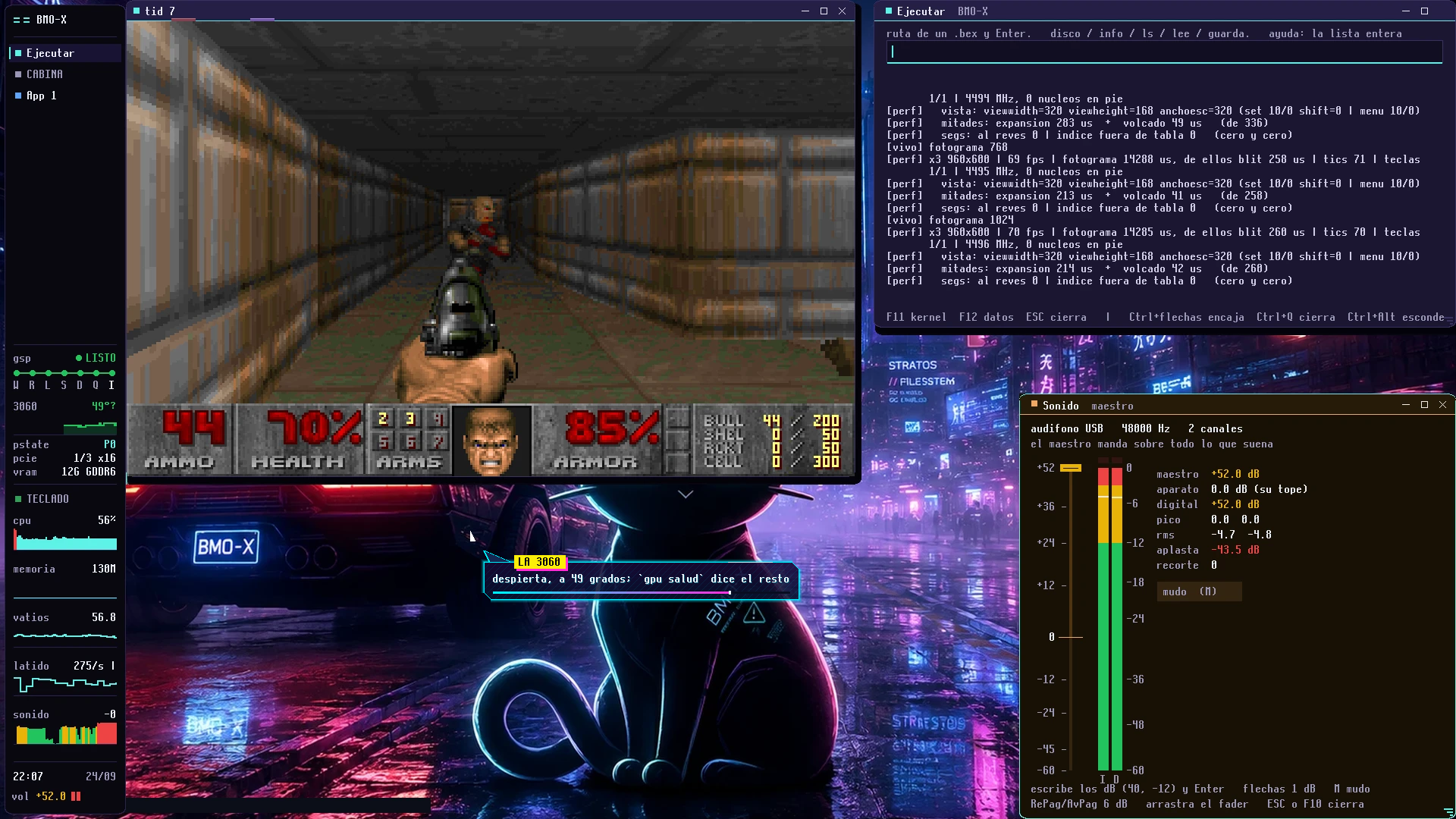
BMO-X's own desktop, on the real machine.
My current work. Its design is Bare Metal Orquestal: programs declare what they need, the system grants capabilities, and the kernel only checks. It runs on an AMD Ryzen 5 5600X with an RTX 3060, not in an emulator.
| Part | What it does |
|---|---|
| Kernel | Capability-based isolation behind two frozen syscalls (INVOKE, WAIT); UEFI → Ring 0 → Ring 3 |
| Languages | Six native paths — C, C++, COBOL, Ada, and two of my own: TITAN++ and INTI — emitting x86-64 without LLVM or GCC backends |
| Graphics | VERRANO, its own drawing API, with a CPU reference path and an RTX 3060 driver written in-house |
| Storage | ESTRATOS, a versioned filesystem; branch and merge compare nodes by BLAKE3 |
| Desktop | Windows, tools, PNG capture, and MUNDO — a native block game written in TITAN++, played on the Ryzen |
| Compatibility | PROTON-X loads Windows PE programs; it displayed the Cyberpunk 2077 intro on BMO-X (CPU-rendered, not playable) |
Source, documentation and hardware evidence are public under Apache-2.0. Open limits are stated, not hidden: GPU firmware startup on the RTX (case 0x15) is still under investigation.
TALK-CPU — hand-written x86-64, booted on real hardware
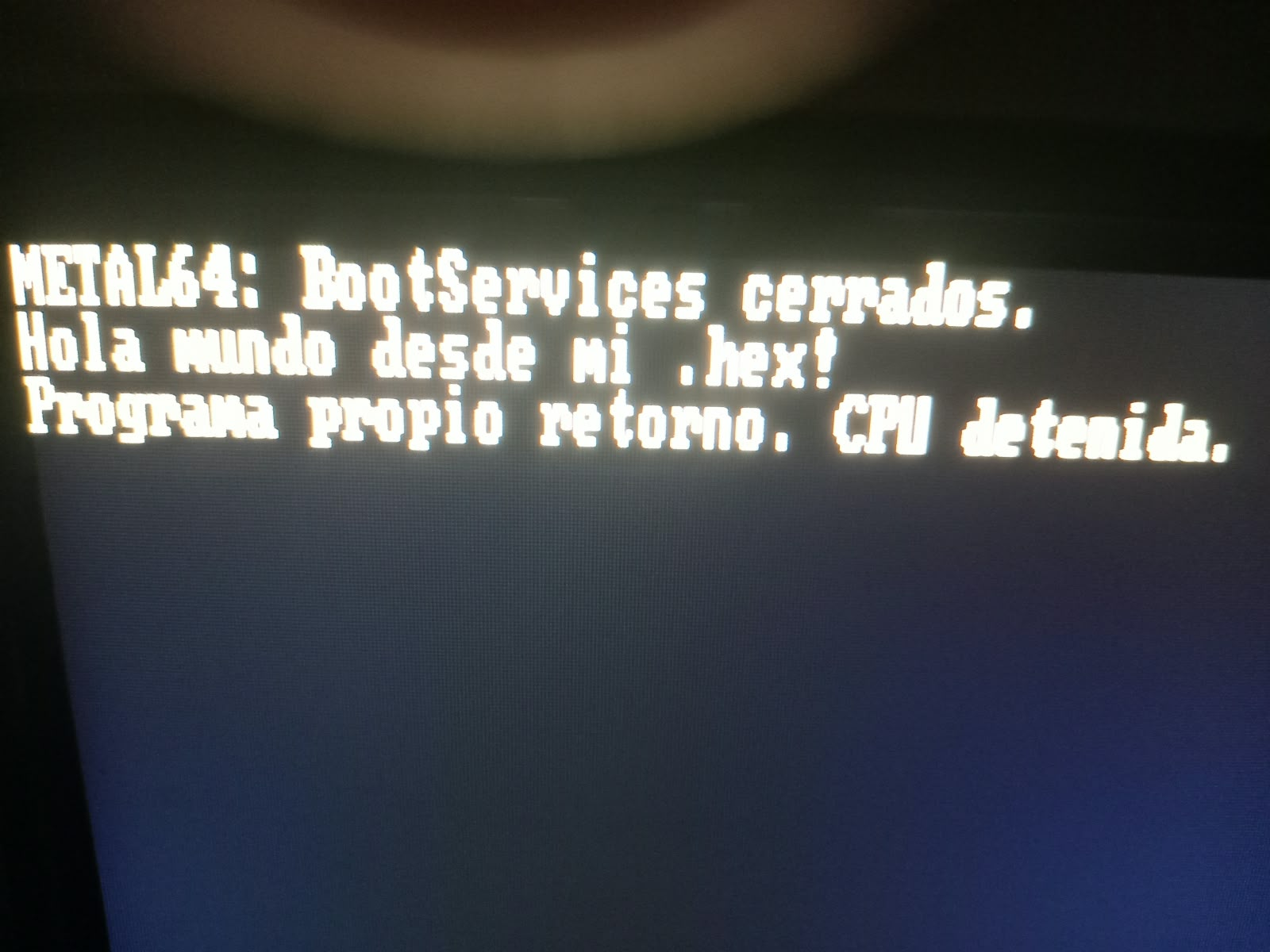
No compiler, no assembler: the instructions are written byte by byte in .hex.
A minimal UEFI bridge loads them from FAT32, calls ExitBootServices and jumps
into my own 64-bit code, which draws straight to the framebuffer.
On October 18, 2026 it booted on the target machine — an MSI A320M-A PRO MAX with a Ryzen 5 5600X — on the first physical attempt:
It also ships Flappy Metal, a playable game (gravity, pipes, collisions, score) in 4,088 bytes of hand-written machine code, running in QEMU.
I didn't collect languages; BMO-X demanded them. Building a machine end to end means meeting each layer in the language it actually speaks — and for most of them, writing the compiler, not just the code.
| Language | Where it was forced on me |
|---|---|
| Rust | The kernel, drivers, filesystem and every compiler in BMO-X |
| x86-64 machine code | Instruction encoders for every backend; TALK-CPU written directly in .hex |
| C | A native C path in BMO-X, and ADead-BIB, a C99 compiler with its own PE/ELF linker |
| C++ | A native C++ path in BMO-X |
| COBOL | Exact decimal arithmetic — the primitive banking software is built on |
| Ada | Strict typing and checked contracts as a native path |
| TITAN++ · INTI | Languages I designed for BMO-X; MUNDO is written in TITAN++ |
| GPU / shaders | VERRANO, the BSF shader format, Vulkan, DirectX 12 |
| PowerShell | The build and deployment pipeline |
| TypeScript · Java · Python | Web and tooling: React, Next.js, Angular, Spring Boot |
This is the part I care most about.
The compilers are tested by executing the emitted machine code and checking
the real output — not by comparing against hand-written byte strings. An IF
that fails to branch looks identical to one that works in a byte dump; the only
way to tell them apart is to run them.
The order of authority is written down and enforced:
- The real CPU
- The specification document
- The emulator
When the emulator and the hardware disagree, the emulator gets fixed. Every claim in BMO-X is labeled METAL (seen on the Ryzen), HOST (checked on the development machine) or OPEN (not solved yet). Features that aren't implemented are rejected with a reason, never stubbed to look like they work.
| Project | What it is |
|---|---|
| ADead-BIB | C99 compiler emitting x86-64 directly. Own IR, PE and ELF output, own linker for .dll/.so — no LLVM, GCC or NASM. |
| UE5 Fast Startup Accelerator | Rust CLI that reads Unreal Engine 5.0–5.8 assets without the editor. 8,865 assets hashed and cached in 813 ms. |
| REACTOR | Experimental game engine in Rust on Vulkan, with an asset CLI and Blender bridge. |
| EPICX | DirectX 12 framework for Rust with React-style components. 446 FPS average on an RTX 3060. |
| PyDead-BIB | Python frontend with a Vulkan compute backend for AI workloads. |
| ORBITA | Web platform for running and monitoring jobs: Next.js, Spring Boot gateway, Rust engine. |
These are research projects, not products. They are public so the code can be read and judged directly.
Independent systems R&D — compilers, operating systems and GPU work, self-directed and built alone. The commit history is public.
Compiler engineering · Systems and OS development · Graphics and GPU · Performance engineering · Remote work
If you want to check whether any of this is real, the fastest way is to read the evidence and run the code. That's what it's there for.