Graph-driven automated vulnerability discovery for secure messaging applications. 577 Industries' engineering implementation for DARPA SBIR Direct-to-Phase-II topic HR0011SB20254-12 (ASEMA).





Looking for evaluator-facing artifacts? The sanitized public feasibility release lives at
577-Industries/asema-feasibility-artifactsat tagv1.0.0-asema-dp2-feasibility. Start there if you're verifying claims in the ASEMA proposal.
The engineering platform — the actual implementation behind AegisGraph:
| Subsystem | Path | What it does |
|---|---|---|
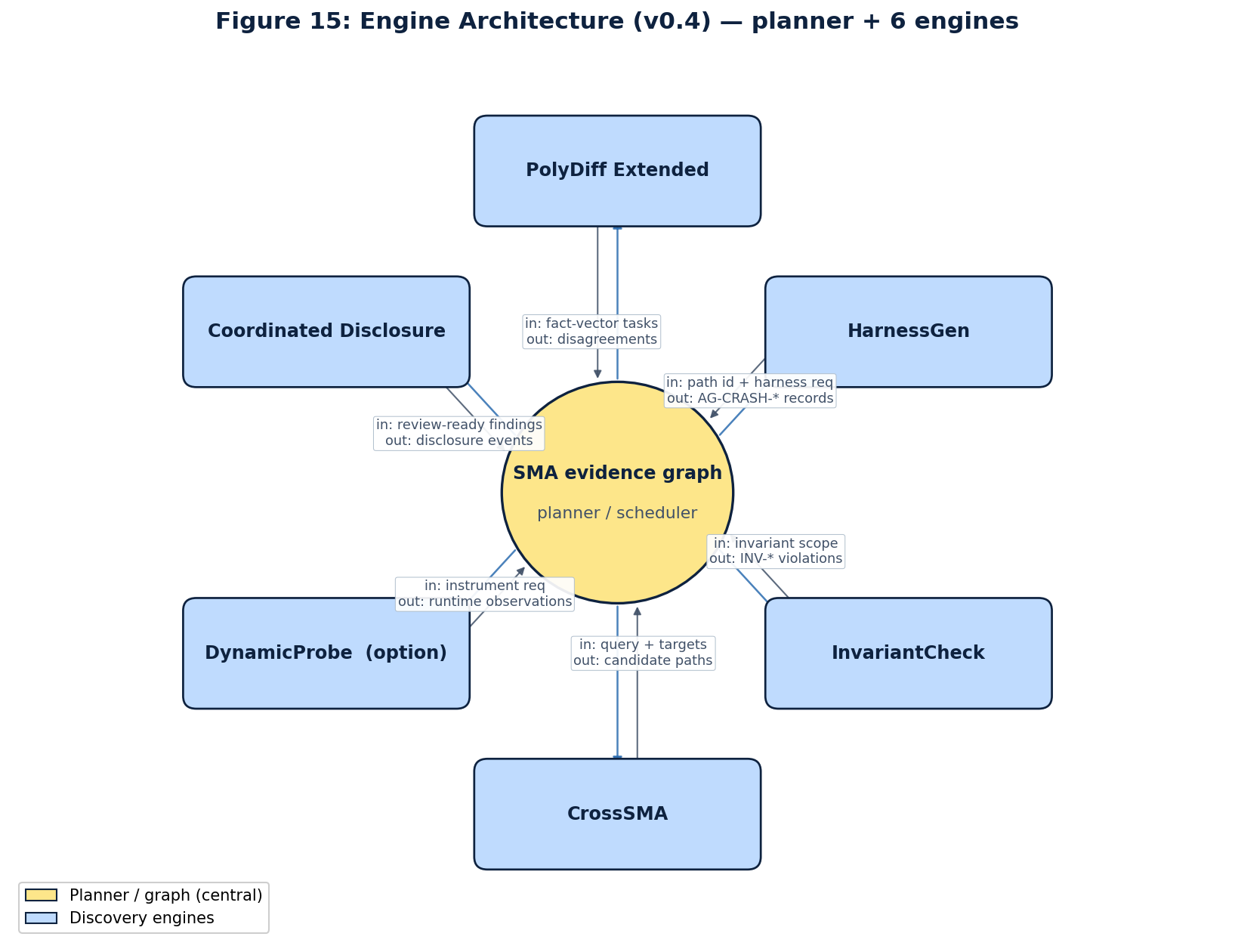
| PolyDiff Extended | aegisgraph/polydiff/ |
Multi-format differential parsing across 6 parser families (url, image, opengraph, deeplink, qr, proto) with normalized fact vectors |
| HarnessGen | aegisgraph/harnessgen/ |
Graph-driven polyglot fuzz-harness generation (Jazzer for JVM, libFuzzer+HWASAN for native, cargo-fuzz for Rust) |
| InvariantCheck | aegisgraph/invariants/ |
15 SMA-specific security invariants with publicly-auditable ground-truth fixtures; MASTG/SSDF mapping |
| CrossSMA | aegisgraph/crosssma/ |
Cross-application propagation matrix (4 SMA targets × 6 patterns) with structural canonicalization |
| DynamicProbe (option period) | aegisgraph/dynamicprobe/ |
Frida-instrumented AOSP+HWASAN emulator with structurally-enforced signed authorization gate |
| Coordinated Disclosure | aegisgraph/disclosure/ |
Hash-chained disclosure ledger + 7-vendor routing + day-7/14/30/60/90 embargo timer + CERT/CC fallback |
| ReproChain | reprochain/ |
Pre-disclosure simulation against CVE-2023-4863 (libwebp); vendored vuln+fix commits + ASAN harness |
| Extraction | extraction/ |
Static extraction over pinned public SMAs (Signal Android, Element X Android); 8 CodeQL queries + 4 Semgrep rules + MobSF integration |
| SMABench | smabench/ |
Three-ring benchmark design: synthetic (Ring 1), public-source static + reachability (Ring 2), authorized dynamic (Ring 3) |
| Validator + safety | validator/, aegisgraph/safety.py |
Schema validation, sanitize-check (Rules 1–9), falsifiability via deliberate-corruption test |
| Schema | schema/ |
6 JSON schemas + Schema v2 additive extension (discovery_run, crash, disagreement, invariant_violation, cross_target_candidate, disclosure_event) |
| Decision log | docs/decision-log/ |
14 ADRs covering all architectural decisions |
git clone https://github.com/577Industries/aegisgraph
cd aegisgraph
git checkout v1.0.0-tier3-research

# Recommended: use the pinned devcontainer
devcontainer up
make tooling-strict                # verify pinned toolchain
python3 -m pytest -q               # expect 1030 passed, 19 skipped

# Per-engine smoke tests
make reprochain-map                # ReproChain reachability mapping
make polydiff-regression           # PolyDiff differential parser regression (8 historical CVE rediscoveries)
make extract                       # static extraction over pinned SMAs
make smabench                      # SMABench benchmark generation
make validate                      # evidence + CETM validation
make reproduce                     # full reproduction pipeline
The CLI entrypoint is aegisgraph after installation, or python3 -m aegisgraph.cli from this checkout.
- Defensive cybersecurity research only. No live-target probing, production account interaction, credentialed testing, or scanning without written authorization.
- No weaponized payloads in public artifacts (crash-triggering bytes are hash-only; raw stack traces stay engineering-side).
- No raw target source redistribution. We work from public source anchors (commit-pinned Signal Android and Element X Android).
- Public artifacts gated by
make export-public-sanitizedand explicit human approval before publication. - Falsifiability. A deliberate-corruption test in the validator confirms that introducing a forbidden pattern, target-source redistribution marker, or score-vector key mismatch is caught and rejected — the discipline is testable, not just stated.
- 1030 passing tests at v1.0 cut (
v1.0.0-tier3-researchtag, commitd91c1df6) - 19 skipped (gated on self-hosted runner provisioning per task T-M4.1; devcontainer brings skipped count to 0)
- CI:
.github/workflows/ci.ymlruns on push;reproduce.ymlisif: falseuntil self-hosted runner is provisioned - Sanitize-check:
validator/sanitize_check.pyenforces 9 rules across every public-export candidate before any artifact leaves this repo
The 14 ADRs in docs/decision-log/ document every architectural decision:
| ADR | Topic |
|---|---|
| 0001 | Repo split: engineering vs public-release boundary |
| 0002 | Private ReproChain handling |
| 0003 | libwebp selection for ReproChain target |
| 0004 | PolyDiff parser selection (initial url family + extension to 6 families) |
| 0005 | Validator migration |
| 0006 | Disclosure ownership (PI named owner; counsel review gate) |
| 0007–0012 | Engine architecture (HarnessGen, InvariantCheck, CrossSMA, DynamicProbe scaffolds) |
| 0013 | Schema v2 (additive extension for engine output) |
| 0014 | Coordinated disclosure ledger format (hash-chained JSONL) |
| 0020 | PolyDiff multi-family extension |
| 0021 | Validator export discipline |
- v1.0.0-tier3-research (current, May 2026) — full 6-engine ensemble, 1030 passing tests, Schema v2, 82-claim CETM
- v0.3.0-tier3-research (May 2026) — v0.3 baseline (preserved as historical anchor)
The matching public feasibility release lives at 577-Industries/asema-feasibility-artifacts:
- v1.0.0-asema-dp2-feasibility (current) — F15-F22 figure pack, 82-claim CETM, baseline-tool-delta, polydiff v1.0 schema, full traceability matrix
- v0.3.0-asema-dp2-feasibility — historical anchor; preserved verbatim
Apache-2.0. See LICENSE.
SPEC.md is the working technical specification. If implementation and spec diverge, update the spec deliberately.