
ChirpArray is a microphone array for outdoor recording projects.
It utilizes Sony's Spresense microcontroller as a processing module.
See https://doi.org/10.1111/2041-210X.14474 for more detail.

- Up to 4ch recording:
ChirpArrayhas 4 microphones to enable sound source localization. - Flexible recording setting and scheduling:
Plenty of options for various research projects:- Sampling rate (16 kHz ~ 192 kHz)
- Channels of recording (monaural, stereo, 4 channels)
- Audio codec (WAV or MP3)
- Recording schedule (see below)
- Low power consumption:
ChirpArraycan run with a 12 W solar power system due to Spresense's low power features. - Automated time correction using on-board GNSS
- Low cost:
The whole system with solar power system costs about $200. - Easy to reproduce:
All parts are available online.
No professional skills are required to assembleChirpArray.
| product name | product type | manufacture | price | quantity |
|---|---|---|---|---|
| Spresense Main Board | Main processing board | SONY | ¥6000 | 1 |
| Spresense Extension Board | Extension board for microphone inputs | SONY | ¥4000 | 1 |
| CME-1538-100LB | Analogue microphone | CUI Devices | ¥500 | 4 |
| 2.2 kΩ carbon resister | general resister | Under ¥10 | 4 | |
| Stripboard (36 mm x 24 mm) | general stripboard | Under ¥100 | 1 | |
| pin header (2 x 8) | general pin header | Under ¥50 | 1 | |
| micro SD Card (512GB) | general micro SD card | ¥10000 | 1 |
| product name | product type | manufacture | price | quantity |
|---|---|---|---|---|
| SY-M12W-12 | Solar Panel (12 W) | SANYOOO solar | ¥2500 | 1 |
| SA-BA10 | Solar Charge Controller | DENRYO | ¥4000 | 1 |
| WP7.2-12 | Battery (12 V, 7,2 Ah) | Kung Long Batteries Industrial | ¥3000 | 1 |
Takachi BCAP151509G (¥1,600)
First, choose a case to house the Spresense. While we have published 3D models of cases that can be printed with a 3D printer, you can also use commercially available waterproof boxes for outdoor installations. If you opt for a commercially available case, select one with enough space to accommodate the Spresense Extension Board (at least 90mm x 90mm x 30mm). Commercially available cases tend to offer better waterproofing, so if you're installing the device near a pond or in a high-humidity environment, it might be better to go with a commercially available case.

Next, arrange each microphone at equal intervals around the circumference of an 8cm diameter circle. If you are using a printable case, attach the microphones as shown in the picture below, and route the wires inside the case. Seal the wire entry points with adhesive. If you are using a commercially available case, drill holes in the case to attach the microphones directly. We also provide a 3D model for a microphone mounting plate, which you can print and use with any cases (in 3Dprintables/off_the_shelf_cases/MicrophoneAdaptor.stl). To avoid rain damage, please install the microphones on the underside of the case.


Finally, wire the microphones. I recommend reading the official tutorial and the hardware documentation as well.
- Attatch Sony Spresense to the Spresense Extension Board
See here for more details. - Wire the microphones and bias resisters.
 The pin assignment of the Spresense Extension Board is shown as below. Follow the "Analogue" microphone placement and wire each microphone. Make sure that each microphone is connected to the correct location.

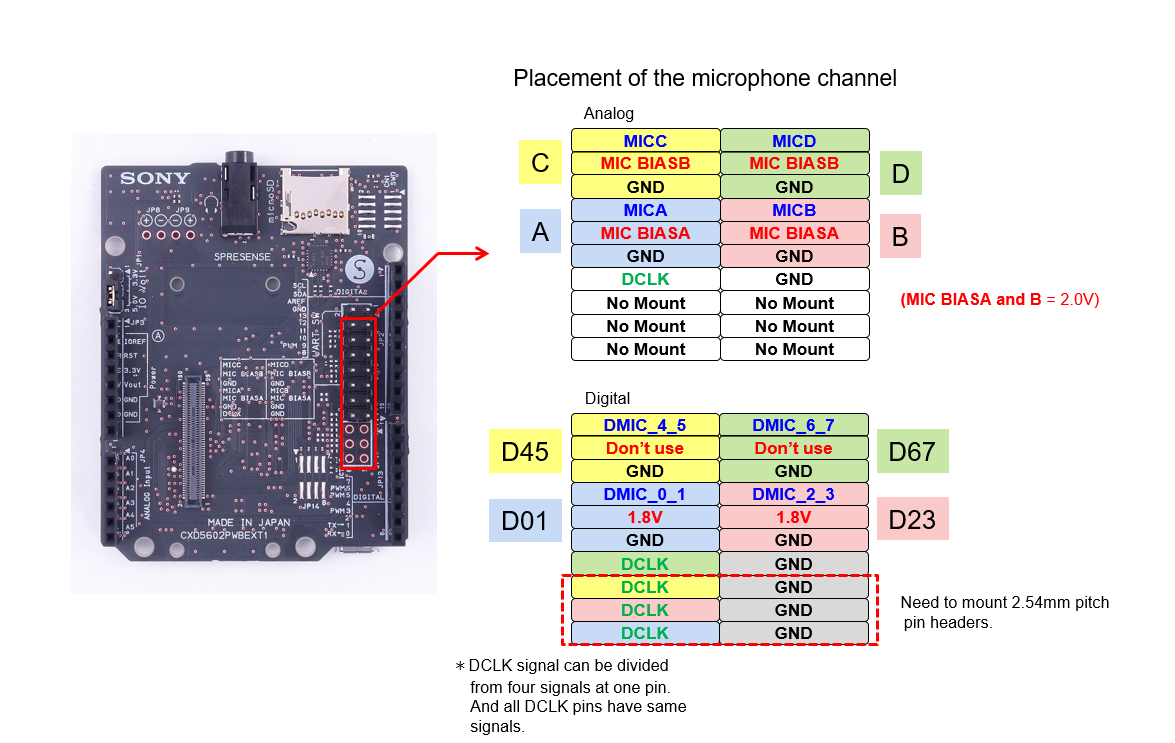
https://developer.sony.com/spresense/development-guides/images/HW_Mic_placement_E.png
The 3D models were designed using Onshape and free to use and modify. See the Onshape document.
- Installing ArduinoIDE
- Setting up your Sony Spresense
For Step1. and 2., please refer to the official tutorial.
- Setting recording options
See the Arduino Sketch for more detail.
You can set recording schedule, channels of recordings, sampling rate, and audio codec.

Okamoto, R., & Oguma, H. (2025). ChirpArray: A low-cost, easy-to-construct microphone array for long-term ecoacoustic monitoring. Methods in Ecology and Evolution, 16, 302–308. https://doi.org/10.1111/2041-210X.14474
@article{https://doi.org/10.1111/2041-210X.14474,
author = {Okamoto, Ryotaro and Oguma, Hiroyuki},
title = {ChirpArray: A low-cost, easy-to-construct microphone array for long-term ecoacoustic monitoring},
journal = {Methods in Ecology and Evolution},
volume = {16},
number = {2},
pages = {302-308},
keywords = {automated recording unit, ecoacoustics, microphone array},
doi = {https://doi.org/10.1111/2041-210X.14474},
url = {https://besjournals.onlinelibrary.wiley.com/doi/abs/10.1111/2041-210X.14474},
eprint = {https://besjournals.onlinelibrary.wiley.com/doi/pdf/10.1111/2041-210X.14474},
abstract = {Abstract Advances in passive acoustic monitoring (PAM) have highlighted the importance of recording devices and audio recognition techniques in ecosystem monitoring. This study introduces ChirpArray, a cost-effective and easily assembled microphone array for long-term ecoacoustic monitoring of outdoor ecosystems. The ChirpArray system features a four-channel microphone array that estimates sound source directions, aids in identifying individual animals and provides a detailed behavioural analysis. Unlike previous microphone arrays, ChirpArray is low-cost, low-power and waterproof, making it ideal for extended-field monitoring. It is a fully open source and is constructed from readily available materials, ensuring broad accessibility for applications ranging from local citizen projects to large-scale landscape recordings. This study details the power, storage consumption and localization performance of ChirpArray. Current measurements show that a small solar-power set-up can continuously operate the system. Localization tests using loudspeakers have yielded promising results. ChirpArray is a compact, energy-efficient microphone array designed for long-term outdoor recording, offering considerable advantages in ecoacoustic monitoring. Its exceptionally low power consumption allows for efficient and flexible deployment, making it an ideal solution for extended-field monitoring and large-scale landscape recordings.},
year = {2025}
}