GitGalaxy Scanner
ActionsAbout
Tags
(2)Repository-scale structural intelligence without compilation.
Docs · Visualizer · Language Crucible · Keyword Rosetta · Raw Output
1 scan · 97 structural signals · 50+ languages · no compilation · 19 risk-exposure categories · 6 outputs
GitGalaxy builds a language-agnostic structural graph of an entire repository directly from source text — no build, no per-language toolchain.
It is designed for repositories that are polyglot, partially broken, legacy, vendor-heavy, or otherwise difficult to analyze through a build-first workflow:
Go + C++ + Python + Java + Bash + YAML
+ generated code + vendored code + legacy code
+ half-migrated modules + broken dependencies
Instead of a separate parser per language, GitGalaxy extracts a common vocabulary of structural signatures — functions, classes, arguments, control flow, state mutation, I/O, APIs, dependencies — and normalizes them into one deterministic repository model that feeds architecture analysis, risk-exposure prioritization, SBOM generation, refactoring and ownership analysis, AI-oriented codebase context, and CI/CD gates.
Central thesis: complete language parsing is not always necessary to recover highly useful structural information at repository scale.
How that thesis is tested — against Tree-sitter and Ctags, against a planted control corpus, and next against Git history — is summarized in Accuracy, measured below and laid out in full in the validation program.
One command:
pip install gitgalaxy
galaxyscope path/to/repo
Six coordinated views of the same deterministic scan:
| Output | Purpose |
|---|---|
| LLM architecture brief | Compact machine/agent-oriented context (below) |
| SARIF | CI/security dashboard integration |
| CycloneDX SBOM | Dependency inventory/compliance |
| SQLite | Queryable repository knowledge graph |
| JSON audit data | Forensic/automation workflows |
| 3D visualization data | Interactive repository topology |
The flagship report is a single Markdown brief built to hand an engineer — or an AI agent — a working mental model of a repository they've never seen. It is a self-contained package: the risk equations are printed in the report itself, and an embedded interpretation prompt lets any LLM narrate it without hallucinating what the numbers mean. Sections cover macro state and language composition, network topology (modularity, articulation points, cyclic density), dependency choke points, the heaviest functions and files, per-file structural signatures with PageRank blast radius, targeted and cumulative risk hitlists, supply-chain audits, and refactoring targets ranked by volatility and authorship centralization — plus an itemized list of every file it refused to scan, and why.
Two examples, scanned 2026-08-31 with the current engine. Both repositories
are public — clone either and run galaxyscope --llm-only <path> to reproduce
the full brief:
curl — 4,250 artifacts, 696 scanned, 112,653 LOC across C, Perl, Python,
Shell, M4 and Makefile. The brief ranks src/tool_setup.h as the top
structural pillar (80 inbound connections) and puts a Perl function —
APPEND_imap in tests/ftpserver.pl, Impact 2135, 1,672 LOC — at the top of
the repo-wide function hitlist, in the same ranking as the C code. That
cross-language graph is the product: one comparable signal set across every
language in the repo. The honest caveat in the same brief: only 16.4% of
artifacts were scanned — the ingestion filter drops binaries, generated code
and test data aggressively, and §5 of the brief itemizes every exclusion by
extension and reason.
cics-genapp (IBM's CICS COBOL/DB2 sample) — 92.1% scanned: 44 COBOL
programs, 29 JCL jobs. The cumulative-risk hitlist leads with
base/src/lgupdb01.cbl (state flux ~100%, cognitive load 92%), and the
heaviest paragraph in the repo is UPDATE-POLICY-DB2-INFO — the SELECT FOR UPDATE row-locking logic, which is exactly where a maintainer of that program
would want to look first. The same brief also shows a limitation plainly: on a
flat architecture with no real import graph, the "structural pillars" list
degenerates to zero-connection files, and the report says to check the
connection counts before trusting it.
Hundreds of unedited briefs for independently selected repositories are
committed at
gitgalaxy-raw-output;
this repo's own always-current self-scan brief is at
docs/gitgalaxy_architecture_brief.md.
| Consumer | Question |
|---|---|
| Architecture | What is this repository made of? |
| Structural analysis | Where are the functions, classes, APIs, dependencies and control structures? |
| Risk exposure | Where are potentially important risk patterns concentrated? |
| Refactoring | Which files are complex, high-churn or load-bearing? |
| Supply chain | What dependencies physically exist on disk? |
| AI context | What architecture and relationships should an agent know? |
| Legacy migration | Where are the structural units to transform? |
| Historical analysis | How does measured exposure change as the repository evolves? |

Two standing measurement programs back the claims above. The full narrative — methodology, verdicts, limits, and what comes next — lives in the validation program; this is the summary.
GitGalaxy is benchmarked against Tree-sitter and Universal Ctags on the pinned Language Crucible corpus — 24 of 45 languages get all three tools, 13 more get two, and every disagreement is investigated against real source and recorded with a verdict (200 of 201 logged discrepancy shapes validated). On that corpus, GitGalaxy's validated function precision is 100% across all 31 tree-sitter-comparable languages, and it is never the tool found wrong in a validated class or argument disagreement. The limit: three structural targets, one fixed corpus — not "parses as accurately as an AST" in general.

The newer program asks the opposite question: does GitGalaxy measure
identical intent identically in every language? The
keyword-rosetta corpus
plants the same 12-probe program in all 46 supported languages with exact known
signal counts — so any divergence is measured language bias, by construction.
Current answer: not yet. On average 75% of languages land within ±25% of the
cross-language median per metric, but only 3 of 33 metrics pass the strict
cross-language gate, and the weakest (risk_cognitive_load, at 15% of
languages in band) are named in the chart rather than hidden. Each deviation is
recorded in a validated ledger and the defect classes found this way are
filed as GitGalaxy issues.
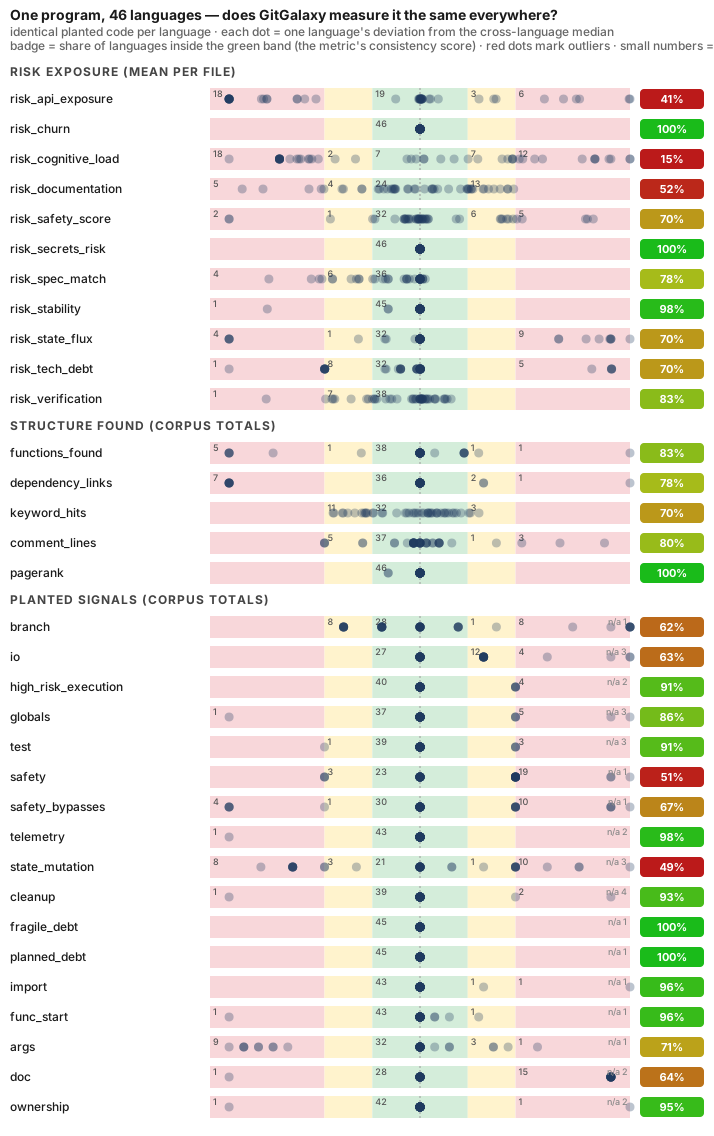
A control corpus proves measurement inequality on identical intent; it says nothing about accuracy on real code (the tri-comparison's job above) — and a constant per-file bias still preserves ranking within a language. The incidence report sizes each confirmed shape against real licensed code.
Example: Kubernetes — ~1.39M lines across Go, YAML, JSON, Shell and Proto.
End-to-end scan: 50.83 seconds. Scan time follows a fitted two-regime model
(flat ~0.11s below ~4.3K LOC, then time(s) ≈ 3.36e-05 × LOC^0.969, R²=0.88
across 599 repos) — so a handful of 20M+ LOC outliers still take minutes, and a
fast scan proves throughput, not insight quality; the accuracy question is
handled separately below.
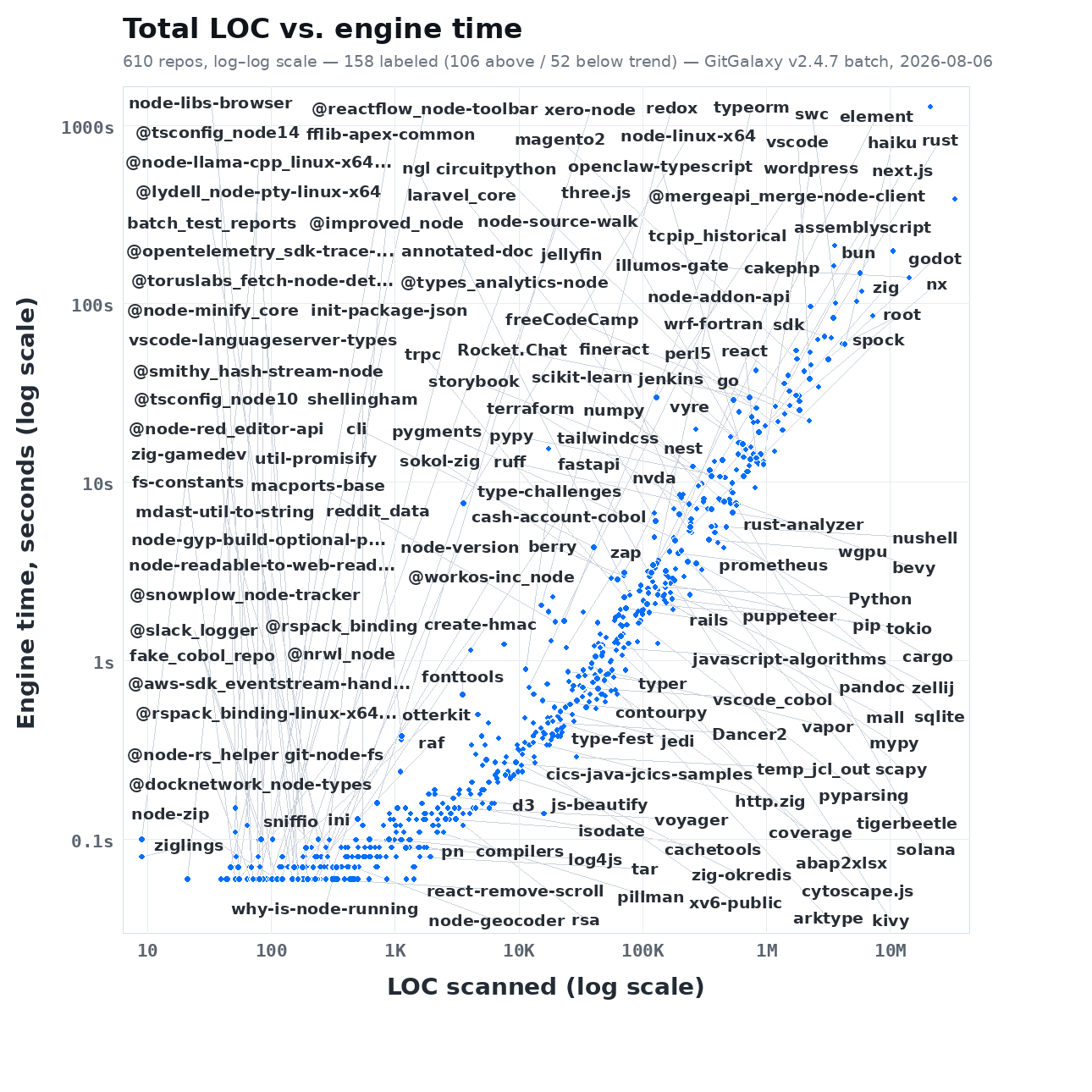
See the raw output repository for unedited artifacts.
GitGalaxy produces risk-exposure measurements, not vulnerability verdicts.
A high exposure means:
This location deserves attention relative to the rest of the repository.
It does not mean:
"This code is definitely vulnerable."
The current system produces normalized exposure categories across the repository and rolls information from structural entities through files, folders and repository-level views.
The underlying signatures cover patterns involving areas such as:
- secrets
- injection surface
- unsafe/memory operations
- dynamic execution
- I/O
- concurrency
- state mutation
- reflection
- APIs
- dependencies
- entropy
- other structural/security characteristics
The important research question is whether these signatures are empirically associated with meaningful classes of software risk, rather than merely correlated with a score that GitGalaxy itself mathematically constructed.
That distinction drives the next phase.
A pinned corpus of real-world source including projects such as Godot, Roslyn, curl, Kubernetes and Apollo 11 flight software.
Real source is rescanned and compared against checked-in expected output so
parser changes have an observable diff. Regenerated with
tests/tools/update_golden_master.py,
never hand-edited.
The same corpus is analyzed against GitGalaxy, Tree-sitter and Ctags where coverage exists — 24 of 45 languages get all three tools, 200 of 201 logged discrepancies validated. On the pinned corpus, GitGalaxy is never the tool found wrong in a validated function-precision, class, or argument disagreement, and matches tree-sitter's function recall everywhere except one nested shell definition it skips by design. See the methodology and the validation program for the full picture and its limits.
The same 12-probe program planted in all 46 supported languages with exact known signal counts, measuring cross-language consistency of every metric — with a validated deviation ledger and the resulting engine defects filed as issues.
Unedited GitGalaxy output is retained for hundreds of independently selected repositories.
7,043 tests in the default suite (python -m pytest tests/), of which
6,165 are per-signature tests across all 45 structurally-signatured
languages — positive matches, explicit exclusions, and adversarial/ReDoS
inputs. See tests/README.md for the breakdown, and
docs/why_gitgalaxy_beats_ast_here.md
for specific, evidenced cases where this extraction beats an AST read.
The next research layer will test whether exposure measurements correspond to real security and maintenance events over Git history — see the validation program.
- repository-scale structural intelligence
- language-agnostic source analysis
- a common structural representation across heterogeneous code
- risk-exposure prioritization
- architecture mapping
- CI-native evidence generation
- useful on broken/uncompiled repositories
- designed for local/offline operation
- a replacement for CodeQL's deep dataflow analysis
- a replacement for Semgrep's rule ecosystem
- a replacement for dependency CVE databases
- a proof of exploitability
- a runtime analyzer
- a complete language parser
- a guarantee that a high exposure is a vulnerability
| Tool | Primary question |
|---|---|
| GitGalaxy | What does this entire repository look like, structurally, and where should attention go first? |
| Tree-sitter | What syntactic structure does this source contain? |
| Ctags | Where are the navigable code entities? |
| Semgrep | Does this code match a specified pattern? |
| CodeQL | What data/control relationships can deeper analysis establish? |
| SCA/CVE tools | Is this dependency/version associated with a known advisory? |
GitGalaxy already incorporates Git history into signals such as churn, contributor concentration, bus-factor exposure, refactoring hotspots, file ownership and temporal activity. The research direction is to extend this from history as a contextual signal to history as an external validation source for the exposure model — the experiment design is in the validation program.
GitGalaxy is designed for local and air-gapped operation.
- Source code is not sent to a GitGalaxy cloud service.
- Scanning and vectorization occur locally.
- The scanner has no runtime network requirement.
- CI/CD execution can remain inside the user's environment.
- The browser visualizer operates on locally supplied data.
pip install gitgalaxySee the documentation for current commands and configuration.
Templates are provided for GitHub Actions, GitLab CI, Bitbucket Pipelines,
Azure Pipelines, and generic shell-invocable CI environments. See
templates/ and the CI integration
guide.
| Resource | What it contains |
|---|---|
| Documentation | Architecture, claims and methodology |
| The validation program | The full proof narrative: thesis, benchmarks, validity ladder, next experiments |
| Language Crucible | Cross-language benchmark and golden corpus |
| Keyword Rosetta | 46-language planted control corpus and bias reports |
| Raw Output | Unedited scans of real repositories |
| COBOL → Java examples | 10 COBOL repos auto-translated to compiling Spring Boot architectures (mvn clean compile works out of the box) |
| Population analyses | Statistical analyses over the raw-output scan population: archetype clustering, risk distributions, threat-classifier studies |
| Museum of Code | Full architectural teardowns of real codebases (Apollo 11, IBM CICS benchmarks) |
| Distribution telemetry | Public fetch metrics across GitHub/GitLab/PyPI, regenerated daily |
tests/README.md |
Regression and golden-master methodology |
tri_comparison_ledger.json |
Disagreement-by-disagreement validation record |
manual_verification.json |
Reviewed cases where comparator coverage is unavailable |
how_to_investigate_a_discrepancy.md |
Comparator-disagreement methodology |
| Visualizer | Local browser-based repository visualization |
Copyright (c) 2026 Joe Esquibel
GitGalaxy is distributed under the PolyForm Noncommercial License 1.0.0.
See the repository license for full terms.


Resources
GitGalaxy Scanner is not certified by GitHub. It is provided by a third-party and is governed by separate terms of service, privacy policy, and support documentation.
About
Tags
(2)Resources
GitGalaxy Scanner is not certified by GitHub. It is provided by a third-party and is governed by separate terms of service, privacy policy, and support documentation.