You signed in with another tab or window. Reload to refresh your session.You signed out in another tab or window. Reload to refresh your session.You switched accounts on another tab or window. Reload to refresh your session.Dismiss alert
@denvercoder changed tiger to lion on the lion branch
@wwhite: changed mother to father on the father branch
@Julesw: Changed tiger to turtle on the turtle branch
YOU: Change an exclamation mark a punctuation mark directly on the master.
---
title: The Poem
---

%%{init: { 'logLevel': 'debug', 'theme': 'base', 'gitGraph': {'showBranches': true, 'showCommitLabel':true,'mainBranchName': 'master'}} }%%

gitGraph
   commit id: "Poem added" tag: "ancestor"
   branch lion
   branch father
   branch turtle
   checkout master
   commit id: "! is ."
   checkout lion
   commit id: "tiger is lion"
   checkout father
   commit id: "mother is father"
   checkout turtle
   commit id: "tiger is turtle"
Loading
OK it looks like a mess; four people hacking in the same file at the same time.!
Let's play a game: You are now the integration manager of a software project.
It's actually a title used (less frequently nowadays). It's the person who does all the merges - sometimes also referred to as merge manager or simply "The Merge Guy". Does that sound like a fun job? Naah! Luckily it's not as common as it used to be. Thanks to tools like git and GitHub and to the spread of more agile processes - most developers today are expected to merge their own stuff and and push it.
But the whole Pull request culture - which is very popular - and strongly advocated by GitHub - is kind of a relic from the past. A distributed - and claimed contemporary - approach to an old school integration manager role. We'll touch on this later when we talk about pull requests.
Your job is now to make all the branches of the poem come together as one on the master branch
Bring them in one at a time and commit each successful merge before you proceed onto the next.
One of these merges is not going to go down easy - can you predict where you'll run into problems?
To merge something in git is dead-easy: A merge is a pull; that means you merge a branch into some other branch. The command is called merge and the synopsis is:
git checkout the branch who shall receive the merge
git merge the branch you want to bring in.
Git will try to merge it without your help and but if it needs your attention it will halt the process in which case you will:
Fix the un-mergeable file manually in your editor.
Resume the merge by calling git merge again with of the switches --continue, --abort or --quit.
Lets try the first on:
git co master
git merge lion
....Argh! The merge will create a commit after the file merge if it goes well - but as you know, a commit requires a message. A message file MERGE_MSG is opened in the editor Type something meaningful. It suggested Merge branch 'lion'. Hmm? that's sufficiently meaningful, so just save/close the file. The commit happens as soon at the file is closed.
Try to run your tree alias:
git tree
It looks right!
Or open the command palette in your CodeSpace and search for "Commit Graph" - open the GitLen tool. Aaaah!
One down - let's continue. This time we don't fall into the manual process of closing the commit message file:
git co master
git merge father --no-edit
WTF!!! There's a merge conflict! That was unexpected!
All @wwhite did was to change "mother" to "father" and no one else altered that particular line. So if the algorithm favours change: "change rules" remember? then why are we blocked by ... yeah by what exactly?
It turns out that it's the change that YOU did on master - where you changed "!" to "." that's causing the conflict.
Maybe @denvercoder was favoured for making the merge before @wwhite - if it had been the other way around perhaps @denvercoder would have received the conflict.
Naah! - that's not it! @wwhite would have received a conflict anyway.
The reason why this is - is because the two lines changed are next to each other - they are in the same block. The merge algorithm insist on not making border-line decisions.
Let's abort - and and analyse the situation.
git merge --abort
Let's test if we could have predicted this try to run
git diff master father
Here's what I get:
Now see the diff to lion
git diff master lion
You see?
The master<>father diff is shown as one diff of two lines.
The master<>lion diff is shown as two diffs each of one line.
A subtle but important difference.
Wouldn't it be nice, if we had a git command like git mergetest or perhaps a switch --dry-run switch to git merge

To Recap the situation:
lionbranchfatherbranchturtlebranchmaster.--- title: The Poem --- %%{init: { 'logLevel': 'debug', 'theme': 'base', 'gitGraph': {'showBranches': true, 'showCommitLabel':true,'mainBranchName': 'master'}} }%% gitGraph commit id: "Poem added" tag: "ancestor" branch lion branch father branch turtle checkout master commit id: "! is ." checkout lion commit id: "tiger is lion" checkout father commit id: "mother is father" checkout turtle commit id: "tiger is turtle"OK it looks like a mess; four people hacking in the same file at the same time.!
Let's play a game: You are now the integration manager of a software project.
It's actually a title used (less frequently nowadays). It's the person who does all the merges - sometimes also referred to as merge manager or simply "The Merge Guy". Does that sound like a fun job? Naah! Luckily it's not as common as it used to be. Thanks to tools like git and GitHub and to the spread of more agile processes - most developers today are expected to merge their own stuff and and push it.
But the whole Pull request culture - which is very popular - and strongly advocated by GitHub - is kind of a relic from the past. A distributed - and claimed contemporary - approach to an old school integration manager role. We'll touch on this later when we talk about pull requests.
Your job is now to make all the branches of the poem come together as one on the
masterbranchBring them in one at a time and commit each successful merge before you proceed onto the next.
%%{init: { 'logLevel': 'debug', 'theme': 'base', 'gitGraph': {'showBranches': true, 'showCommitLabel':true,'mainBranchName': 'master'}} }%% gitGraph commit id: "Poem added" tag: "ancestor" branch lion branch father branch turtle checkout master commit id: "! is ." checkout lion commit id: "tiger is lion" checkout father commit id: "mother is father" checkout turtle commit id: "tiger is turtle" checkout master merge lion commit id: "merged lion" merge father commit id: "merged father" merge turtle commit id: "merged turtle"One of these merges is not going to go down easy - can you predict where you'll run into problems?
To merge something in git is dead-easy: A merge is a pull; that means you merge a branch into some other branch. The command is called
mergeand the synopsis is:This most common flow is:
git checkoutthe branch who shall receive the mergegit mergethe branch you want to bring in.Git will try to merge it without your help and but if it needs your attention it will halt the process in which case you will:
git mergeagain with of the switches--continue,--abortor--quit.Lets try the first on:
....Argh! The merge will create a commit after the file merge if it goes well - but as you know, a commit requires a message. A message file
MERGE_MSGis opened in the editor Type something meaningful. It suggestedMerge branch 'lion'. Hmm? that's sufficiently meaningful, so just save/close the file. The commit happens as soon at the file is closed.Try to run your
treealias:It looks right!
Or open the command palette in your CodeSpace and search for "Commit Graph" - open the GitLen tool. Aaaah!
One down - let's continue. This time we don't fall into the manual process of closing the commit message file:
WTF!!! There's a merge conflict! That was unexpected!
All @wwhite did was to change "mother" to "father" and no one else altered that particular line. So if the algorithm favours change: "change rules" remember? then why are we blocked by ... yeah by what exactly?
It turns out that it's the change that YOU did on master - where you changed "!" to "." that's causing the conflict.
Maybe @denvercoder was favoured for making the merge before @wwhite - if it had been the other way around perhaps @denvercoder would have received the conflict.
Naah! - that's not it! @wwhite would have received a conflict anyway.
The reason why this is - is because the two lines changed are next to each other - they are in the same block. The merge algorithm insist on not making border-line decisions.
Let's abort - and and analyse the situation.
Let's test if we could have predicted this try to run
Here's what I get:
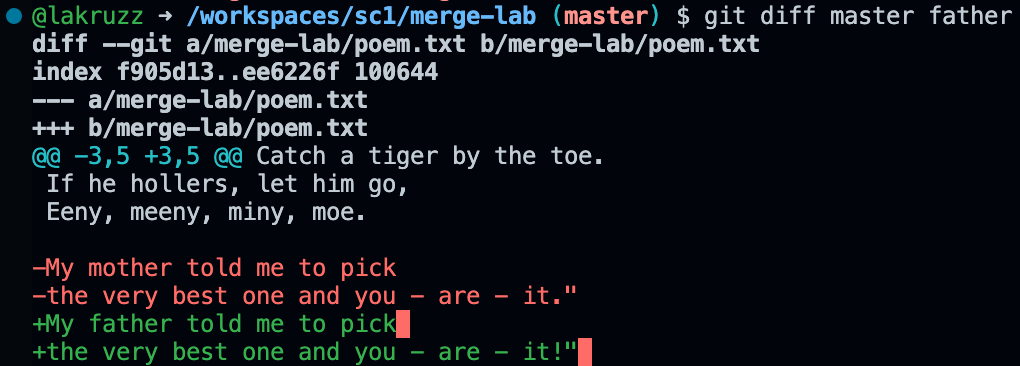
Now see the diff to
lionYou see?
master<>fatherdiff is shown as one diff of two lines.master<>liondiff is shown as two diffs each of one line.A subtle but important difference.
Wouldn't it be nice, if we had a git command like
git mergetestor perhaps a switch--dry-runswitch togit mergeHave a look at hit post on stack overflow: Is there a git-merge --dry-run option? Someone turned it into a nice alias
You can store it in your
.gitconfigfile if you want:...and then try it out:
Alright - there's apparently not escaping this manual merge, so let's get back to it - run this again:
And then fix the file in the editor - Use the merge editor. and when you have completet your work complete the merge of the file.
And then go back and run
You are done - If you merge had more conflicting files, you would have had to continue until all was settled.
OK Last one:
Again you get a conflict - but this one was expected!
Now wrap up!
Nice graphs by the way eh? They are made from MarkDown code too!